Native American tribe reclaims 900 acres of Yosemite National Park in California
Published in Science & Technology News
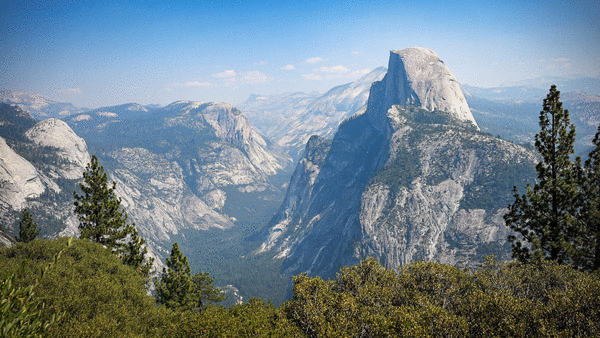
A Native American tribe that was displaced by the establishment of Yosemite National Park is getting part of its lands back.
The land transfer, from Pacific Forest Trust, is considered a major milestone for Indigenous cultural and land restoration in California.
In addition, the move could lead to better management and control of wildfires in and around the areas.
The South Sierra Miwuk Nation has reattained nearly 900 acres bordering Yosemite National Park — 175 years after the tribe was originally expelled from the lands.
The returned lands represent approximately 1.4 square miles of Yosemite National Park’s 1,169 square miles.
“Having this significant piece of our ancestral Yosemite land back will bring our community together to celebrate tradition and provide a healing place for our children and grandchildren,” said Southern Sierra Miwuk Nation’s Tribal Council Chair and elder Sandra Chapman. “It will be a sanctuary for our people.”
Southern Sierra Miwuk Nation are people indigenous to Yosemite and greater Mariposa County.
With nearby Yosemite National Park attracting 4 million visitors annually, the lands provide a large platform for public education of Indigenous climate-smart land stewardship.
Among them is the Southern Sierra Miwuk Nation’s traditional ecological practices of using fire to promote healthy forests.
Setting fires to control wildfires
The act of intentionally setting fires to lands was once regarded as primitive by early European settlers.
The U.S. government even passed in 1850 the Act for the Government and Protection of Indians that outlawed intentional burning in California even before it was a state.
By 1978, both the National Park Service and the Forest Service changed its policy on prescribed fires.
The California Department of Forestry and Fire Protection uses controlled burns to reduce fire intensity.
“When the Indian was on the land, the canopy was 40 percent or less open,” said Honorable Ron W. Goode, Tribal Chairman of the North Fork Mono Tribe, in an article published on the University of California website. “In that open space, a variety of plants, bushes, and smaller trees, like oak trees, were able to grow, as did plants still used today by native tribes for food, medicinal or cultural purposes.
“These varied landscapes were more resilient to fire; in today’s forests, once the crowns of the trees catch fire, a blaze spreads rapidly, using the tree canopy as a kind of deadly highway.”
Questions regarding who decides where the fire goes, what it burns and who is the stewart of a natural element, however, have remained contentious, according to a story from The Guardian.
The transferring of the lands located just west of Chinquapin/Badger Pass will allow the Southern Sierra Miwuk people who cared for Henness Ridge to once again practice its own cultural restoration of their forest lands.
The project will also facilitate movement across private-public corridors for plants and animals adapting to climate change.
“This transfer reunites our people to this unique area of our homeland after 175 years of displacement,” said Tara Fouch-Moore, Tribal Secretary. “We will be able to harvest and cultivate our traditional foods, fibers, and medicines and steward the land using traditional ecological knowledge, strengthening our relationships with plants and wildlife, and benefiting everyone by restoring a more resilient and abundant landscape.”
Land transfer details
Pacific Forest Trust acquired the lands two decades ago when vacation home development threatened the land. Since then, the organization prepared it for tribal return and restored 500 acres after the 2018 Ferguson Fire burned across the property.
The transaction closed this week and was funded by a California Natural Resources Agency Tribal Nature-Based Solutions grant.
This structure of giving lands back to Native Americans is viewed as a model for similar efforts statewide on how returning lands to Indigenous groups helps in the advancement for all.
The project also strengthens the Southern Sierra Miwuk tribe’s case for federal recognition that it’s pursued since 1982.
“Since 1982 the Southern Sierra Miwuk, aka American Indian Council of Mariposa County, have petitioned for federal acknowledgment,” the Southern Sierra Miwuk tribe posted on its website. “Our ancestors signed treaties in good faith with the federal government during the Gold Rush. These treaties were hidden away and left unratified leaving Southern Sierra Miwuk Nation and many California Indians landless.”
The transfer underscores Pacific Forest Trust’s longstanding commitment to working in partnership with tribal nations.
In the 1990s, the organization partnered with the InterTribal Sinkyone Wilderness Council to establish the first-ever conservation easement with tribal entities in the United States. That precedent helped pave the way for projects like Henness Ridge, where conservation and cultural restoration go hand in hand.
“When we were first approached to conserve this land over 20 years ago, we recognized immediately how important it was to protect and conserve,” said Laurie Wayburn, cofounder and president of Pacific Forest Trust. “As we’ve protected it from development, strengthened its role as a buffer to Yosemite, and prioritized both conservation and cultural restoration, this is an extraordinarily fitting and positive outcome!”
_____
©2025 The Fresno Bee. Visit fresnobee.com. Distributed by Tribune Content Agency, LLC.





Comments