Mark Gongloff: Extreme cold is a billion-dollar problem, too
Published in Op Eds
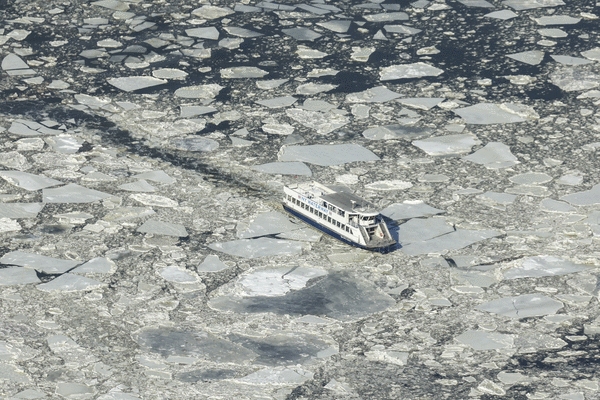
If you’re a climate-change denier in the eastern U.S., including the president, then the past few weeks have been a dream. It’s cold and snowy where I live, you might say, colder and snowier than in years. Therefore, climate change is a hoax, just as I’m always saying. Would I be able to hold this snowball otherwise? Check and mate.
Unfortunately, extreme spells of winter weather can still happen in an atmosphere made more chaotic by rising heat. The fact that a record-smashing summer heat wave is happening in Australia at the same time that a brutal winter cold is punishing the U.S. illustrates the point. And all these weather extremes endanger people and make them poorer, costs that will keep mounting the more we waste time pretending the problem doesn’t exist or hoping half-measures will suffice.
It’s no coincidence that, as temperatures have risen in this century, so has the damage from climate-fueled weather. The world has spent $20 trillion in the past 25 years cleaning up and insuring property after disasters, Bloomberg Intelligence estimates. That includes $1.4 trillion last year, a rare and merciful dip from 2024’s record $1.6 trillion, thanks in part to the U.S. avoiding landfall from a hurricane for the first time in a decade.
Those costs include not only hurricanes, floods and wildfires, but also deep freezes and winter storms. As you might expect, the latter two events don’t seem to have increased in frequency as the planet has become hotter. But they haven’t gone away.
For the past 40 years in the U.S., there have more or less consistently been one or two winter storms or freezes or both each year that are strong enough to inflict at least $1 billion in damage, according to the nonprofit group Climate Central. Sometimes these events inflict terrible death tolls and financial costs, as did 1993’s Storm of the Century and 2021’s winter storm Uri. But so far there’s been no consistent trend for either better or worse.
It’s true this winter’s assault on the U.S. has been unusually damaging, not long after Uri’s record-breaking $28 billion hit. Winter storm Fern, which affected more than half the people in the country and at one point resulted in about 1 million power failures, inflicted between $105 billion and $115 billion in total economic losses, private weather forecasting firm AccuWeather has estimated. That would make it the country’s costliest natural disaster since the California wildfires a year ago. A follow-up storm and deep freeze that dumped snow across the Southeast and froze citrus trees in Florida cost an additional $13 billion to $15 billion, according to AccuWeather.
All of this has been another boon to the companies in Bloomberg Intelligence’s Prepare and Repair index, which has beaten the S&P 500 this year and every year for the past five. Foot traffic to home-improvement stores on Jan. 23, just ahead of Fern, was up 41% from a year earlier, according to BI analyst Andrew John Stevenson. That helped Prepare and Repair stalwarts such as Home Depot Inc. make up for a slow hurricane season.
Of course, repeatedly buying plywood, sandbags and snowblowers and frantically hoarding French toast ingredients, as one does ahead of every storm, is no way to run a productive economy. Unless your business is disaster, disasters are generally bad for business.
One possible silver lining is that, contrary to whatever President Donald Trump might post on social media, cold weather truly has become less frequent in recent decades, particularly in the U.S. and other relatively northern places. For most of the world, the coldest days of the year are noticeably warmer than they were 50 years ago, Zeke Hausfather, a climate scientist at the nonprofit research group Berkeley Earth, wrote in the Climate Brink newsletter. Across the U.S., on average, there are 13 fewer below-freezing days each year than there were in 1970.
There is a theory that a hotter planet could make occasional wintry blasts more likely. For one thing, because the Arctic is heating more quickly than the middle of the planet, the temperature differential between the two, which helps keep the polar jet stream under control, is weakening. When the jet stream wobbles, it lets polar air invade lower latitudes. The jet stream also slows down under such conditions, meaning it doesn’t snap back quickly.
But climate scientists haven’t yet been able to demonstrate this convincingly. What the data do show is that U.S. cities have set four times as many record high daily temperatures this winter than lows, according to Climate Central. And snowpack in the western U.S. is at a record ebb, even after that January snowstorm. That means bare ski slopes and less water for the already strained Colorado River later this year.
Suffice it to say that, for now, a hotter planet hasn’t yet made winter storms obsolete even as it has made other natural disasters more frequent, or at least more dangerous. Deaths from cold weather may decrease as the planet warms but not disappear, while deaths from hot weather increase.
No matter the weather, then, we should be trying to keep the climate from becoming more chaotic while better preparing communities to handle the chaos already in store. The climate-change deniers setting policy in the U.S. are doing neither. Snowballs melt. The harm that will result from such malpractice will linger.
____
This column reflects the personal views of the author and does not necessarily reflect the opinion of the editorial board or Bloomberg LP and its owners.
Mark Gongloff is a Bloomberg Opinion editor and columnist covering climate change. He previously worked for Fortune.com, the Huffington Post and the Wall Street Journal.
©2026 Bloomberg L.P. Visit bloomberg.com/opinion. Distributed by Tribune Content Agency, LLC.

















































Comments