Editorial: Congress should make it harder to abuse the Insurrection Act
Published in Op Eds
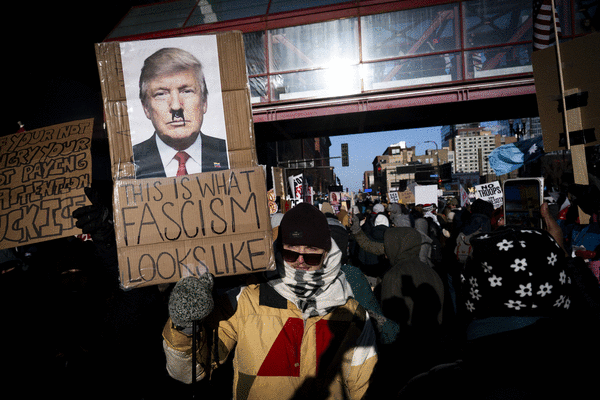
Even if the administration has temporarily backed off threats to invoke the Insurrection Act to quell protests in Minnesota, the idea will come up again. That’s partly because the power — which would allow the president to use active-duty troops to conduct domestic law enforcement — is dangerously vulnerable to abuse.
What’s known as the Insurrection Act is actually a set of statutes enacted by Congress between 1792 and 1871. Under certain conditions, they allow the president to circumvent the Posse Comitatus Act’s injunction against using the military for civilian law enforcement — say, if asked by a state for help in suppressing unrest, or if the White House deems that any insurrection or violence is preventing the exercise of federal laws. In the continental U.S., the act was invoked most recently in 1992, to restore order during the Los Angeles riots, and before that to enforce desegregation and civil-rights laws in the 1960s.
Examples are so rare largely because presidents — or their cabinet members — have shown restraint. The triggers for the law’s employment are remarkably broad and vague; they could theoretically allow the White House to call up the 82nd Airborne Division if two individuals were impeding its deportation campaign. Nothing in the act requires that it be treated as a last resort. It has no provisions for congressional or judicial review. While a 1964 Justice Department memo does narrow its focus, the current administration could simply revise that guidance.
Stronger guardrails would be in everyone’s interests. The military isn’t trained for these kinds of missions. (In one incident in 1992, when cops responding to a domestic violence incident asked Marines for “cover,” the troops responded by riddling the home with more than 200 bullets.) Even those inclined to agree with the administration’s description of protesters as “insurrectionists” should worry about lowering the bar for a future president to exploit such sprawling powers.
Former officials from both parties have been calling for reform for years. While Congress can debate specific language, the broad principles are clear. The triggers for invoking the act should be narrowed so that it’s clearly a tool of last resort, and updated to replace archaic and unclear terms. The president should consult with state officials first and explain the decision to Congress. Any deployment should be strictly time-limited; extensions should require congressional authorization.
Bills have been introduced to reform the act as recently as last summer. While achieving a veto-proof majority is unlikely under current conditions, Congress has shown itself willing to clarify other antiquated laws in the recent past. An open debate could usefully expose these issues to public scrutiny and remind the administration how controversial and counterproductive deploying the military would be.
No one is likely to welcome reform more than the troops themselves, the vast majority of whom have no interest in fighting partisan battles and being distracted from the mission of defending the U.S. against external enemies. If Congress wants to prioritize U.S. security, it will shield them from that possibility.
____
The Editorial Board publishes the views of the editors across a range of national and global affairs.
©2026 Bloomberg L.P. Visit bloomberg.com/opinion. Distributed by Tribune Content Agency, LLC.
















































Comments