Michael Hiltzik: Your stocks are slumping, but you probably can't blame Trump
Published in Op Eds
Tariff turmoil. Threats against Iran. An anti-immigration surge that has taken two innocent lives.
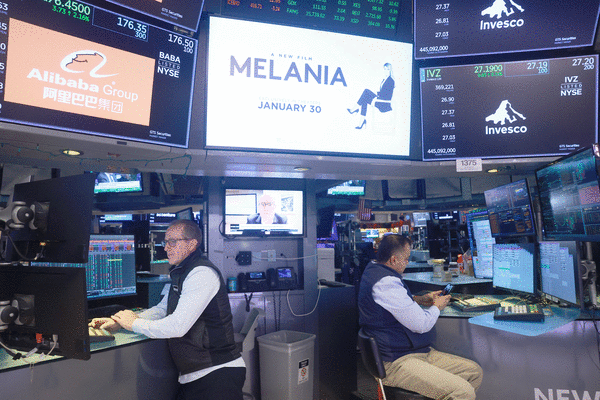
And there's a sizable slump hitting the stock, bond, precious metals and cryptocurrency markets.
What's the connection?
The answer is: Not much.
When it comes to Trump policies, investors have come to realize that Trump is often all talk, little action—that's the underpinning of the "TACO" trade, for "Trump Always Chickens Out," which I described in May.
As recently as Jan. 20, for example, the Standard & Poor's 500 index fell by more than 2% in a possible reaction to Trump's saber-rattling over Greenland and threat to hike tariffs on European countries he felt were thwarting his imperial ambitions.
The next day, the index began a comeback, rising nearly 1.2%. By three sessions later, it had recovered all that first day's loss. The index went on to set an all-time record on Jan. 27, one week after the Greenland sell-off.
The latest sell-off in the investment markets doesn't appear to be connected to Trump's policymaking. The current narrative blames artificial intelligence. There's an inchoate expectation that AI will have a great economic impact, though little of that has emerged thus far, and no one is very clear on what form it will take or even whether it will happen at all.
Investors and investment analysts don't really know what to make of AI. From reading the most recent market commentaries, one might conclude that investors are unnerved by the potential of AI to upend industries across the spectrum.
"For two years, we have been talking about how AI is going to change the world," Michael O'Rourke, chief investment strategist at Jonestrading, told Bloomberg. "In the past two weeks, we have seen signs of it in practice."
The evidence that most Wall Street pundits cite is the downdraft in technology stocks, including software companies that (according to the narrative) may lose their franchise to AI bots. The tech-heavy Nasdaq composite index has lost a cumulative 5.6% since notching a high on Jan. 28 and has lost 6.2% since its all-time intraday high, reached on Oct. 29.
Yet companies that are seen as winners in the AI derby, such as Google parent Alphabet (down 5.4% this week) and chipmakers AMD (down about 26% since its recent peak in late January) and Nvidia (down 7.5% in the last week), also have been caught in the downdraft.
Leaving the hard numbers aside, conjectures about the effects of AI on individual companies are exactly that — conjectures. The specific trigger of the current downdraft, it's said, was the release by AI company Anthropic of a tool with which law firms can use the company's Claude AI bot for tasks including document reviews and research.
Anthropic's announcement this week sent shares of legal publishing and legal technology companies plummeting. Thomson Reuters, the publisher of Westlaw, was among those most severely hit — down nearly 20% since the announcement.
Yet Anthropic's real impact on the legal publishing and tech businesses is, at this moment, the subject of sheer speculation. No one can say whether the AI firm will actually dislodge the incumbent providers, several of which already claim to be powering their services with AI.
The sell-off was driven by "a lot of unsophisticated investors just really thinking that AI is going to immediately overnight take away the business of these legacy players," Ryan O'Leary, a research director at International Data Corp., told Law.com. "A lot of this stuff has been offered for years from the legacy legal technology providers."
Much of the recent commentary is produced by investment mavens searching for explanations for market moves in recent news nuggets. That's always a mug's game. Investors are looking in the wrong place when they try to tie market swings to current events.
(I know whereof I speak, for I used to have the job of conjuring up just such explanations for a market story on a daily basis.)
My favorite investment guru, Barry Ritholtz, author of the 2025 primer "How Not to Invest," points out that the markets typically give back some portion of their gains after steep run-ups.
"Markets," Ritholtz wrote, "go up and down; it is easier to ride out a downturn when you realize the giveback is but a small percentage of the recent gains."
That may be what's happening now. The Standard & Poor's 500 index has lost about 43 points this year. But that's less than two-thirds of a percentage point, and it comes after the index turned in average annual gains of more than 23% from the start of 2023 through the end of last year. The Nasdaq composite has lost about 700 points this year, but that's about 3% of its value, and it comes after gaining 43.4% in 2023, 28.6% in 2024 and 20.4% in 2025.
This record evokes the classic remark of physicist I.I. Rabi at the 1954 hearing convened to consider stripping J. Robert Oppenheimer of his security clearance because of his opposition to developing the hydrogen bomb. After listing Oppenheimer's wartime accomplishments, including overseeing the invention of the plutonium bomb, Rabi asked the inquisitors, "What more do you want, mermaids?"
Stocks and bonds aren't the only investment showing signs of exhaustion after a period of sizable gains. Bitcoin traded as high as $97,916 on Jan. 13; on Thursday it traded at about $63,426. That's a loss of more than 35% — but then, bitcoin is notoriously volatile.
None of this means that the investment markets' performance is always driven by animal spirits. Real-world events can have significant and sometimes lasting effects. But those events tend to be intrinsic to business rather than externalities such as White House maneuvers or geopolitics.
Consider what happened to the Dow Jones industrial average on Jan. 27. That day, shares of the giant healthcare company UnitedHealth lost nearly 20% of their value due to as a weak earnings report, along with the Trump administration's plan to limit rate increases for Medicare Advantage plans, an important component of UnitedHealth's business, next year. The company's plunge brought down the Dow by more than 400 points, or 0.8%.
But the Dow comprises only 30 companies, weighted by share prices, so a sharp change in an expensive stock can exert strong pressure on the average. But the rest of the market took the news in stride, with the S&P 500 riding a gain of about 0.4% to an all-time high.
It's also true that the markets aren't entirely immune to Trump's policies. The problem is that investors and market outsiders often take him at his word, when he's merely throwing out options, and thus overreact. Investors tend to take Trump's tariff threats as done deals, when in the final analysis he has chickened out.
Expectations that the tariffs would drive inflation much higher, for instance — an eventuality that might actually have a genuine effect on the economy and therefore on market values — haven't been borne out. But the reason, notes Paul Krugman, is that "effective tariff rates have risen much less than headline rates."
That's because some countries and some businesses have negotiated carve-outs from the official rates. Despite Trump's blustering, more than 87% of the value of exports from Canada and Mexico still enjoy tariff exemptions under the U.S.-Mexico-Canada Agreement of 2018, which Trump, after all, negotiated and signed.
And Trump does have the power to turn his whims into reality, in ways that could have real-world effects on society and the economy.
All that can be said right now is that hasn't happened yet. But many of his policy pronouncements remain so nebulous and unrealized that if you're looking for why the stock market has been in a slump, you would be well advised to look elsewhere.
____
©2026 Los Angeles Times. Visit at latimes.com. Distributed by Tribune Content Agency, LLC.
















































Comments