SpaceX resupply mission to International Space Station set for Sunday
Published in News & Features
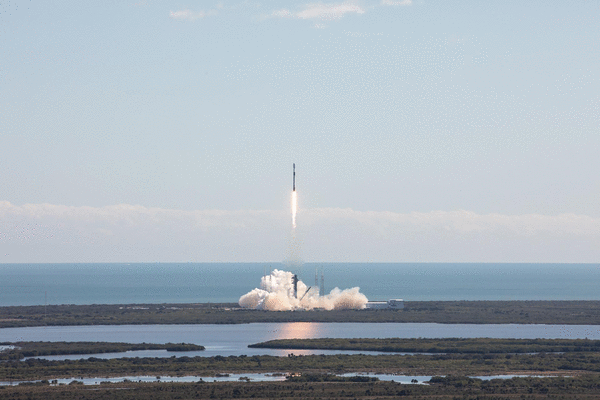
ORLANDO, Fla. — SpaceX is lending a hand once again to Northrop Grumman to fly its Cygnus spacecraft on a resupply mission to the International Space Station, a launch slated for Sunday morning that also features a booster return that could bring a sonic boom to parts of Central Florida.
A Falcon 9 with the Cygnus XL carrying 11,000 pounds of supplies and science is slated to lift off from Cape Canaveral Space Force Station’s Space Launch Complex 40 at 10:47 a.m. Sunday with a backup Monday at 10:24 a.m.
Space Launch Delta 45’s weather squadron forecasts a 75% chance for good conditions, with the primary concern of thick clouds. Conditions worsen if delayed to Monday or Tuesday with both days only sporting a 30% chance for good conditions as a front moves across the state.
The first-stage booster for this flight is making its ninth trip to space and will attempt a recovery landing back at the launch site at Landing Zone 40.
The return about eight minutes after liftoff prompted SpaceX to issue a sonic boom advisory, which means residents in Brevard, Orange, Osceola, Indian River, Seminole, Volusia, Polk, St. Lucie, and Okeechobee counties “may hear one or more sonic booms during the landing, but what residents experience will depend on weather and other conditions.”
For Northrop Grumman, the flight with SpaceX continues its reliance on its competitor as its own Antares rockets remain on the shelf. This mission, CRS-25, is the third flight of the larger Cygnus XL spacecraft. Northrop Grumman and SpaceX with its cargo Dragon spacecraft are the two commercial resupply providers for NASA. SpaceX has one more Falcon 9 set aside to support Cygnus, so the new Antares 330 rocket, which Northrop Grumman has been developing with partner Firefly Aerospace, likely won’t be available until later in 2027.
As far as Cygnus, it was first developed by Orbital ATK, and had its first mission in 2013. Over 13 years, it has delivered more than 169,000 pounds to the station.
Unlike Dragon, which makes returns to Earth, the Cygnus spacecraft eventually is released to burn up in the atmosphere, usually filled with trash.
NASA astronauts Jessica Watkins and Luke Delaney, who hails from Central Florida, will be on board the space station to grapple Cygnus when it arrives using the Canadarm2 and affix it to the station’s Unity module on its Earth-facing port.
The spacecraft has been commemoratively named the S.S. James “Jim” A. Lovell, the commander of Apollo 13 who also flew on Apollo 8, Gemini VII and Gemini XII.
Among the food arriving on board are treats for the holiday season.
As far as science, the payloads headed to the station include those “aimed at improving drug delivery for cancer and osteoarthritis treatment, predicting cancer spread, advancing treatments for muscle loss, improving radiation sensing, and supporting food production for future long-duration missions,” according to a NASA press release.
This would be the 62nd launch from the Space Coast in 2026, with all but eight flown by SpaceX.
Six have come from United Launch Alliance, one from Blue Origin and one from NASA with its Space Launch System topped with the Orion spacecraft on the historic Artemis II flight around the moon.
It’s far short of the record 109 launches, also led by SpaceX, that occurred in 2025. It’s a combination of problems with some of the launch providers flying on the Space Coast and a refocus of SpaceX to its in-development Starship program.
ULA’s launch earlier this month saw its Vulcan rocket suffer issues with its first-stage booster that ultimately led to the loss of its payload for Amazon. ULA has only six Atlas V rockets left, all set aside for Boeing’s Starliner, so it’s uncertain when ULA will fly again as the company works to figure out what went wrong with Vulcan, which is the company’s replacement for Atlas V and the already-retired Delta IV family of rockets.
Blue Origin has not flown since its launch pad at Canaveral’s Launch Complex 36 suffered major damage during a rocket test hot fire in May that SLD 45 commander Col. Brian Chatman said was the largest explosion ever seen on the Space Coast. Jeff Bezos’ company had been trying to get the pad repaired before the end of the year but recently pushed plans to return to flight of its New Glenn rocket to late January.
NASA’s SLS won’t fly again until Artemis III, slated for summer next year. The rocket recently completed its stacking at Kennedy Space Center’s Vehicle Assembly Building, minus the Orion spacecraft, and what NASA calls the “short stack” version will be rolled out to Launch Pad 39-B for testing in the coming months.
SpaceX, meanwhile, has one more Falcon Heavy launch upcoming, a mission to send Voyager Technologies’ lunar lander Griffin to the moon. NASA officials said earlier this month the first launch window closes in early January and teams were still pushing to get it ready for that flight, which would launch from KSC’s Launch Pad 39-A.
Adjacent to that pad is SpaceX’s nearly complete Starship and Super Heavy launch tower, which is pushing to get ready for what would be the first launch of the world’s most powerful rocket in the coming months.
Next year could see the return of New Glenn to regular launches, though, as well as ULA’s Vulcan if the company can solve that rocket’s issues. Also expected is the debut launch of Stoke Space’s Nova Pathfinder rocket from Canaveral’s historic Space Launch Complex 14, the same complex from which John Glenn flew his historic Mercury mission in 1962, becoming the first American to reach orbit.
And Relativity Space, which flew its smaller Terran 1 rocket from the Cape in 2023, looks to return with the larger Terran R from Canaveral’s Launch Complex 16.
©2026 Orlando Sentinel. Visit orlandosentinel.com. Distributed by Tribune Content Agency, LLC.






Comments