Trump's treasured negotiating edge dulled by tariff defeat
Published in News & Features
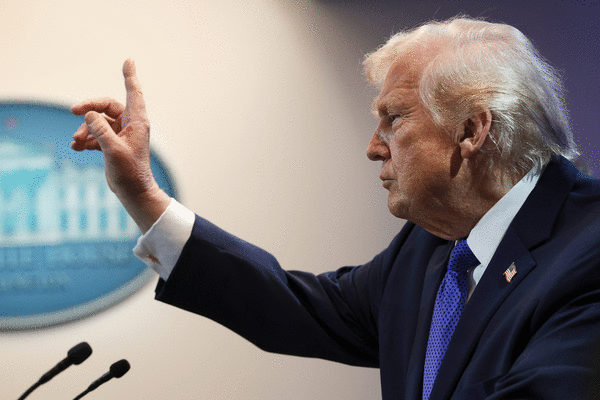
With the stroke of a pen, the Supreme Court wreaked havoc on President Donald Trump’s favorite method of wielding leverage over other countries.
The justices’ landmark ruling Friday striking down the administration’s global tariffs marks a significant blow to a president who relishes exerting unilateral power to achieve his goals — something he did virtually unchecked during his first year in office. Trump quickly announced plans to reimpose the duties, but the other means available to him are far less nimble.
“It’s one of the most important moments of the presidency so far,” said Josh Lipsky, who leads international economics work at the Atlantic Council, a Washington think tank.
Tariffs imposed under an emergency powers law “have been the primary economic weapon the president has leveraged to remake the global trading system.” The question now, Lipsky said, is “can you rebuild it in aggregate?”
As the White House regroups, the ruling has immediate implications for Trump’s planned meeting with his counterpart Xi Jinping in China, in which the two were expected to extend a tariff truce reached last year. Beijing will come into the discussion with a strengthened hand, and could make Trump’s expected demands for large purchases of American goods, Boeing Co. aircraft and energy exports a tougher sell.
Wilbur Ross, who served as Trump’s Commerce Secretary during his first term, said the president’s alternatives all contain “drawbacks” that “limit” the scope of his powers.
“What all of them will do is give him less negotiating power with all these countries, particularly with China,” he said in an interview.
It also raises the stakes for Tuesday night’s State of the Union address, which the president has already said would tout his economic agenda. Trump may be forced to recalibrate his message now that his signature policy has been thrust into chaos.
Fearful of having his power clipped, Trump has spent months openly begging the court to keep the levies in place, declaring that the president “has to be able to wheel and deal with tariffs.” He has credited the tariffs — or the threat of them — for pressuring foreign leaders to the negotiating table to rectify trade imbalances and even stop armed conflicts.
But the court — controlled by a conservative majority, including three justices Trump appointed to the bench — did not bow to his entreaties.
The message from the majority opinion was clear: “The Framers gave ‘Congress alone’ the power to impose tariffs during peacetime,” it states. “And the foreign affairs implications of tariffs do not make it any more likely that Congress would relinquish its tariff power through vague language, or without careful limits.”
The blow comes amid a perilous stretch for the White House, with Trump facing criticism over his threats to acquire Greenland, violent actions by immigration officers and the fallout from the Jeffrey Epstein files.
After the ruling, Trump flashed anger at a White House press conference, claiming that “foreign countries that have been ripping us off for years are ecstatic.”
Indeed, a senior European official described their reaction to the ruling as schadenfreude, and argued it showed that the U.S.’s system of checks and balances still seems to work.
Trump that day announced his plan to impose a 10% global tariff for as much as five months to buy time to enact duties under other authorities. By Saturday morning, he said he was raising it to 15% while again assailing the high court as “anti-American.”
Those alternatives face limitations. Section 122 of the Trade Act allows the baseline rate, but only for a maximum of 150 days. The other powers, Section 301 and Section 232, permit the president to unilaterally impose tariffs but only following investigations that typically last months.
Asked if his power will be undermined by this decision, Trump predicted “in the end I think we’ll take in more money than we’ve taken in before.” Still, he acknowledged the process was going to be “a little more complicated than what we had.”
Trump said some of his negotiated trade deals would stand and some would be replaced by the other duties. A White House official later said that the 10% rate would apply to all countries with agreements while new authorities are worked out.
Trump’s first year back in office involved a series of contentious negotiations following his April 2 tariff announcement, in which the specter of losing access to the lucrative U.S. market loomed large if leaders refused to agree to his demands. But with his tariff authority curtailed, Trump’s counterparts may be less compelled to give up difficult concessions. That could change the tenor of ongoing trade negotiations with the European Union and other major economies.
Moreover, the ruling serves as a rebuke of the president’s favorite economic initiative just months before midterm elections expected to hinge on the cost of living. Frustrations with the White House are rising among Republicans as they stare down the possibility of losing their narrow House majority. Already, a cluster of GOP representatives recently broke with their party to back legislation aimed at ending Trump’s tariffs on Canadian goods.
Some six-in-10 Americans said they disapproved of Trump’s tariffs, and about half said the president’s policies have made the economy worse, according to a Pew Research Center poll released earlier in February.
Foreign backlash
At the same time, Friday’s decision gives the administration the opportunity to recalibrate its tariffs in a way that might provide a reprieve to American consumers. Trump recently exempted some key products, in what many saw as an acknowledgment that adjustments were needed to soften prices.
A 10% global duty could raise the average effective U.S. tariff rate to 16.5% from 13.6% under his previous levies, or lower it to 11.4% if current exceptions are maintained, according to Bloomberg Economics estimates.
Several officials in foreign capitals crowed that the ruling vindicated their long-running complaints about Trump’s protectionism. Dominic LeBlanc, the Canadian minister responsible for U.S. trade, said the decision showed the tariffs were “unjustified” and added that “critical work lies ahead” to shield his country’s products from other levies.
Ahead of the opinion, Trump cast the decision in existential terms as he beseeched the justices to decide in his favor. Last year, he said an appeals court ruling that the tariffs were illegal “would literally destroy the United States of America” if allowed to stand.
Trump’s threats
Trump is still likely to use other tools to back up his threats. He has found other ways to flex U.S. muscle globally, as evidenced by his recent demand to acquire Greenland or his buildup of U.S. military forces near Iran.
One European diplomat described the court decision as merely a symbolic victory for U.S. trading partners, in large part because of Trump’s impending moves to reimpose tariffs through other means. The administration expects countries that have entered into trade frameworks to honor their deals, a White House official said.
“It’s always good news when tariffs are removed, but I don’t think there will be any major changes,” Italian Foreign Minister Antonio Tajani said, according to the newswire Ansa.
While the administration has reached trade understandings with many foreign governments, some negotiations have dragged on for months. The EU and U.K., for example, are still seeking to iron out the fine print of their deals.
During his decades in politics and business, Trump has long relished employing leverage against his negotiating partners. In his book "The Art of the Deal," he writes: “The best thing you can do is deal from strength and leverage is the biggest strength you can have. Leverage is having something the other guy wants. Or better yet, needs. Or best of all, simply can’t do without.”
Trump has touted billions of dollars the tariffs have collected for the U.S. Treasury, pledges from countries to buy American goods and commitments from Japan, South Korea and others to invest hundreds of billions of dollars in the U.S. He has also used the threat of tariffs to exert diplomatic pressure on his counterparts, including by strong-arming India into curbing purchases of Russian oil.
Treasury Secretary Scott Bessent predicted Friday tariff revenue would remain “virtually unchanged” in 2026 as a result of the alternatives Trump is pursuing. But during a speech in January, he argued that harm could still be done by an adverse court ruling.
“What is in doubt, and it’s a real shame for the American people, was the president loses flexibility to use tariffs both for national security, for negotiating leverage,” he said.
———
(With assistance from Erik Larson, Jennifer A. Dlouhy, Donato Paolo Mancini and Samy Adghirni.)
©2026 Bloomberg L.P. Visit bloomberg.com. Distributed by Tribune Content Agency, LLC.




Comments