'A war room': Inside Epstein's campaign to influence public opinion
Published in News & Features
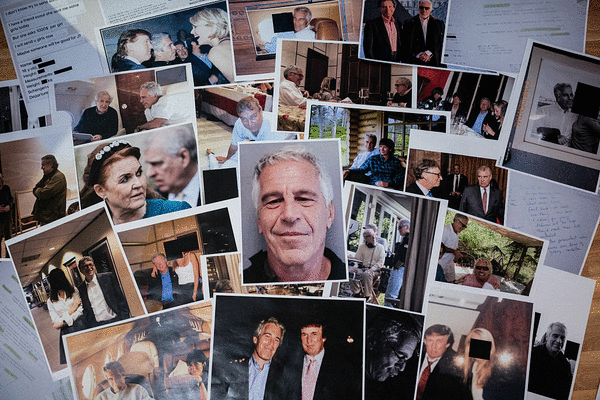
In the winter of 2018, Jeffrey Epstein was afraid his world was crashing down.
The disgraced financier had spent millions of dollars over the previous decade rehabilitating his image after pleading guilty to solicitation charges in a Florida state court in 2008.
But a 2018 Miami Herald investigation documenting his crimes — and how he and his high-powered legal team evaded more serious charges — had led to renewed public outcry and political pressure to re-investigate him.
Epstein turned to a group of some of his closest confidants to help him counter the public narrative that was forming against him.
The advisors included former Obama White House deputy counsel Kathyrn Ruemmler; far-right provocateur Steve Bannon; former U.S. Solicitor General Ken Starr; journalist Michael Wolff; and left-wing academic Noam Chomsky.
Their goal as Bannon put it in a text message to Epstein: “(C)rush the pedo/trafficking narrative; then rebuild your image as philanthropist.”
In the weeks and months leading up to Epstein’s arrest on July 6, 2019, the team brainstormed public relations strategies, gave Epstein media training, checked in on his well-being and offered him words of support.
In at least some of their eyes, it was Epstein — and not the women and girls he had exploited — who was the real victim and the press was unfairly targeting him.
“Reality has been rewritten,” wrote Wolff in a missive to the financier on Dec. 1, 2018.
Epstein and his associates’ efforts failed.
But they highlight how some of the most influential figures in American society closed ranks and attempted to protect him from social consequences a second time.
The Herald’s reporting is based on the millions of pages of records released by the U.S. Justice Department last month to comply with the Epstein Files Transparency Act, which was passed last year.
Wolff told the Herald in a statement that he believed the Herald’s series “largely reflected the views of the attorneys for the Epstein plaintiffs, and that Epstein, if he believed that view was wrong, should make his own case to the public.”
A spokesperson for Ruemmler said she knew Epstein through her work as a criminal defense attorney and was “friendly in that professional context.”
“Ms. Ruemmler has deep sympathy for those harmed by Epstein and if she knew then what she knows now, she never would have dealt with him at all,” the spokesperson said. “She was not his defender. She never advocated on his behalf with any third party – not the press, not a court, not a government official.”
Neither Chomsky nor Bannon responded to the Herald’s request for comment. Starr passed away in 2022.
‘Humanizing the image of a monster’
Wolff emailed Jeffrey Epstein on the evening of Nov. 28, 2018 — the day the Herald published its investigation — asking if he was receiving a lot of questions or criticism about the revelations.
“Let me know if there’s anything I can do,” he wrote. He followed up the next day with the draft of a short statement Epstein could use.
Starr emailed Epstein the same day asking if he should grant the Herald’s request for an interview. Epstein connected Starr with Ruemmler — to whom he had already complained about the story — and asked him to “agree (on) some bullet points” with her before speaking to any reporter.
Epstein thought laying low was the best option but was being pressured to comment by some of his associates who were facing questions.
“I keep receiving phone calls from friends asking that I say something so that they [can] use it to defend themselves,” he wrote to Ruemmler.
Epstein was adamant that he had received an appropriate penalty and said he believed the women the Herald’s story highlighted were not victims but sex workers, email exchanges show. In one message, Epstein even compared them to Jussie Smollett, an actor who claimed to have been a victim of a hate crime in 2019 that police later determined he had staged.
Both Ruemmler and Wolff warned that the age of the women — they were young and some minors — meant that public outrage wouldn’t be quelled by any legal argument. Ruemmler also warned Epstein about the legal ramifications of any response from him: “[N]othing short of a full and complete mea culpa is worth doing, and legally you can’t do that — at least not now.”
Wolff suggested bringing Bannon onboard on Dec. 1. The two men and Ruemmler agreed that they needed an overall strategy and to “game out everything” instead of a “piecemeal response.”
“You need someone to coordinate the decision matrix,” Wolff wrote to Epstein two days later. “It’s a running analysis, a war room.”
A few days later Epstein also asked Chomsky for his advice.
“These things have a half-life,” Chomsky wrote back. “Just stay above the furor, wait it out, go on with what matters.”
In subsequent weeks and months, Epstein discussed several options with his band of confidants — asking Starr to write an editorial piece defending him; getting an independent group or judge to investigate the accusations to “separate truth from fiction”; and having a Federalist Society member author an article in his favor.
The records show he also considered taking what he said was his friend filmmaker Woody Allen’s advice to do an interview with Wolff which Allen would edit; offering Julie K. Brown, the author of the Herald series, an interview and releasing an “apology alongside clearly setting the facts straight”; establishing a “mental health center for sex workers” and sending a delegation of Starr, Ruemmler and attorney Alan Dershowitz to meet then-Sen. Ben Sasse, a Nebraska Republican, who had been a vocal critic of Epstein’s South Florida plea deal.
“I’m trying to humanize the image of a monster,” Epstein wrote to Ruemmler in February, 2026.
He finally settled on two avenues: financing a documentary made by Bannon that would tell his side of the story and publishing an opinion piece in a major newspaper.
Bannon’s film would highlight, in Epstein’s words, the “hypocrisy of the liberal left.” It would feature interviews with scientists and academics whose work had benefited from his donations. Epstein thought he could even get some of “the girls” to go on record in his favor.
In late-December 2018 Epstein shared the draft of an op-ed with Ruemmler, Wolff and Chomsky. His plan was to potentially submit it to the Washington Post with one or more of his attorneys listed as an author, the records show.
Ruemmler and Wolff offered some edits. Chomsky suggested he should “develop a thick skin” and just ignore the press and the public outrage.
The article never saw the light of day.
But the New York Times did publish a letter defending Epstein’s plea deal signed by his attorneys Starr, Martin Weinberg, Jack Goldberger and Lilly Ann Sanchez in March 2019.
Epstein shared the article with numerous people on his contacts list, the records show.
It is unclear whether Bannon’s documentary was ever finished.
Epstein never met with Brown or anyone else at the Herald.
With friends like these
The records show that Epstein corresponded with many of his friends about the Herald’s reporting.
Some offered support.
“This cannot be fun. My heart goes out to you,” evolutionary biologist Robert Trivers wrote in an email the day after the first Herald story published.
The same day, Landon Thomas Jr., then a financial reporter at the New York Times, asked Epstein how he was “holding up.”
“Someone alerted me to the Miami herald [sic.] hit piece,” Lawrence Krauss, a theoretical physicist, wrote in a text message a few days later. “We are hoping that it is mostly bluster and that you are holding up well.”
Krauss, a Canadian-American, is a long-time Epstein associate who himself has been accused of sexual misconduct at Arizona State University.
Krauss told the Herald that he only knew Epstein through events like “salons with interesting speakers or scientific meetings.”
“None of the communications with Epstein relate in any way to the horrendous crimes he was accused of in 2019,” he said. “I was as shocked as the rest of the world when he was arrested.”
Krauss did not respond when the Herald sent him a follow-up request to review the record of his message to Epstein just days after the 2018 series and months before his arrest.
The Herald was not able to immediately reach Thomas Jr. and Trivers.
Epstein also turned to others for additional advice.
In February 2019, Epstein asked former Treasury Secretary Larry Summers for his thoughts on responding to the reporting. Summers, who was also formerly the president of Harvard University, advised Epstein against saying anything publicly.
Summers did not respond to questions the Herald sent to his spokesperson.
But Epstein’s associates and well-wishers, the records show, did not always agree with each other.
Wolff, for instance, did not think a video of him interviewing Epstein — an idea that Epstein claimed was Woody Allen’s — was going to work.
Ruemmler had apprehensions about Epstein employing crisis management experts suggested by Bannon.
“Steve’s people are, shall we say, kind of out there,” Ruemmler wrote in a missive to Epstein.
Epstein himself had a non-disclosure agreement drafted for Bannon’s crew before they could film anything.
Epstein also initially raised doubts about the optics of having Starr be the face of his defense, the records show. He pointed out to Ruemmler that Starr had been accused of failing to properly investigate sexual assault allegations while he was President of Baylor University in Texas.
But despite their misgivings, Epstein’s friends still banded together to help shield him.
“We will get you through this storm,” wrote Ruemmler in a late-February 2019 email.
Epstein was arrested on July 6 that year. Roughly a month later, he was found dead in his cell at a federal detention facility in Lower Manhattan.
_____
©2026 Miami Herald. Visit miamiherald.com. Distributed by Tribune Content Agency, LLC.




Comments