This fairy-tale coastal town has long avoided street addresses. Those days are numbered
Published in News & Features


CARMEL-BY-THE-SEA, Calif. — City Hall in Carmel-by-the-Sea soon could have this address: 662 Monte Verde St.
Seems pretty standard, right? Not in this wealthy little town on the Monterey Peninsula that has never had street addresses.
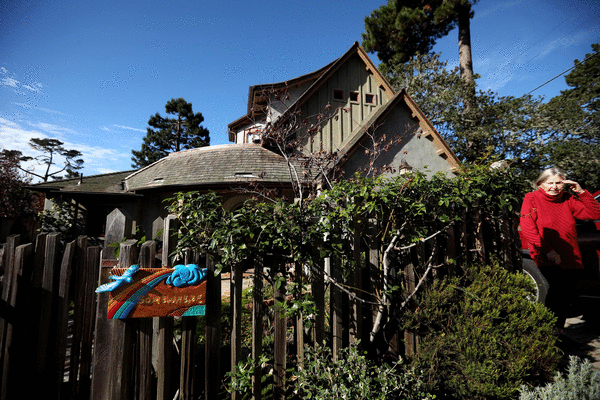
For 109 years, residents have used directional descriptors — City Hall is on the east side of Monte Verde Street between Ocean and 7th avenues — instead of building numbers. And they have given their homes whimsical names such as Sea Castle, Nut House and A Turn of Fraise.
But this spring, every government building, business and house in the town of 3,200 people will be assigned a number. After decades of debate, city officials this month released a draft map of the one-square-mile town with proposed addresses, which could be implemented as soon as May.
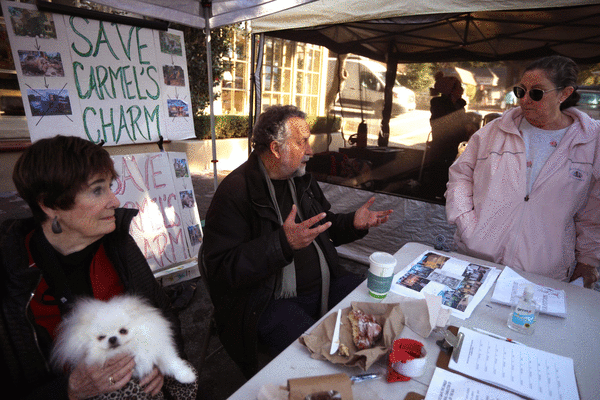
The address issue has long been contentious in artsy Carmel-by-the-Sea, where residents once threatened to secede from California if they were forced to number their homes. They argued that the lack of addresses — along with other quirks, such as having no streetlights or sidewalks in residential areas, leading many to walk at night with flashlights — added to the vaunted "village character."
But the complaints about missed packages and mail-order medications, as well as trouble setting up banking accounts and utilities, kept piling up. And in the aging community — where the median age of 69 is nearly double that of the state as a whole — there have been growing fears about emergency responders being unable to find people in the midst of a crisis.
Plus: The California Fire Code requires buildings to have and display addresses. Carmel-by-the-Sea has long been out of legal compliance.
Even the "reluctant traditionalists" have mostly come around to the reality that "we just have to do this," said Nancy Twomey, a member of the Address Group, a committee of citizens and city officials formed last year to research address implementation.
Changing the century-old system has been a lot of work. The Address Group, Twomey said, has done extensive community outreach and met with city and Monterey County officials, utility companies, U.S. Postal Service representatives, police officers, firefighters and more.
"We've got to be sensitive in this work and preparation to those who are holding on to tradition really tightly as well as those who are really looking forward to the convenience that comes with this implementation," Twomey said.
To strike that balance, residents still will be encouraged to name their homes "because that's a quirky Carmel thing," said Twomey, who lives in a home dubbed Seashell. (When she moved to Carmel in 2017, Twomey abided by another local tradition: Keeping the name bequeathed to the house by previous owners.)
Twomey said the draft address map released Jan. 13 still must be formally approved by city and county officials. Some quirks, such as how to deal with corner houses that have doors on multiple sides, are still being evaluated, she added.
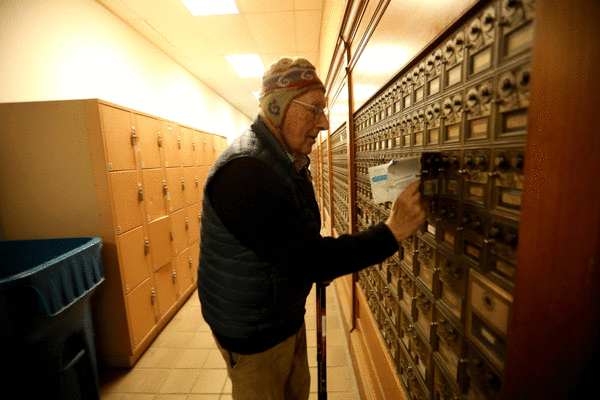
Carmel-by-the-Sea has no home mail delivery. Locals pick up their parcels at the downtown post office, where, locals say, serendipitous run-ins with neighbors are an essential part of the small-town charm.
Some opposed to addresses worried they would lead to home mail delivery and trigger the closure of the post office.
In a December presentation to the City Council, Emily Garay, a city administrative analyst, said the new addresses will not lead to home delivery. Residents will keep their post office box numbers and continue to pick up mail at the post office.
During public comments at that meeting, Karen Ferlito, a former City Council member, said the building numbers were long overdue.
Ferlito said she recently tried to order a watch, and the first two deliveries never arrived. During the third attempt, she said, "my husband sat at the end of our driveway all day long, with a sign and a flag to show where we lived."
When she was on the council, she said, one man used to come to "virtually all of the meetings," and his request was that "he just wants to die peacefully at his house ... knowing that someone would find him if he was in trouble."
"With over half of our residents age 65 or older, [and] no streetlamps, our aging population faces unacceptable risk during nighttime emergencies," she said. "We can't wait for tragedy to force our hand."
Carmel-by-the-Sea has long had its own dispatch center, with workers trained to decipher people's descriptions of where they live, former Police Chief Paul Tomasi told The Times in 2024.
That year, Tomasi explained to the City Council that if someone in town calls 911 for a police emergency, the Police Department can immediately dispatch an officer. But for a fire or medical emergency, he said, the local dispatcher calls a Monterey County dispatcher and has to explain where the caller is.
"If you have a medical emergency or a fire and you need that service, you're essentially calling 911 twice, which slows the response," he said, adding that the process would be "much quicker" with standard addresses.
In an interview Wednesday, Ian Martin, a former member of the city's Planning Commission who grew up in the area, said he had mixed feelings about finally getting an address. He lives in a dwelling nicknamed Jelly Haus, a moniker chosen by his daughter when she was about 5 years old.
"I just love that Carmel has been and continues to be this place out of time that defies the traditions and expectations of Anywhere, USA," Martin said. "So, I am sad on that level to see that tradition go by the wayside. That said, I have undergone heroic battles with utility companies and banks, trying to get them to find me."
Martin said he applied for a loan a few years ago and had to spend hours on the phone with the bank, trying to "convince them that I live in a real town with real locations." And his family eventually started having packages sent to his mother's house in nearby Carmel Valley, an unincorporated community with standard addresses.
"I can see both sides of this thing," he said of the address issue. "I do get wary of anything that homogenizes us."
But, he said with a laugh, his now-15-year-old daughter who loves to shop online is thrilled.
©2026 Los Angeles Times. Visit at latimes.com. Distributed by Tribune Content Agency, LLC.





Comments