Europe returns focus to Ukraine after fractious week with Trump
Published in News & Features
Europe is ready to get back to work with the United States, wary, frustrated and knowing it can’t trust an ally it’s relied on for decades.
With Donald Trump’s threats to seize Greenland off for now, European Union leaders at an emergency summit in Brussels on Thursday said the bloc should now return to a to-do list that was already long before the U.S. president nearly brought the transatlantic alliance to its knees.
His latest demands scarred the relationship, they said. But, practically speaking, Europe can’t ditch the U.S. economically or otherwise. It still needs U.S. trade, financial flows, energy, protection and, most pressingly, American security guarantees for Ukraine.
“There is certainly no reason for any kind of excessive optimism,” said Polish Prime Minister Donald Tusk. “But very serious tasks still lie ahead of us, and we have wasted some time.”
“I really hope that we can now get back to serious discussions,” echoed Swedish Prime Minister Ulf Kristersson.
First up is a nearly finalized trade deal between the two sides, which was put on hold earlier this week as Trump demanded that EU and NATO ally Denmark hand over Greenland, one of its territories, threatening tariffs on European countries that opposed him.
Trump’s reversal, which came late on Wednesday after a meeting with NATO Secretary-General Mark Rutte, was enough to justify restarting the ratification process, European Parliament President Roberta Metsola said on Thursday.
“Our focus must now be on moving forward on the implementation of that deal,” European Council President Antonio Costa said after Thursday’s meeting.
More complicated will be Ukraine.
Before Trump’s Greenland ultimatum, much of Europe’s focus had been on drafting a peace deal framework with Ukraine and the U.S. Officials were making progress on one of the most sensitive issues — pledges from Washington to protect Ukraine if Russia should invade again.
Trump has swerved constantly on the subject, but European allies finally seemed to get the White House to make firm commitments at a meeting in Paris in early January. Then the Greenland crisis took over.
Several EU leaders implored their colleagues to return Ukraine to the top of the agenda, just as U.S. envoy Steve Witkoff and Trump’s son-in-law Jared Kushner began late-night talks with Russian President Vladimir Putin in Moscow.
“It cannot be the case that, through both necessary and unnecessary turmoil and emotions, Ukraine is pushed into the background,” Tusk said. “We will need to persuade our American friends and all Europeans to refocus on what is fundamental to our security.”
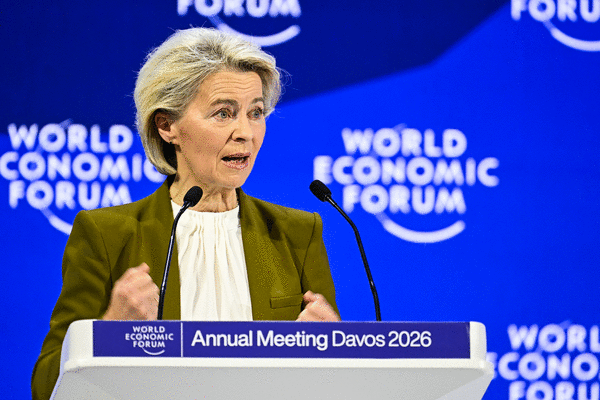
With this in mind, European Commission President Ursula von der Leyen, the EU’s top executive, touted a post-war “prosperity” package for Ukraine that was being drawn up with the U.S. And she recalled that the EU has given €193 billion ($227 billion) to Ukraine over the past four years, plus a recent €90 billion loan.
“What we can do is stand by their side,” she said. “I think the figures speak for themselves.”
Her remarks came just hours after Ukrainian President Volodymyr Zelenskyy tore into his European allies during a speech at the World Economic Forum in Davos, Switzerland.
“Europe loves to discuss the future but avoids taking action today,” a visibly angry Zelenskyy told the audience. “Where is the line of leaders who are ready to act?”
The admonition was particularly pointed after a week in which the EU rushed to unite against Trump as he openly contemplated grabbing territory from one of their members.
While their tone differed, EU leaders mostly agreed that this was a moment to draw a line in the sand and swiftly drew up retaliation plans.
Within a few days, the EU was prepared to trigger €93 billion in counter-tariffs if Trump followed through on his economic threat. There was even mounting support for deploying a powerful, never-used trade tool, the anti-coercion instrument, which could empower the EU to punish U.S. tech giants or bar American companies from public contracts.
“We need to face reality,” Spanish Prime Minister Pedro Sanchez said Thursday night. “The government of the U.S. is not respecting international law and is provoking tension in the transatlantic relation between the USA and EU like never before.”
EU leaders and officials argued that this rapid and collective response, combined with sharper-than-normal rhetoric toward Trump, helped pressure the U.S. president to stand down.
Von der Leyen summed up the approach as “firmness, outreach, preparedness and unity. And it was effective, so going forward we should maintain this very approach.”
But while that worked this time — likely with some help from the sinking markets and unusually strong Republican opposition — there are no longer any guarantees with the U.S., leaders cautioned. That means Europe must also accelerate plans to stand on its own if it comes to that.
“There is a good outcome,” said German Chancellor Friedrich Merz. “Nevertheless, we will need to strengthen the resilience of the European Union. This is primarily about defense capabilities and competitiveness.”
Von der Leyen urged the EU “to work more and more for an independent Europe,” pushing for further integration of the bloc’s internal market and additional trade deals abroad. “The more trade arrangements and trade agreements the more independent we are.”
While that work is ongoing, EU leaders are already bracing themselves for another transatlantic blow up.
“That crisis did not materialize, but how will we deal with the next one?” said Austrian Chancellor Christian Stocker. “We must adopt a confident and strong position, keeping a cool head but also a steady hand.”
Realistically, Europe doesn’t have much of a choice.
“We all need this transatlantic relationship to work,” said Romanian President Nicusor Dan.
(Kirsi Heikel, Katharina Rosskopf, Andra Timu, Donato Paolo Mancini, Ewa Krukowska, Max Ramsay, Kamil Kowalcze and Jan Bratanic contributed to this report.)
©2026 Bloomberg L.P. Visit bloomberg.com. Distributed by Tribune Content Agency, LLC.






Comments