U.S. lawmakers speak out on Haiti's rape crisis, stand with women, girls
Published in News & Features
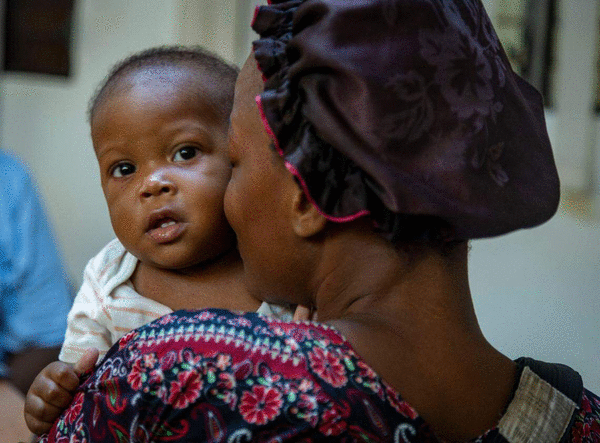
A number of members of Congress are taking a stand for Haiti’s women and girls, warning that their bodies can no longer serve as a battleground for the country’s deepening crisis.
Forty-eight Democrats in the House have signed onto a resolution introduced by Democratic Rep. Yvette Clarke of New York condemning what it describes as the “systematic sexual violence” carried out by armed gangs and the lack of protection, services and accountability for survivors. The measure calls for urgent action by Haiti’s authorities and its international partners.
“The failure to center women’s leadership and women-specific needs and protections in Haiti’s transition threatens the effectiveness of the transition and the long-term security, democracy, and socioeconomic development of Haiti,” the resolution states.
“The dire conditions faced by Haitian women and girls today are difficult to put into words. From widespread sexual and gender-based violence, to their near-total exclusion from the political power they need to overcome their desperate situation, the daily devastation they are experiencing cannot be overstated, and must not be ignored,” Clarke said.
She noted that in just two weeks, more than 350,000 Haitians in the U.S. will face the end of their Temporary Protected Status and the possibility of being deported back home.
“As we stand on the brink of Haiti’s TPS expiration on February 3rd that would condemn hundreds of thousands more to the same chaotic environment too many are already suffering, my colleagues and I are proud to introduce this resolution that makes our humanitarian and moral obligations clear,” Clarke added. “In a just and decent nation, these words would not have to pass through the halls of Congress to be accepted as a universal truth. But that is not what America is today under the brutal thumb of the Trump administration. And so, we will continue to call for justice for our Haitian sisters, and we will continue to demand the immediate extension of TPS for our Haitian neighbors. This president should know that the longer our calls go unanswered, the louder they will become.”
Gang violence remains widespread across Haiti, where rape is routinely used as a tool of punishment and control. A Miami Herald investigation, “Haiti’s Lost Generation,” found that between January and September of last year the country recorded an average of 27 cases of gender-based violence a day, based on more than 7,400 cases reported to humanitarian organizations.
Sexual assaults accounted for more than half of the reported cases of “gender-based violence” — a broad phrase that includes acts that inflict psychological, physical, mental or sexual abuse or suffering based on an individual’s sex. Assaults involving several attackers accounted for 65% of the rapes. Fifteen of the victims were killed after they were raped, according to the Human Rights Service of the U.N. Integrated Office in Haiti, which has recently stepped up monitoring of sexual crimes.
In a report published this week, the U.N. office said that between Sept. 1 and Nov. 30, its Port-au-Prince office documented 449 incidents of sexual violence involving 430 women, 35 girls and a boy.
“Collective rape remained the predominant violation, accounting for 74% of incidents, while sexual slavery, often linked to kidnappings and the exploitation of children by gang members, continued to be reported,” the report said.
During the same period, the gender-based violence category recorded 1,692 cases, of which 70% involved rape or sexual assault. “Access to survivor-centered support remained limited, with only 28% of rape survivors gaining access to medical care within the critical 72-hour window,” the U.N. Integrated Office added.
In addition to highlighting the violence women and girls continue to face in Haiti, the resolution calls for women’s full participation in the country’s political life.
Read More: Haiti’s Lost Generation
Haiti is at a critical juncture. The Trump administration has ended temporary legal protections for more than 300,000 Haitians as of Feb. 3. Four days later, Haiti’s Transitional Presidential Council is scheduled to step down. The council, which has sought to remain in power, has been warned by Washington that it cannot do so and that an effort late Wednesday to remove Prime Minister Alix Didier Fils-Aimé from office would run opposite to U.S. interests.
The Congress members described the situation as alarming. Among those who signed the resolution are Hakeem Jeffries, the House minority leader, and Democratic Reps. Sheila Cherfilus-McCormick, Debbie Wasserman Schultz and Frederica Wilson of Florida.
Human rights and feminist groups welcomed the resolution, which has a companion in the Senate that’s being spearheaded by Democratic Sen. Jeanne Shaheen of New Hampshire, the ranking member of the Foreign Relations Committee.
“The proposed resolution represents an extraordinary measure of solidarity with Haitian women and girls and with Haitian civil society,” said Sasha Filippova, senior staff attorney for the Institute for Justice and Democracy in Haiti. “Members of Congress are saying that the U.S. government, Haiti’s international partners, and Haiti’s transitional government are violating women’s rights, and in the process undermining their own efforts to establish peace and stable democracy in Haiti. The representatives have also aligned their calls for immediate measures with those that have been urged by Haitian women’s rights and other civil society leaders — including what almost 200 organizations have put forward through the Policy Framework for an Effective and Equitable Transition.”
Read More: What happens to a child born of rape? Grandma raises the baby her daughter rejects
The document notes the failings of the current transitional government when it comes to women and girls: There is just one woman on the nine-member presidential council — and she doesn’t have a vote. The document also accuses the minister on the Status of Women and Women’s Rights of trying “to change and dilute the Ministry’s mandate away from advancing the rights“ of women and girls.
“Deploring these persistent failures and deeply concerned with their impact on the success of Haiti’s transition, we, feminist and human rights organizations based in Haiti and throughout the world, demand urgent measures to secure the rights of women and girls as part of Haiti’s transition,” the group said, providing recommendations for immediate policy changes.
Pascale Solages, co-director of Haiti-based feminist group Neges Mawon, said securing women’s empowerment, addressing women’s distinct needs and confronting gender-based violence are “central and indispensable to securing lasting peace and prosperity” in Haiti.
“But we are instead seeing women left out of leadership; we are seeing women’s distinct needs and safety being treated as marginal or ignored altogether; and we are seeing elections being planned without consideration of gendered political violence and structural exclusions that, if unaddressed, will entrench and deepen inequality and instability in Haiti,” Solages said.
Lawyer Kattia Dorestant-Lefruy, co-director of the Haiti-based Bureau des Avocats Internationaux, said in the organization’s daily encounters with survivors of sexual violence “we are seeing horrific abuses and an absence of effective responses.”
Those on the front lines of trying to respond to the sexual violence crisis note that there is a lack of outrage inside Haiti and in the international community. For example, European nations have been frustrated in their negotiations with the U.S. as it seeks to deploy a new U.N.-backed Gang Suppression Force to help Haiti fight armed groups. U.S. officials refuse to recognize gender-based violence, and foreign diplomats believe not enough attention is being paid to the rampant rape crisis as part of the force’s operations.
On Wednesday, as members of the U.N. Security Council met in New York to discuss the deteriorating situation in Haiti, Denmark’s permanent representative said his country remains “alarmed by Haiti’s mounting humanitarian and human rights” crises.
U.N. Secretary-General António Guterres shared a report with the council ahead of the meeting that said he remains “deeply concerned by the continued use of sexual violence by gangs, which terrorizes communities, entrenches cycles of trauma and fear and systematically undermines the safety and dignity of women and girls.”
_____
©2026 Miami Herald. Visit miamiherald.com. Distributed by Tribune Content Agency, LLC.





Comments