At one time, Illinois was a top oil producer. Today, that legacy is a $160M problem
Published in News & Features
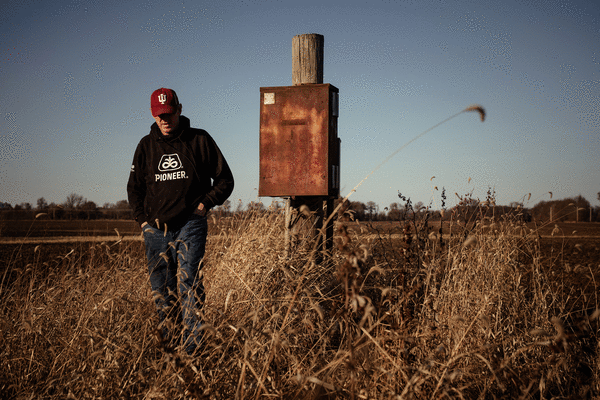
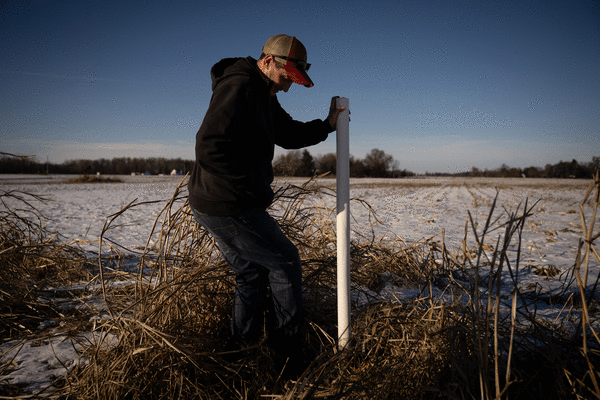
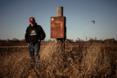
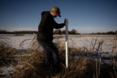
CRAWFORD COUNTY, Ill. — Bill Rosborough and his son Jon stopped their pickup truck near a 40-acre cornfield and pointed to a white PVC pipe that rose 5 feet from the snow-covered ground on a windy December afternoon.
The Rosboroughs farm this land and placed the pipe to mark the spot where an oil well once stood.
“I don’t even know that we’ve found the casing yet,” Jon Rosborough said. “It’s just a hole.”
He crouched by a small pool of liquid near the pipe, obscured by stalks of dead grass. The faint rainbow sheen of oil was visible.
State records show the well extends 965 feet below ground, drilled in March 1916. Neither Rosborough knew who was responsible for it today.
“I don’t know what its official status is,” Jon Rosborough said, “but as you can see, they’ve not been here in a while, let’s put it that way.”
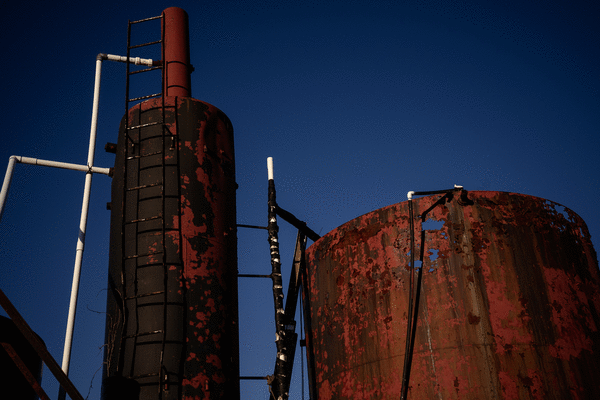
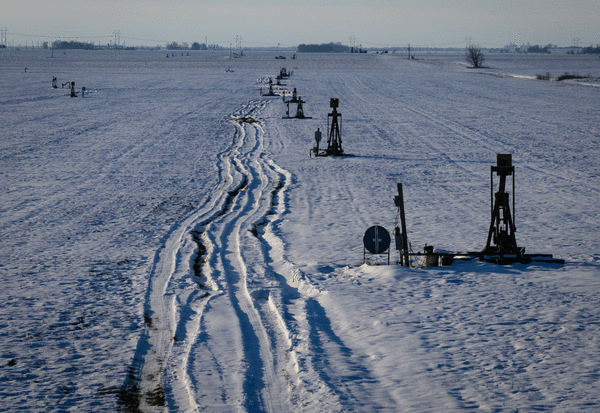
Thousands of similarly abandoned oil and gas wells are strewn across southern Illinois, remnants of a distant past when the state was one of the nation’s top oil producers. They litter farm fields, hide in woods and abut waterways. Many are called “orphans” by the state, their owners dead or unidentified, their companies bankrupted by a notoriously volatile global industry punctuated with booms and busts.
Left unplugged, some of these wells leak toxic chemicals hundreds of feet below the surface, potentially contaminating groundwater, and spit climate-warming methane gas into the atmosphere. They allow underground fluid called brine — several times saltier than seawater — to spill onto fertile farmlands, killing crops and leaving a virtually dead zone of soil that can take years to fix.
While oil companies are responsible for mitigating those risks by plugging wells that have stopped producing, there are nearly 4,000 abandoned oil and gas wells that are currently unplugged — holes, essentially, left behind for the Illinois Department of Natural Resources to close.
And for years, the state has fallen woefully short of the task, the Tribune has learned after reviewing hundreds of pages of public records and conducting more than two dozen interviews with southern Illinois farmers, oil industry representatives, environmental scientists and advocates. The paper’s three-month investigation found the state has mismanaged millions in operator fees designed to prevent orphan wells from becoming problems and has failed to document just how many abandoned wells exist.
Those who work in the oil business acknowledge the environmental threats posed by orphan wells and the role their industry has played in creating them. They admit that while some good-intentioned companies simply couldn’t survive when oil prices plummeted, there have been a few unscrupulous operators who, in past decades, have found ways to shirk their responsibilities for plugging wells once those assets become liabilities.
Still, industry representatives say oil production continues to play a vital role in southern Illinois, pumping millions of dollars every year into community coffers while extracting a crucial natural resource.
“Orphan wells are definitely something we take very seriously,” said Seth Whitehead, executive director of the nonprofit Illinois Petroleum Resources Board. “The vast majority of our operators do everything they can to address their wells when they stop producing and get them plugged.”
Consider, Whitehead and others say, that for the last 35 years, a portion of annual fees paid by Illinois oil operators has been deposited into a fund to plug wells and restore the land they once occupied. And yet, the state cannot account for where most of that money has gone over the years, only to say that much of it has been swept away for uses other than intended.
“We’re paying the penance for the people who didn’t follow the rules,” said Chuck Robinson, an Indiana-based oil operator whose company operates and plugs wells in Illinois, Indiana and Kentucky.
Illinois’ DNR calculates the cost to plug known orphan and abandoned wells in Illinois is $160 million. But in a state where 155,000 wells have been drilled since oil was discovered more than a century ago, and where most of the 23,000 or so active oil and gas wells today are considered “marginal” — producing less than two barrels a day — the price tag for plugging wells could end up being much higher.
In the last four years, Illinois received two separate federal grants totaling $50 million to bolster its well-plugging efforts through the Bipartisan Infrastructure Law under the administration of President Joe Biden, which earmarked $4.7 billion for similar efforts nationwide.
Environmental advocates and some downstate residents say much more is needed.
“If nothing changes, Illinois faces a perfect storm: aging wells leaking pollutants, rural communities left with contaminated land and groundwater and derelict well equipment that makes farmland unusable, and a state budget that cannot absorb the cleanup costs,” say the authors of a newly released report on unplugged oil and gas wells in Illinois, jointly created by the California-based environmental nonprofit ClientEarth USA and the Environmental Advocacy Center of the Bluhm Legal Clinic at Northwestern University’s Pritzker School of Law.
The 41-page report lays out what its authors call “critical flaws” in the state’s oil regulation, which have “created conditions for widespread abandonment of inactive and low-producing wells.”
Illinois’ DNR says it has done its best — often with limited resources — to protect the public from environmental hazards abandoned oil wells could pose while holding operators responsible for plugging wells before they can become orphans.
“As much as we can get people working with us to continue to be in compliance, the fewer wells (need to be plugged),” said Dan Brennan, director of the department’s Oil and Gas Resource Management division. “We’re all just doing the best we can to make sure everything is as safe as possible. … We try to work with all operators, and we try to do things as carefully and as thoughtfully as we can.”
A whiskey bottle and an oil boom
People have been trying to find oil under Illinois soil as far back as the 1850s. Some of the first wells were drilled a decade or so later in Montgomery and Clark counties. Despite some limited successes, commercial oil production wouldn’t take hold in the state until 1905, when two West Virginia wildcatters struck oil on a 50,000-acre farm in Crawford County.
A year later, three Pennsylvania men were supposedly searching for a place to drill on land leased from Crawford County farmer John W. Shire. After emptying a bottle of whiskey, the story goes, they tossed it over their shoulders, determined to drill a well wherever the bottle landed.
The well they drilled, called Shire No. 1, instantly yielded upward of 1,000 barrels of oil a day, catapulting Illinois to the nation’s third-largest oil producer.
Oil derricks sprang up seemingly overnight, as did the tent cities that housed oil field workers.
Production dropped sharply in the 1920s and ‘30s. By 1937, advancements in exploration and drilling brought a second boom to the state. Oil fields were discovered under land covering a dozen southern and southeastern counties. In Marion County alone, the Salem oil field produced 95 million barrels in 1940, which, according to the Illinois Petroleum Resources Board, made it the second-largest oil field in the country that year.
In referencing the oil field and the need for fuel during World War II, President Franklin D. Roosevelt is rumored to have said, “Thank God for Salem, Illinois.”
Illinois reclaimed its spot as the nation’s third-largest oil producer. Farmers, many of them having struggled through the Great Depression, were suddenly rich, leasing their fields to companies that would go on to have familiar names: Marathon. Texaco. Exxon.
An anecdote on the town of Salem’s website illustrates the change in fortunes. One young farmer had apparently been so excited by his newfound wealth that he drove his car into a pond. He had enough oil money to buy a new one the next day.
By the end of the year, the young man had bought three new Buicks.
How orphans were born
As the 1960s closed, the boom years were over.
National companies saw what was coming and looked elsewhere. To Texas and New Mexico, offshore and overseas. They sold their wells to smaller independent operators, some of them started by former big oil company employees who decided to stay in Illinois and strike out on their own.
These smaller operators gambled that, despite fluctuations in oil prices, their lower overhead costs would allow them to turn a profit even with lower producing wells.
Many did. Then the bust came.
Between 1980 and 1986, oil prices plunged 70%, throwing the industry into turmoil. Some Illinois operators went bankrupt or walked away from their leases, forfeiting the bonds they filed with the state in the event they could not plug their wells.
The state responded in 1991 with the creation of its plugging and restoration fund. Illinois operators pay an annual fee on every well they own: $100 per well for the first 100 and $75 for every well beyond that. At least half the money is deposited in the plugging and restoration fund. The rest is used for equipment such as vehicles, computers and gauges, as well as contract services and travel.
It’s unclear how much of that money has gone toward plugging abandoned oil wells since. Brennan, the state’s Oil and Gas Resource Management director, said he had been told by his predecessor that the state has, in years past, swept that money away for other purposes — a common practice in Illinois.
State law requires the department to submit yearly reports on plugging fund activity to an oil and gas advisory board. The department could only find reports from six fiscal years in the 2010s, Brennan said, adding that he was unaware of the requirement when he took the job in 2019.
The few state reports that have been compiled show that only a fraction of the funds have been used to plug wells.
“What I’ve been doing since I’ve been here is trying to make sure that we take any money we can for plugging and use it for that,” Brennan said.
Those assurances have done little to assuage the frustration felt by some southern Illinois farmers who have watched the number of abandoned oil wells that need plugging remain virtually unchanged for 30 years.
“It’s basically indicative of probably a failure in Springfield,” said Bill Rosborough, the Crawford County farmer and realtor who, along with other farmers, helped lobby for the state to plug abandoned oil wells in the 1990s. “It’s one of those things where it’s quite a ways from Springfield, and it’s not a high priority. The sad part is it’ll continue to get worse because they’re not going away.”
Environmental risks that ‘defy easy quantification’
Over 8,000 orphan wells pepper the Illinois Basin, a large swath of sunken land under Illinois that extends into parts of Indiana and Kentucky — a geological formation with layers of sediment, such as sand, mud and ash, that accumulated hundreds of millions of years ago. Trapped within are ancient animal and plant remains fossilized by intense heat and pressure, transformed into coal and oil deposits that became vital economic resources for the region.
But pollution from coal mining and oil drilling has tainted the state’s groundwater resources, which rural residents with private wells and most community water systems away from Lake Michigan rely on. In southern Illinois, where most oil activity occurred, groundwater is primarily found in sand and gravel aquifers between 300 and 500 feet below the surface. Fossil fuel extraction also poses unprecedented challenges for another of the state’s most enduring economic activities: agriculture. In the Illinois Basin, 60% of orphan wells are located in a farm area, according to data from the U.S. Geological Survey.
Even when they are no longer productive, oil wells can leak pollutants into groundwater, harming the farming economy, public health and ecosystems.
Across Illinois, wells that have been abandoned, are marginally productive or were plugged improperly by modern standards have leaked oil, saltwater and chemicals into waterways and farmland, according to hundreds of pages of citizen complaints obtained through a Freedom of Information Act request and reviewed by the Tribune. Farmers and oil workers recall a time when tree trunks and fence posts were used to plug wells. Even properly plugged wells can leak as the casing infrastructure deteriorates over time.
“Any open hole like that is an avenue for contamination,” said Brian Snelten, former president of the Illinois Association of Groundwater Professionals. “Anytime you punch a hole in the ground, you’re disturbing what nature put there.”
Oakley Shelton-Thomas, a senior researcher with the national nonprofit Food & Water Watch, said all abandoned wells should be treated as potentially dangerous.
“Because various pressures (and) underground conditions can change, and these wells can provide a pathway for contamination to the surface,” he said. “The fact that nothing is leaking from an abandoned well at one point in time doesn’t mean that abandoned well poses no risk.”
Existing issues and risks are top of mind for the IDNR’s Oil and Gas division, Brennan said, and are used to prioritize abandoned wells that need urgent attention. However, wells are not regularly monitored for leaks; instead, the agency relies on observations during annual inspections as its “biggest tool” and on citizen complaints to determine if and when an abandoned well is causing environmental damage.
“The salts, the brine, any oil (getting) into a groundwater supply or surface water supply has the most likely potential for harm,” Brennan said. “And, of course, that ties into the safety of any people nearby, any livestock or wildlife nearby. That’s our biggest concern. After that, it’s always the economics concern. Unfortunately, saltwater is rather destructive to plant life and to crops.”
For the last two decades, Kelly Aldrich has had to plant corn, soybean and wheat crops around a couple of dozen barely productive wells owned by an out-of-state company — some producing as little as half a barrel of oil a day, he says — on parts of land he farms where leaks of oil and brine have rendered several acres infertile.
“You can’t grow anything on it,” the Lawrence County farmer told the Tribune. Sometimes, leaks that have gone unnoticed at the surface still have impacts from below. “People just don’t realize what’s going on under the ground there … in several places on my farm, and other people’s, too. I mean, there’s a lot of land ruined here.”
Over in Crawford County, Jon Rosborough pulled up a production map for one 168-acre field his family farms. Two separate clusters of red, close to 4.5 acres in all, produced nothing. The culprit, he and his father said, was saltwater leaking from oil wells.
“I had a guy tell me it’s a lot like if your mother made mashed potatoes and she got too much salt in them and the only thing you can do is fix more mashed potatoes to blend the ratio back to something that’s livable,” Bill Rosborough said. “That’s basically what you have to do with these salt-damaged areas. You’ve got to try to leach it out and then blend something back into it.”
Contaminants from unplugged wells include components of brine from deep within land formations, such as chloride, which degrades aquatic ecosystems and can cause salt kills in agricultural land, and barium, which can cause gastrointestinal and cardiovascular issues if humans consume it in drinking water. Another contaminant of water and air, hydrogen sulfide can cause cardiovascular, neurological and respiratory issues.
Unplugged oil and gas wells can release benzene, a carcinogen, into the atmosphere and groundwater. According to the World Health Organization, there is no safe exposure level to this chemical in the air — even low quantities can lead to severe health effects. Inhaling it can irritate airways, causing coughing, wheezing and shortness of breath, and in the long term, it can contribute to neurological symptoms, a suppressed immune system and blood disorders.
“People would see these wells in their backyard and not even think about what they are or what it means. And now, when they learn about it, they realize, ‘Oh, this is a threat to my family’s health.’ It’s become a different story,” said Adam Peltz, energy director and senior attorney at the national advocacy nonprofit Environmental Defense Fund. “It’s not like everyone who lives near an orphan well is drinking poisoned water. But it’s definitely a risk vector.”
In a study published last year, USGS researchers set out to investigate precisely how vulnerable aquifers are to hazards from the more than 117,000 documented orphan wells across the country, a number they say could be three to five times higher.
“We don’t want to, like, scare people,” said Nick Gianoutsos, one of the study authors and a physical scientist at the USGS and project chief for the agency’s research into orphan wells. “When you look at a map, they’re kind of everywhere. … Probably the majority of the wells are benign for now — meaning not leaking gases or anything — but it’s hard to see what’s happening below the surface.”
The scientists found the Illinois Basin has 0.191 wells per square mile; for context, aquifer systems in the Appalachian Region and Oklahoma — historically top-producing areas — have densities two to three times higher. In addition, 3% of orphan wells in the basin are located within lakes, rivers or wetlands, and 3.5% are within a developed area, where they pose threats to the environment and human health.
Even on land, unplugged wells can pose serious problems for waterways. For instance, Aldrich worries that the oil and brine that the structures in his land often spill could reach far beyond, into a nearby slough, then a creek and ultimately the Embarras River.
Another factor in evaluating risks to groundwater is age; older wells are more prone to leaking or failing because they weren’t built with modern groundwater protections in mind, like the Clean Water Act of 1972 and the Safe Drinking Water Act of 1974, and have deteriorated over decades of wear and tear. Over 2,000 orphan or abandoned wells currently in the state’s plugging fund — that is, more than half — were permitted for drilling before 1972.
Unplugged wells can also release methane into the air, where it works as a potent greenhouse gas that can trap over 80 times more heat than carbon dioxide in the atmosphere during its first 20 years in the atmosphere. These leaks can sometimes cause explosions, which pose a serious safety risk to nearby communities.
“Now, they don’t all emit methane,” Peltz said. “Scientists think that maybe 10% to 20% (of orphan wells) emit appreciable amounts of methane.”
According to a Reuters investigation, orphan and abandoned oil and gas wells in the country emitted 281,000 tons of methane into the atmosphere in 2018. This is equivalent to approximately 7.9 million tons of carbon dioxide — the same amount released by 1.7 million gasoline-powered passenger vehicles in a year.
Still, the climate impact from orphan and abandoned wells is not greater than methane emissions from active wells.
“No one well is changing the climate. But when you add up maybe the 100,000 (orphan) wells that are leaking, that’s starting to have a material impact” across the country, Peltz said. “At least with the active oil and gas industry, you have someone who’s theoretically supposed to deal with it, a solvent operator. With these orphan wells, it means that there is no solvent, responsible party, and it just falls on the state.”
‘A kitchen table conversation’
The problem of orphan wells had for decades been largely unknown outside of the oil industry and the communities where those wells were drilled.
That started to change in 2021, when the Biden administration’s Bipartisan Infrastructure Law included $4.7 billion for states to plug orphan wells.
“And so,” Gianoutsos said, “that really kind of made orphan wells a household conversation, a kitchen table conversation.”
Oil-producing states refocused their efforts on identifying orphan wells, and as a result, their inventory lists grew.
A 2024 report published by the Interstate Oil and Gas Compact Commission noted a 54% increase in the number of orphan wells documented by states since 2020. The multistate government agency’s report identified 28 states with a combined 141,959 known orphan wells.
Illinois was one of nine states that reported fewer orphan wells. Its tally of 3,946, a 9% drop from 2020, was 12th most out of the reporting states. About half of the nation’s wells were found in three states: Ohio, Oklahoma and Pennsylvania. Kentucky reported nearly 16,000 orphan wells; Indiana had around 1,200.
Illinois’ federal grant application asked for around $163 million, which amounts to nearly $40,000 per well. In 2022, the state received an initial $25 million federal grant, enough to plug around 500 wells. Prior to federal intervention, the state plugged an average of 20 to 25 wells a year.
The state received a second $25 million federal grant in October 2024. Nearly 100 orphan wells have been plugged thus far using that money, Brennan said. That same year, the U.S. Department of Energy awarded IDNR another$17.3 million to address methane emissions from low-producing wells by plugging them.
Fixing ‘a failing system’
More money will be needed, the Northwestern and ClientEarth report’s authors contend, unless the state cures its “regulatory blindness” that has turned existing laws into “paper tigers” and has given oil operators too many avenues to avoid cleaning up their dying wells.
“At the end of the day, if we have a failing system, either the wells will remain unplugged forever, or the government will have to pay to close them,” said Robert Weinstock, director of Northwestern’s Environmental Advocacy Center and one of the report’s authors.
To start, the Northwestern and ClientEarth report advocates for Illinois’ DNR to track how much oil each well produces.
“The failure to collect production data is remarkable,” Weinstock said. “IDNR is depriving itself of the most basic and effective tool to identify inactive wells by failing to collect that data. It could do so much more, even with its existing limited resources, if it just did that.”
Illinois’ DNR largely relies on operators to self-report any oil wells they need to plug. Or, they find abandoned wells through routine inspections — some 30,000 were conducted last year by 13 inspectors — or through public complaints, which typically happen only after a well causes a problem,such as an oil or saltwater leak.
Production data is one tool, the report argues, that could help the state sniff out any attempts to transfer dying oil wells to companies that don’t have the financing to keep them going or to companies designed to go bankrupt, all but ensuring those wells will become millstones hanging around the state’s neck.
Brennan recalled a case from some 20 years ago, before his time at the department, in which an oil company in Sangamon County was found to have created a smaller shell company to take on all its unproductive wells. The IDNR learned about it beforehand and thus was able to intervene and file suits with the attorney general, then negotiated with the company to plug most of the wells.
“We were able to stop the worst of it,” Brennan said. “In this industry, a small percentage, 5-10% of people, are going to try to get away with what they can, and we’re just trying to stay on top of it to see if we can stop them before it gets too bad.”
The state should publish production data, the report’s authors argue, so the public could better identify inactive wells and take action to have them plugged. That could be by making use of an IDNR grant program meant to reimburse landowners who pay for that work to be done. The grant program has not been used in at least two years, the report notes, and should be reformed.
“Folks who have the means to plug a well themselves and wait for the state to reimburse them can jump the line, even if (the well is) farther down the priority list based on public health factors,” said Ben Segal, an attorney with ClientEarth USA and one of the report’s authors.
Knowing how much oil is being pulled from Illinois reservoirs would also be a step toward creating a tax on that production, which the Northwestern and ClientEarth report notes could pay for plugging abandoned oil wells and repairing any environmental damage they caused.
Thirty-four states either tax the market value of crude oil or the volume produced, or some combination of the two.
“There’s no doubt that the oil industry has been an important part of Illinois’ economy and oil wells that are still producing oil are certainly producing a useful product,” Weinstock said. “The problem is, how do we make sure that when those wells aren’t producing useful products, they also stop producing all the really dangerous and harmful byproducts? The industry that profits from these wells must pay for the consequences of those wells. That’s basic economics.”
As it is, Illinois lawmakers recently increased the bond amount operators are required to post with the state for each well, an insurance policy, of sorts, should they shirk their cleanup responsibilities.
The bipartisan law, passed unanimously in 2025, raises the per-well bond rate from $5,000 to $10,000 and removes the $100,000 cap on blanket bonds for operators with more than 100 wells. The change applies to new wells drilled and to operators who defaulted on fees in the preceding five years.
“(It) is a complicated way of very simply saying: ‘If you make a mess, clean it up,’” said state Sen. Erica Harriss, a Republican from Edwardsville who introduced the law. “And I think that’s not an unpopular opinion.”
The Northwestern and ClientEarth report authors say the new law doesn’t go far enough. Not all operators are required to post bonds, and the ones who meet the requirement are still able to post bonds far below the cost for well-plugging and site remediation. The new bond rate for an operator with 100 oil wells, for example, amounts to $1,000 per well.
Beyond strengthening financial requirements, the report’s authors say the state should reform the way it places inactive oil wells in temporary abandonment status. That designation lasts five years and carries an annual fee of $100 per well. Wells can be kept in that status indefinitely.
“To call it a temporary abandonment classification is really a wild joke because operators are legally permitted to keep a well temporarily abandoned forever,” Weinstock said, adding that the status is another way for operators to avoid plugging and remediation costs and a pathway toward oil wells becoming orphans.
A Tribune review of temporarily abandoned wells in an IDNR spreadsheet found at least two dozen that later became the state’s responsibility to plug. Just over 3,600 are currently classified as temporarily abandoned, according to agency records.
The state could limit how long a well can be in temporary abandonment status, the report’s authors suggest, or increase fees over time — as California does — to discourage long-term abandonment.
‘The fabric of small communities’
To be sure, any new regulations on oil production will face scrutiny from the industry.
“The industry has been much more responsible in their operations,” said Edward Cross, CEO of the Illinois Oil and Gas Association. Case in point, he said, its support for recent changes in the state’s bonding scheme showed it’s “stepping up to the plate to try to resolve these issues.”
The state’s existing guardrails are sufficient to prevent future orphan wells, Cross said. “It’s very difficult today to just say, ‘I’ll walk away and leave this with the state.’”
Cross and others in the oil business reject the suggestion that Illinois’ DNR needs to track how much oil each well produces or that it should tax that production, saying operators already pay millions in taxes every year to the state and the rural communities where they work.
Illinois’ reservoirs still yield around 19,000 oil barrels a day, making it the nation’s 16th largest producer. The companies producing that oil today are not the global conglomerates that most people picture when they think of the industry, Cross said. Rather, they’re mainly independent operators who form “a very important part of the fabric of small communities.”
He may as well have been talking about people such as Chuck Robinson. The 42-year-old’s grandfather came from Louisiana to the Illinois Basin with Magnolia Petroleum Co. in the early 1960s. When the company left the area later that decade, C.A. Robinson opened his own shop. He bought a lease for some wells, a tank truck and slowly grew the operation.
Chuck Robinson grew up idolizing his grandfather and father, a petroleum engineer. He remembered being in fourth grade and going with both men at 10 p.m. on a Tuesday to watch a well being drilled to its target depth. Then, around sunrise, he’d head back home, armed with a story to excitedly tell his friends at school.
His dad and grandfather warned him to stay out of the business, with its punishing cycles of feast or famine, to use his Indiana University business education on anything else. He followed their advice, for a bit. But about 20 years ago, when C.A. Robinson told him the family business could use his help, he jumped at the chance.
“Even now, to see all of the equipment come together and to drill a well thousands of feet deep and produce a substance that has not been touched by a human. Who knows how many millions or billions of years this has been there?” he said. “And you kind of tame Earth. And this substance that we produce is so critical that we would literally be living in the Stone Age without it. Nothing that we qualify as modern would exist without it. You just think, man, I idolize that. It was heroic to me.”
From its base in Evansville, Indiana, Robinson’s company operates around 500 oil wells in the Illinois Basin and runs an oil field services shop that has received contracts with Kentucky regulators to plug wells using federal grant money. He estimates the process, which involves injecting cement into a well casing at different depths, costs around $15,000 — the federal program includes wage requirements that can elevate that figure.
Like others in his industry, Robinson said he feared overregulation could force more operators into bankruptcy and thus, create more orphan wells. “It can be a self-inflicted wound.”
Some southern Illinois farmers who spoke with the Tribune said they, too, worried that the state could drive oil companies out of business in the name of eliminating abandoned wells. It’s a tightrope, they acknowledge, but one that the state and the industry must learn to walk.
On a Tuesday afternoon in December, Jim Knollenberg steered his truck onto a 165-acre field he farms in Jasper County. He stopped near two white PVC pipes standing in an overgrown patch, placed to alert tractor drivers of the rusted well casing in the ground.
He said there are perhaps seven other oil wells in similar condition on the field. In years past, they and other abandoned wells have caused some soil damage from salt leaks. He estimates farmland that shares ground with oil fields will see a 20% drop in crop yield.
“Ground that doesn’t have oil production on it is worth more to us as a farmer to rent it than ground that has oil wells,” he said.
Once, maybe five years ago, Knollenberg said he spoke to someone at the IDNR who told him the state didn’t have the money to plug them.
Those wells, like the one on the Rosboroughs’ farm, do not currently appear on the state’s list of wells that need to be plugged.
©2026 Chicago Tribune. Visit at chicagotribune.com. Distributed by Tribune Content Agency, LLC.





Comments