$1.25 million study of Michigan's Native American schools is scrapped. Consultant blames 'whitewashing'
Published in News & Features
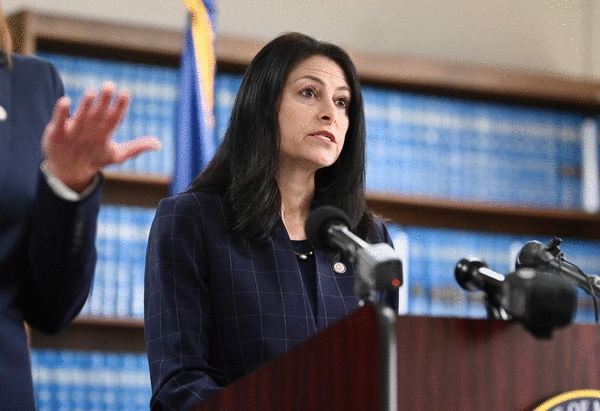
LANSING, Mich. — About a week before Attorney General Dana Nessel announced a criminal investigation into Native American boarding schools in Michigan, a separate $1.25 million state investigation into the same issue came to an inauspicious end.
The Michigan Department of Civil Rights on Nov. 30 issued a memo to legislative leaders and Gov. Gretchen Whitmer informing them that the consultant hired to investigate Native American boarding schools had used "unethical approaches" in its research methods, failed to address key questions and provided an "overall unreadable format/structure."
Because of those issues, the department said, it would not be submitting a final report to the lawmakers and governor who set aside $1.25 million for the study.
Kauffman and Associates Inc. denied the allegations in a statement to The Detroit News.
"Not having a comprehensive final report to submit today is a disappointing result for all involved in this project, but the department sees no other feasible option," the Nov. 30 memo from Michigan Department of Civil Rights Executive Director John E. Johnson Jr. said. "Too many questions exist concerning (Kauffman and Associates Inc.'s) work and not enough time or funding exists for the department to restart this project."
Former Michigan Civil Service Commission Chairman David Worthams said in October, when the commission received an update on the problems plaguing the study, that it highlights the need for improved communication by "the Legislature and other executive departments" with the Department of Civil Rights. Without that communication, Worthams said, the state is saddled with "shoddy reports and poor outcomes."
"When you do not have good communication, coordination between what the left hand is doing, what the right hand is doing, suddenly you get boilerplate that shows up in the budget that you’re not aware of, and now you have to somehow figure out how to carry the ball forward," Worthams said.
The failure of the study and the serious concerns raised by tribal members who participated prompted questions about the willingness of tribal members to meet with Nessel's team.
Danielle Hagaman-Clark, the criminal bureau chief for Nessel's office, said the team is trying to convey to survivors who may be considering coming forward that the criminal investigation taken by the attorney general is completely separate and very cognizant of the sensitivity surrounding the allegations made by former students of the boarding schools.
"Yes, we are a part of the state," Hagaman-Clark said. "Yes, we understand that the state, as a big whole, has been not great to Native communities in many ways. But we did not have anything to do with this prior investigation. That's separate and distinct from what we're trying to do. Ours is very much a criminal investigation."
The Michigan Department of Civil Rights earlier this month said no decisions had been made regarding whether it would attempt to recoup the money paid to Kauffman and Associates.
Gov. Gretchen Whitmer's spokesman, Bobby Leddy, said Tuesday the governor, who first introduced funding for the study in February 2022, "recognizes the intergenerational trauma boarding schools caused for indigenous communities."
"It is important for all of us to continue learning to understand what happened at these boarding schools in Michigan," Leddy said.
How study was developed
Kevin Ollokot Keefe, CEO of Kauffman and Associates, said the study's research methodology was developed with the state department and reflected "established, trauma-informed, and community-centered research practices.
"Informed consent procedures were used throughout the study, and participants were informed of the purpose of the project and how their contributions would be used, consistent with ethical research standards," Keefe wrote. "The methodology of our work was iterative and collaborative with the state throughout the entire process."
The Spokane-based firm, which is American Indian-owned, said the state attempted repeatedly to "narrow, constrict, and whitewash the historical record and the intergenerational impacts of boarding schools on survivors and their descendants."
The department would not release Kauffman's report, which is considered a public record, without a Freedom of Information Act request. It said it would work to produce the document but likely would redact personally identifiable information.
The study was first introduced in Whitmer's fiscal year 2023 executive budget recommendation, presented in February 2022. Lawmakers appropriated money for the study totaling $1.25 million, $500,000 in 2022 and $750,000 in 2023, to produce a report that identified the number of Native American children forced to attend boarding schools in the state, the number who were abused, died or went missing, and the long-term effect on their families.
The study would also locate, analyze and preserve records as well as interview boarding school survivors and their families.
In January 2024, the civil rights department entered a contract valued at more than $1 million with Kauffman and Associates Inc., but Johnson said, "it became clear that there was inadequate time to conduct all the necessary historical research and produce a comprehensive report."
The department received an initial draft from Kauffman in January 2025, the month the group's contract was set to expire. The initial draft, Johnson said, had "prominent issues," including a lack of focus on what happened in boarding schools in Michigan; statements and claims without factual support, citation or sources; an exceedance of the scope of the study; and an "overall unreadable format/structure."
The group, Johnson said in his memo, also reached "conclusions regarding issues outside the expertise of the researchers, including legal conclusions regarding federal treaties and other matters with unknown or potentially negative consequences both to the state and tribes."
State outlines concerns
The department extended Kauffman's contract so it could focus on "substantial revisions and a structural overhaul" to focus on the questions the Legislature had requested be answered.
In July and August, the department sent the initial draft to tribal leaders to get their response, and the tribal leaders' reaction "affirmed the department's prior concerns."
"Notably, the comments also suggested that KAI used unethical approaches in its human-subject research methods, calling into question whether participants had given informed consent," Johnson wrote. "This was the first time that the department had received comments of that nature."
The department worked to obtain Kauffman's research materials related to the study to preserve them, as had been requested by the Legislature, the department's executive director said.
In September, Johnson said, Kauffman circulated "an authorized third draft" of its report to tribal leaders without the department's knowledge or permission.
The next month, tribal leadership and individuals who had attended the schools again expressed serious concerns and "urged the department not to accept and distribute KAI's work product, as it may cause future harm to victims."
Their concerns led Johnson to stop publication of the report, which was due Nov. 30. The department issued a short 12-page summary, in place of Kauffman's work, that consisted largely of a reiteration of federal studies into the issue as well as a summary of the concerns raised by participants about Kauffman.
"The MiNABS (Michigan Native American Boarding Schools) study was a first step by the state to start to understand what happened in boarding schools in Michigan, an issue that requires more time and resources than this project allowed," Johnson concluded.
Keefe said the "unauthorized third draft" referenced by the department was its final report and was distributed to the department, the attorney general's office and tribal leaders.
The consulting firm said the state, after submission, requested to see personally identifiable information, including the individuals who signed consent forms. The firm could not produce that information and still uphold confidentiality commitments made to participants, Keefe said. Additionally, the state asked that the initial report be reduced to 50 pages, but the firm believed those cuts would "compromise the integrity of survivor and descendant testimony."
"While we respect the state’s authority regarding publication decisions, KAI stands by the integrity of the study’s methodology and our ethical obligation to protect participant confidentiality and honor survivor and descendant voices," Keefe wrote.
"Decisions regarding publication ultimately rest with the commissioning agency, not KAI," Keefe added.
But the firm said the structure allowing the state agencies, rather than the tribal nations, to be the primary decision makers created "an inherent risk of conflict of interest."
"The state directed the removal of county references and quotations that could imply state jurisdiction, responsibility or liability," Keefe said.
The firm urged the state to release the full Kauffman report, which is "free from further whitewashing of this history."
_____
©2026 The Detroit News. Visit detroitnews.com. Distributed by Tribune Content Agency, LLC.





Comments