Multibillion-dollar transit project to tunnel through the Santa Monica Mountains is approved by LA Metro
Published in News & Features
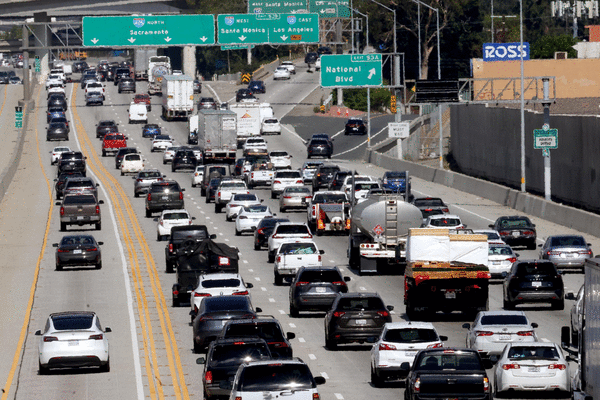
LOS ANGELES — The Sepulveda Transit Corridor project would connect Los Angeles' Westside to the San Fernando Valley in less than 20 minutes and ideally eliminate traffic congestion along one of the nation’s busiest corridors by offering an alternative to the snarling 405 Freeway over the Santa Monica Mountains.
The multibillion-dollar Metro plan is considered one of the most significant transit projects in the country — and is finally moving forward after years of debate. But billions of dollars have yet to be secured, raising questions over its timeline.
Metro’s board of directors unanimously approved an underground heavy-rail option Thursday that would go from Van Nuys to Sherman Oaks, pass under the mountains and Bel Air, stop at UCLA and ultimately end at the E Line/Expo Sepulveda station. The option, which was pushed forward by Metro’s planning and programming committee last week, eliminates a controversial monorail proposal through the Sepulveda Pass and bypasses a stop at the Getty Center, which had been under consideration.
“The Sepulveda Corridor a vital link between the communities of greater Los Angeles, connecting residents of San Fernando Valley to the Westside’s bustling entertainment and employment hubs and cultural landmarks,” Cecily Way, senior executive officer of countywide planning for Metro, said during Thursday’s meeting. “The Sepulveda Transit Corridor project would add a critical regional connection to the transportation network.”
The project has been the subject of multiple Metro community meetings and has elicited thousands of public comments for and against various proposals. Some routes faced extensive pushback from local residents concerned about neighborhood disruptions and environmental risks. On Thursday, public comment was overwhelmingly supportive of the project and the board’s decision drew cheers.
The current route would travel under Van Nuys Boulevard. It pulls from two other proposals and was developed after residents voiced concerns over a route that would drill near a high-pressure water main along Sepulveda Boulevard.
Bob Anderson, the vice president of the Sherman Oaks Home Owners Assn. and a retired aerospace engineer, was “pleasantly surprised” that Metro took residents’ concerns into consideration with the proposal.
The group has been a vocal critic of some of the proposed routes and still has questions about the current proposal, such as how it will affect parts of Sherman Oaks and Bel Air. Anderson said that although the association supports the current recommendation, he still has concerns over funding.
“We still have not heard from Metro how they’re going to pay for this thing,” he said. “We don’t need to know every financial detail, but we do need to know where they’re going to get the funding stream that feeds it and how much the financing is going to cost us.”
The estimated cost of the project has ballooned since 2016, when voters approved transit improvements between the Valley and the Westside under Measure M.
At the time, the project was slated as $6 billion, then grew to an estimate of $9.4 billion to $13.8 billion with a completion goal of 2033. Metro does not have an estimate for the current modified proposal. A previous version estimated a price tag of about $24.2 billion, but Metro said that wasn’t accurate for the new model.
“A shorter, or initial operating segment, more direct alignment and fewer stations could reduce costs,” the agency said.
Roughly $3.5 billion has so far been secured through Measure M and Measure R.
The transit agency cited the need for reliance on state, local and federal funding to fix the shortfall and has raised the idea of private-public partnerships — similar to proposals for the state’s underfunded high-speed rail project. But it did not have a specific plan for how that money would be obtained or how it would affect the project’s schedule.
“With existing voter-approved funds, Metro can continue to advance environmental clearance and engineering; however, additional funds will be needed to advance substantial construction,” the agency said. The opening date for a previous route was slated for mid-2038, but Metro said there isn’t an updated schedule yet for the new version.
Board member Katy Yaroslavsky called for transparency around the cost of the project.
“Dreaming big matters, but honesty matters too. We can’t afford to approve transformative projects without being clear about the path to funding and delivery,” she said Thursday. “Public trust depends on our ability to show progress in years, not in decades, and we’ve all seen what happens when expectations outpace reality.”
Board member Ara Najarian said that funding would be obtained through the board’s “great connections and friendships and influences at the state and federal level.”
“That will happen — I hope it will happen in my lifetime,” he said. “That doesn’t matter. As a leader, you do things that may not be done in your lifetime.”
Yaraslavsky also asked Metro staff to report back to the board about how the proposal, which had not been included in a previous environmental review, will affect nearby communities, and Mayor Karen Bass asked staff to explore transit connections to the Getty Center since the route would not make a stop there.
The busy corridor and solutions to improve it have been under discussion for decades. Ethan Elkind, a rail expert and director of the climate program at the Center for Law, Energy and the Environment at UC Berkeley, said that a variety of political and logistical factors slowed attention to it: a focus on downtown transit, opposition to high-capacity transit in the San Fernando Valleyand geological challenges in the Sepulveda Pass.
“It’s a lot of land. And the more land you have to go through, the more expensive it is, the more logistically challenging it is,” Elkind said.
L.A. County leaders have largely been supportive of the project.
L.A. County Supervisor and Metro board member Lindsay Horvath said last week that the project would be a historic development for the Los Angeles region, affecting drivers who commute through the Sepulveda Pass along the 405.
“What we have before us is the potential to take more than a quarter of those 400,000 daily commuters out of their cars, off the 405 and onto public transit. This represents a mode shift for hundreds of thousands of residents and visitors,” she said. “More people choosing to use transit instead of personal vehicles creates a commuting culture — a culture of ridership — and brings along all of the social and economic benefits that come with it.”
Los Angeles City Council member Nithya Raman said that construction for the project would create hundreds of thousands of jobs and that revenue from ridership would help local businesses.
“We don’t have to accept sitting in traffic as our only choice, and this is our pathway forward,” she said.
Raman pressed the board to complete the full line “aggressively,” and not just prioritize the initial segment, which would connect the Metro G Line at Victory Boulevard to the Metro D Line at Wilshire Boulevard, leaving out connections to the Van Nuys Metrolink station and the Metro E Line Expo/Sepulveda station.
©2026 Los Angeles Times. Visit at latimes.com. Distributed by Tribune Content Agency, LLC.






Comments