Will South Carolina residents be able to drive on Charlie Kirk Highway on day honoring him?
Published in News & Features
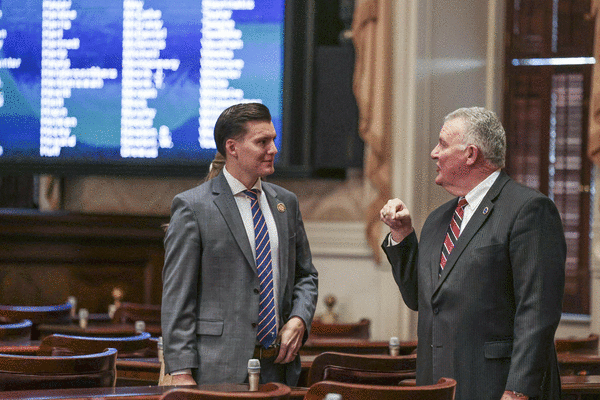
COLUMBIA, S.C. — Though it happened more than 2,000 miles away, the fallout of the assassination of conservative activist and campus speaker Charlie Kirk may reverberate during South Carolina’s 2026 legislative session.
Some House lawmakers want to honor Kirk, who spoke about conservative politics on college campuses, with an annual day and a highway in Laurens County. A dayslong social media spat between lawmakers over the appropriate reaction to Kirk’s public killing also boiled over into proposed South Carolina House censures.
In total, House members filed 258 bills and resolutions ahead of the 2026 legislative session, which will take place during an election year and as lawmakers try to stave off any primary challengers.
The Turning Point co-founder was fatally shot while speaking at Utah Valley University on Sept. 10. His death sparked an outpouring of condolences and condemnation of political violence from across the political spectrum, in addition to controversy and firings over several South Carolina public employees’ social media reactions.
Lawmakers look to honor Kirk
House lawmakers filed bills that would memorialize Kirk with an annual day and a highway in the Upstate.
Eight conservative lawmakers, led by state Rep. John McCravy, R-Greenwood, sponsored a resolution to make Oct. 14 in South Carolina “Charlie Kirk Day.” Kirk was born Oct. 14, 1993.
“Whereas, through relentless persecution, cancellation attempts, smears, and ultimately his assassination, Mr. Kirk became a martyr for truth and faith, enduring personal and professional attacks with unwavering resolve to expose corruption, challenge elite narratives, and uphold objective reality in the face of censorship and cultural decay,” the bill reads.
Another resolution, sponsored by state Rep. Luke Rankin, R-Laurens, asks the state Department of Transportation to rename a stretch of Route 76 to “Charlie Kirk Memorial Highway.”
SC lawmakers spat over Kirk assassination leads to censure calls
A social media spat among lawmakers in September has led to two dueling censure resolutions.
In the days after Kirk’s assassination, state Rep. John King, D-York, pointed out on social media that not everyone mourned Kirk’s death, calling words Kirk used racist, homophobic and harmful.
“As a kid, I was taught: you live by the sword, you die by the sword,” King wrote in one social media post. “Kirk chose his weapon hatred. And while no one should celebrate death, we cannot erase the reality of the life he lived. He made his mark by tearing people down, by fanning the flames of racism and bigotry.”
King drew a rebuke from House Freedom Caucus members, state Sen. Wes Climer, R-York, who is running for Congress, and U.S. Rep. Ralph Norman, R-Rock Hill, who is running for governor.
They called for King’s removal from committee assignments.
A few days after a Charleston magistrate Judge James Gonsell had been arrested on child sexual abuse material charges, King went to social media to call out the same Republican elected officials who criticized him. Gonsell in 2003 had used a racial slur in court.
State Rep. Stephen Frank, R-Greenville, responded.
“I’ll try to help you @repjohnrcking, but understand the difficulty of slowing myself down to your level of comprehension and awareness,” Frank posted on social media.
“I don’t run a 24/7 outrage hotline and thus can’t condemn every bad thing that happens in South Carolina. But notice I’ve never once justified or excused this individual,” Frank added. “Whether it’s your ignorance or dishonesty playing out here, you’re unfit for office.”
Frank and state Rep. April Cromer filed H. 4565, a House resolution to censure King.
King and state Rep. Hamilton Grant filed H. 4566, a House resolution to censure Frank.
Bill numbers are assigned as legislation arrives in the clerk’s office, so these two sanctioning efforts were filed back-to-back.
Firing employees for political opinions
State law says an employer who fires an employee for having certain political opinions can face a misdemeanor charge. It was the law first cited by Clemson University as to why they didn’t immediately fire employees who appeared to mock or celebrate Kirk’s assassination.
Attorney General Alan Wilson then clarified to the university the school would not face criminal charges for firing the employees, but said the school could still face civil action.
Now state Rep. Bill Taylor, R-Aiken, wants to remove that state law all together.
He has proposed repealing the provision meant to prevent someone from being fired or evicted from a property purely for a political opinion.
_____
©2025 The State. Visit thestate.com. Distributed by Tribune Content Agency, LLC.





Comments