Municipal courts can't issue harsher punishment than state court for same offenses, Colorado Supreme Court rules
Published in News & Features
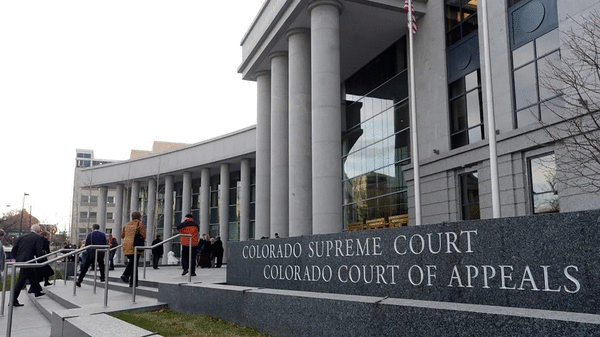
DENVER — The Colorado Supreme Court ruled unanimously Monday that cities cannot punish lawbreakers beyond what state courts would allow for the same offense in a ruling that could set precedent for hundreds of municipal courts around the state.
The justices ruled that when a municipal ordinance and a state statute prohibit identical conduct, the municipal penalties for such conduct “may not exceed the corresponding state penalties for that conduct.”
By imposing more stringent penalties for the same crimes, these cities “materially impede the state’s interest in ensuring that maximum penalties for non-felony offenses are consistent and uniform across Colorado,” the opinion stated.
Chief Justice Monica M. Márquez delivered the opinion, and was joined by Justices Brian D. Boatright, William W. Hood III, Richard L. Gabriel, Carlos A. Samour Jr. and Maria E. Berkenkotter. Justice Melissa Hart, who announced her retirement last week after being on leave since October, did not participate.
The cases centered on low-level prosecutions in Westminster and Aurora municipal courts in which the alleged offenders faced significantly more jail time after being charged in city court than they would have if charged in state court.
In 2022, Aleah Camp was charged with stealing less than $300 worth of goods from a Westminster store. The officer, by checking a single box on a criminal summons, sent the case to municipal court — where Camp faced a potential jail sentence 36 times longer, and a fine almost nine times higher, than what would be allowed under state law.
In the other case, Danielle Simons was charged in 2023 with motor vehicle trespass in Aurora Municipal Court. As a result of the officer’s decision to pursue municipal rather than state charges, Simons faced up to 364 days in jail and a $2,650 fine. If she had been charged with the same offense in state court, the maximum penalty would be 120 days in jail and a $750 fine.
Simons’ and Camp’s attorneys argued the significant sentencing discrepancies in their cases violated their clients’ rights of equal protection under the Colorado Constitution.
The Supreme Court did not address the equal protection argument, instead ruling that the city ordinances are preempted by state law. The cities argued that, under home-rule provisions, they are allowed to create their own sentencing policies.
But the justices wrote that the court has consistently held that the regulation of non-felony criminal offenses is a matter of mixed local and statewide concern.
Municipalities can still punish offenders beyond the state’s sentencing caps when there is no identical state offense, the court ruled. However, when cities regulate conduct for which there exists an identical state offense, they cannot exceed the state’s cap.
Ashley Cordero, Simons’ attorney, said Monday’s ruling sends a clear message to municipalities. To have uniformity in sentencing, she said, is a huge relief for a wide swath of people who appear in these city courts.
“The majority of the people who are prosecuted in municipal court are working class or unhoused,” she said in an interview. “This will make real change for a lot of folks.”
In 2021, on the heels of nationwide protests for racial justice, Colorado lawmakers enacted sweeping state-level reforms that significantly lowered the potential penalties for misdemeanor and petty offenses in Colorado’s state courts. But those reforms didn’t impact municipal courts.
As a result, the potential jail sentences for minor crimes in city courts now often far outpace the state’s limits, The Denver Post reported last year. The newspaper found defendants across 10 of Colorado’s largest cities served, on average, five times more jail time in municipal court — though the difference was just a matter of days.
Officers have wide leeway to choose which box to check on their summons forms, The Post found. Police departments said they didn’t have specific policies outlining how arresting officers are supposed to decide between arresting someone on municipal or state charges.
_____
©2025 MediaNews Group, Inc. Visit at denverpost.com. Distributed by Tribune Content Agency, LLC.





Comments