Afghans in Chicago are saddened after last month's National Guard shooting, and now fear deportation
Published in News & Features
CHICAGO — Beheshta was preparing for finals at Oakton College, where she is studying to become an echocardiographer, when she got a text from her sister in Italy.
“Hey, do you know what happened in the United States? They’re saying they will send all the people from Afghanistan back,” Beheshta, 30, recalled, paraphrasing the message.
Beheshta, who came to the U.S. in 2021 from her home in Panjshir, Afghanistan, and now lives in Skokie with her husband and young child, said she was “shocked” when she heard the news about the two National Guard members who were shot — one killed — in Washington, D.C., on Nov. 26.
“No one in this world can understand the depth of their ... sorrows as much as our people do,” she told the Chicago Tribune. Every Afghan family living in the U.S. has lost a loved one to violence in the past, she said.
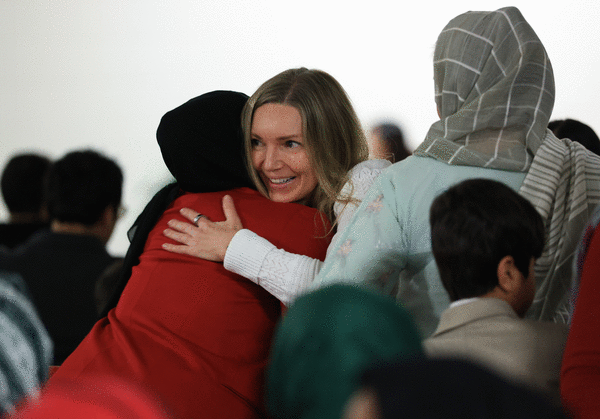
On Friday night, about 250 Afghans and others in the community gathered in Niles at a celebration of the Persian tradition of Yalda, a winter solstice festival that signifies rebirth. There they honored Spc. Sarah Beckstrom, 20, who was killed, and Staff Sgt. Andrew Wolfe, 24, who was critically wounded in the Washington attack.
Federal authorities have charged the suspected shooter, Rahmanullah Lakanwal, with first-degree murder. Lakanwal, who came to the U.S. from Afghanistan under Operation Allies Welcome in 2021, reportedly had been unraveling for years leading up to the shooting.
Wakil Pasakohy, an Afghan who helped organize the Yalda event, said it felt like his duty to remain by the victim families’ side, because he has lost family to violent attacks, too. When Pasakohy first learned about the attack, he was overcome with shame.
“That guy is from my country,” Pasakohy said. “I was very sad and I’m sad still.”
The shooting has sent ripples of worry and anxiety across many of the roughly 2,300 Afghans who have resettled in Illinois since the U.S. withdrew from Afghanistan in 2021. More than 190,000 have resettled across the U.S.
Many Afghans who resettled to the U.S. risked their lives working with the American government or military before the Taliban took control of the country prompting a hasty evacuation by U.S. troops and officials. Qualifying Afghans were provided with pathways for resettlement to the U.S.
In recent weeks, President Donald Trump’s administration moved to pause all pending immigration applications including those for asylum, green cards and citizenship for immigrants from Afghanistan and other countries that the U.S. government deems to be “high-risk.”
Beheshta, who only gave her first name due to sensitivities with immigration statuses in the U.S. and the risk of government reprisal in Afghanistan, said she felt empathy for the victims and their families, but she questioned why a community as a whole should be punished for one person’s actions.
“His crime is an individual action and that is why he must face consequences, not whole communities,” she said.
In June, the Trump administration announced a travel ban for citizens from Afghanistan and 11 other countries, with seven other countries facing restrictions. Last week, the administration announced it will expand travel restrictions on Jan. 1 for an additional 20 countries.
The administration’s recent move to pause all pending immigration applications from immigrants from Afghanistan and 18 other countries of concern has left many in a legal limbo. Some have work permits expiring and no clear way to renew them. Others, waiting anxiously for their naturalization certificates, learned their process had been abruptly halted.
“If (applications) remain paused and someone becomes undocumented in the country, then the government has the right to deport them,” said Wahedullah Niazi, a refugee resettlement supervisor at Jewish Child and Family Services in Chicago. “We are actually fearing that situation.”
Niazi himself is one of the Afghans who resettled in the U.S. after the Taliban took control of Afghanistan on Aug. 15, 2021. He remembers going to his office in Kabul as usual that day and hearing the news of the takeover. It took him hours to get home — a commute that was normally about 20 minutes — because of the gunfire and chaos.
“I was not expecting to be alive until reaching home,” he said. Shortly after, he left his country. He eventually resettled in Chicago.
He believes that if Afghan nationals are deported, they will risk death from the Taliban.
“If they return back, the people there will not see them as friendly,” Niazi said. “With the current government there, I’m definitely sure that they will be prosecuted and they will be thrown into jail. They will be killed.”
Afghan families are also struggling to put food on the table as work permits expire and applications are on hold.
Niazi works with an Afghan family of seven in Chicago. They recently lost their jobs after their work permits expired. They were just weeks away from getting their green cards, Niazi said, but after the pause they are now in a legal limbo: unable to renew their work permits or move on with their green card applications. They worry about being able to feed themselves or pay rent if the pause is sustained, Niazi said.
“Everything is now frozen,” said Rachael Moreno, a program manager of immigration legal services at JCFS who works with Afghans pursuing legal services in the Chicago area.
U.S. Citizenship and Immigration Services has stopped processing immigrant benefit applications such as work permits and residency applications for people from Afghanistan and other “high-risk” countries since Dec. 2, Moreno said, referencing a department memo.
The agency also announced it would be re-reviewing approved applications from immigrants who came to the U.S. after January 2021 from any of the 19 countries of concern, including those with green cards. Yet there is no clear indication of what the re-review process will look like, Moreno said.
One of Moreno’s clients from Haiti, which is listed as one of the countries of concern, had passed their citizenship exam and was waiting to take their oath of allegiance. About a week after the announcement their naturalization ceremony was suddenly canceled with no explanation, said Moreno.
“Where is the justification for those actions?” Moreno said. “People are doing the best they can to follow the rules and the rules keep changing. How do you follow the rules when the rules are unfair?”
Pausing immigration processes for high-risk countries feels like “collective punishment,” said Sayeda Qader, an Afghan community advocate in Chicago and founder of Kalaam Project. “And it has left a lot of Afghans in fear, especially with ICE presence in Chicago.”
Immigration and Customs Enforcement has ramped up Afghan immigrant arrests since the National Guard attack, with roughly two dozen known arrests, mostly in Northern California, according to The Associated Press.
Qader says immigration processes have been delayed since at least the start of 2025, with Afghans not hearing back after scheduled interviews. They now face a new fear: deportation.
“Because of ICE’s presence in Chicago, because of what we’re seeing happen to our Latino community, the Afghan community is in fear that deportations will begin,” Qader said.
“What is the difference between the way the U.S. government will treat the Afghan community and the way they’ve been treating the Latino community?” she said.
Dita De Leeuw, an Afghan community volunteer in the Chicago area and founder of the Roya nonprofit, said that she is not personally aware of Afghan detentions in Chicago as a result of the crackdown. But she has discussed “laying low” with community members and not going downtown unless necessary.
“They are devastated and they are fearful,” De Leeuw said of the Afghan community, because they are uncertain about what the announcement may mean for their immigration cases.
A day after the National Guard shooting, U.S. Citizenship and Immigration Services said it would issue new guidance to consider “negative, country specific factors” when vetting immigrants from 19 countries deemed high-risk by the federal government.
“My primary responsibility is to ensure that every alien is vetted and screened to the maximum degree possible,” USCIS Director Joseph Edlow said in a statement on Nov. 27. “Effective immediately, I am issuing new policy guidance that authorizes USCIS officers to consider country-specific factors as significant negative factors when reviewing immigration requests. American lives come first.”
The Trump administration announced Tuesday it was expanding travel restrictions for an additional 20 countries including Syria and for people traveling with Palestinian Authority-issued documents, doubling the number of countries with travel restrictions to the U.S.
“This is not about security. It is about targeting people based on nationality and political identity, and it will devastate families across Chicago and the country,” Ahmed Rehab, executive director of the Council on American Islamic Relations in Chicago, said in a statement Wednesday. “(Trump aide) Stephen Miller, a far-right ideologue with a problematic track record of undermining our constitutional values, seems to have been given a carte blanche to do as he may — and that is dangerous for America and the world.”
Restricting immigrant visa processing also makes it more difficult for families to reunite and pursue lawful pathways to residency, Heena Musabji, legal director of CAIR-Chicago, said in a statement. “This policy inflicts real harm on people who have done nothing wrong.”
Beheshta, the Afghan woman who has built her life in the U.S. and is studying to become an echocardiogram technician, described returning to Afghanistan as a death sentence.
“Returning back to Afghanistan and the regime of Taliban would be falling to our deaths,” she said.
Women living in Afghanistan are not allowed to study beyond secondary school, and are blocked from most jobs and public spaces like parks or gyms due to Taliban orders. Many are unable to leave their homes out of fear, mobility restrictions, and other forms of discrimination, lending way for gender-based violence, according to a 2025 report by the United Nations.
Afghan women living in America are “free,” Beheshta said. “These women, they have a hope now. They’re studying, they want to do something for their future.”
Beheshta and her 4-year-old daughter have grown used to life here and want to stay.
“This country has become our home,” Beheshta said. “We want to stay here, we want to get an education, we want to grow and to serve for the next generation, and we want to serve for America.”
_____
©2025 Chicago Tribune. Visit chicagotribune.com. Distributed by Tribune Content Agency, LLC.






Comments