Alaska Airlines pilot says Boeing blamed him for door plug blowout
Published in Business News
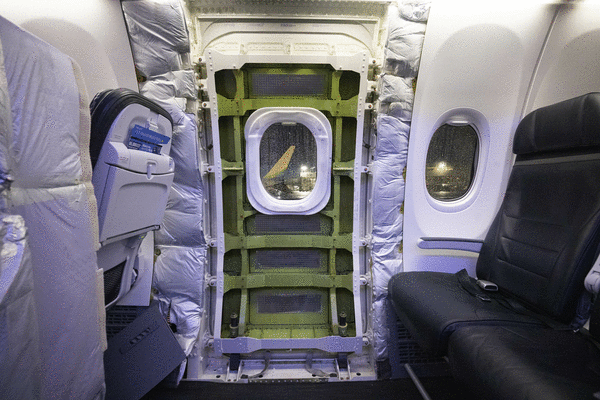
The Alaska Airlines pilot flying Boeing’s 737 Max plane that lost a panel midflight has sued the aircraft manufacturer, accusing the company of initially casting blame for the incident on himself and other parties.
Brandon Fisher, a resident of Vancouver, Washington, said in a Dec. 30 court filing that he has flown only Boeing planes while working for Alaska Airlines. Yet, in the weeks following the panel blowout, he felt the company used him as a scapegoat.
On Jan. 5, 2024, a panel flew off an Alaska Airlines 737 Max just a few minutes after it took off from Portland. The pilots landed the plane safely back in Portland, with passengers reporting minor injuries but no fatalities.
Safety regulators have now determined the panel, known as a door plug, flew off because it was missing four bolts meant to hold it in place. After a year and a half of investigating, the National Transportation Safety Board said in June that Boeing and its chief regulator, the Federal Aviation Administration, were to blame for the blowout.
In the weeks immediately following the incident, though, Fisher said Boeing failed to take responsibility. Instead, the company “attempted to shift blame, intentionally and falsely claiming that (the pilots) made mistakes,” Fisher said in the recent court filing.
Fisher’s lawsuit is one of several filed against Boeing and Spirit AeroSystems, Boeing’s Wichita, Kansas, supplier that builds Max fuselages before shipping them by train to Renton, Washington. Those lawsuits, from passengers, flight attendants and now one of the pilots on board Alaska Airlines Flight 1282, accuse Boeing and Spirit of failing to build and deliver a safe aircraft.
Fisher is seeking $10 million in compensation for the physical and emotional toll of the harrowing flight. In court papers, attorneys from the Seattle-based law firm Cozen O’Connor describe the distressing sequence of events as Fisher landed the plane knowing there was a gaping hole in the aircraft.
Exactly two years ago Monday, Fisher and first officer Emily Wiprud were piloting an Alaska Airlines flight from Portland to Ontario, Calif., when, just six minutes after takeoff, the plane rapidly depressurized. A panel near the back of the cabin had flown off, leaving a gaping hole in the side of the plane at 16,000 feet in the air.
In the cockpit, Fisher’s face was forced forward into the flight deck system and his headset dislodged. He heard a loud noise, which the crew later determined was the cockpit door flying open. Fisher and Wiprud donned oxygen masks.
The pilots struggled to communicate with the flight attendants and heard only that there was a large hole near the back of the plane.
While Wiprud communicated with air traffic control, Fisher disengaged the autopilot and began the plane’s descent, safely landing the aircraft back in Portland, with some passengers reporting minor injuries.
Upon landing, Fisher said the first thing he heard was that a passenger was missing. Fisher later learned the passenger, a teenage boy who was traveling with his mother, had moved to a different seat in the plane but the shock of that moment has stuck with the pilot.
Investigators with the NTSB determined the panel flew off because Boeing mechanics in Renton failed to install four bolts meant to hold the piece in place. Those mechanics removed the panel to fix manufacturing mistakes made at Spirit AeroSystems.
In response to the NTSB’s final report, Boeing said in June it would review the report and recommendations “as we continue to implement improvements.”
“We at Boeing regret this accident and continue to work on strengthening safety and quality across our operations,” a spokesperson said.
Boeing did not immediately respond to request for comment about Fisher’s lawsuit, which was filed in Portland just a few days before the second anniversary of the blowout on Monday.
Fisher felt Boeing tried to blame the pilots for the incident because of how the manufacturer responded to a separate class-action complaint filed against Boeing, Spirit and Alaska Airlines from passengers on board the flight, attorneys from Cozen O’Connor said in the lawsuit.
In response to the class-action litigation, Boeing’s attorneys wrote that the manufacturer should not be held responsible for its products being “improperly maintained or misused by persons and/or entities other than Boeing.” Boeing later amended its legal filing to remove that paragraph.
Fisher says he has endured “lasting physical consequences,” is unable to sustain physical activity for as long as he could before the incident and still thinks about “the troubling events that occurred.”
He has been named in lawsuits filed by passengers on board the flight as recently as May, the court filing read, and has to constantly field questions “about his conduct that were born of Boeing’s inaccurate and accusatory statements.”
The four flight attendants on board when the panel blew out sued Boeing in July, arguing they sustained physical and mental injuries, emotional distress and other financial costs related to the incident.
The lawsuits from passengers and flight attendants remain pending.
©2026 The Seattle Times. Visit seattletimes.com. Distributed by Tribune Content Agency, LLC.









Comments