California allows commercial salmon fishing for first time in 3 years
Published in Outdoors
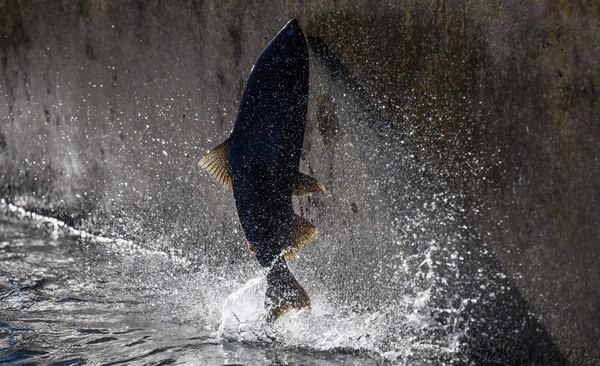
SACRAMENTO, Calif. — California is resuming commercial salmon fishing after three consecutive years of closure due to concerns over declining populations.
Gavin Newsom and state officials celebrated the move, citing the state’s conservation efforts as a key factor that has contributed to the progress.
“We’re doubling down on our strategies to protect this iconic species and ensure it thrives, not just for today, but for generations to come,” Newsom said in a news release Monday.
Fishers will be allowed to fish from Point Arena to the Mexico border, and the season is set to open in May. The first open period will run from May 1 through May 6, according to the California Department of Fish and Wildlife.
Some of the restrictions also include a prohibition on commercial fishing for coho salmon, and the maximum number of lines per vessel is capped at six. The most notable restrictions include a limit of 160 fish per open period per vessel, with a total seasonal cap of 83,000 fish from May through August across all vessels.
The Golden State was hit with some of its worst droughts in 2021 and 2022, causing low water flows and degraded river conditions. Salmon rearing habitats deteriorated amid rising temperatures, both of which shook the population as the fish struggled to survive and make their way to the ocean.
The state has restricted commercial fishing for three consecutive years since 2023 and has leaned on a number of efforts to support the salmon population, including increasing the number of hatchery-reared salmon, while conservationists continue to call for stronger measures and increased water allocations.
“The return of salmon seasons in 2026 is a testament to the heavy rains of 2023, not a shift in management,” Vance Staplin, executive director of the Golden State Salmon Association said in an email.
“While these limited seasons provide some much-needed relief, the industry is still operating in survival mode. Until we see more balanced state and federal water policies that leave enough water in our rivers, these brief openings will remain a Band-Aid on a much deeper wound.”
California has seen several wet seasons in recent years following the droughts of 2021 and 2022. In 2023, in particular, the state experienced what scientists and state officials described as “weather whiplash,” with a deluge of heavy precipitation. Even so, the long-term climate change trend continues to constrain water regulators’ ability to manage a limited water supply, as has been the case this year.
Just last month, conservationists called for the urgent release of additional water from reservoirs into the Sacramento River after the U.S. Fish and Wildlife Service released more than 6.2 million juvenile salmon into what they described as “deadly” low-flow conditions. The Bureau of Reclamation released additional water from Keswick Dam, but current snowpack conditions still point to risks for the remainder of the water year.
California Department of Water Resources Director Karla Nemeth said during snowpack media day on April 1 that the state’s near-record-low snowpack of about 18% of average statewide will be what California has to rely on through October. The state is seeing above-average water levels in key reservoirs like Shasta Lake, but it relies on snowpack during drier periods, as its gradual melt into rivers acts as a natural reservoir that replenishes flows.
“We have seen several wet years and the cohorts of fish now in the ocean experienced good freshwater conditions in 2023 and 2024,” Carson Jeffres, a senior researcher at UC Davis’ Center for Watershed Sciences, said.
“We have seen in the past that fish that left freshwater in these wet years generally have pretty good survival and should be relatively abundant in the ocean,” Jeffres continued, adding that he hopes the harvest quotas are “well within the conservative range of population models.”
____
©2026 The Sacramento Bee. Visit sacbee.com. Distributed by Tribune Content Agency, LLC.





Comments