Omar Kelly: Dolphins better learn from organization's previous costly mistakes
Published in Football
MIAMI — “The market [is] the market,” and the Miami Dolphins made a horrendous mistake by, in Tua Tagovailoa’s own words, “show[ing him] the money.”
Those were Tagovailoa’s infamous words spoken two offseasons ago when the Miami’s Dolphins’ Pro Bowl quarterback was explaining why he wasn’t participating in the 11-on-11 portions of the team’s offseason work, and hinting that he might become a holdout, or hold-in for training camp if a contract extension didn’t get done.
It was a warning, a threat made with the intention of getting the Dolphins franchise to cave, sweeten their negotiating position to pay the former Alabama standout a contract that escalated his salary to where his peers — Jalen Hurts, Justin Herbert, Trevor Lawrence, Jared Goff — were, getting him up to the $40 million-plus a season salary range.
The Dolphins did just that fearing a hold-in during training camp, which would have set the offense behind for the 2024 season.
Then head coach Mike McDaniel twisted the organization’s arms, forcing general manager Chris Grier to sweeten the team’s offer to Tagovailoa at the end of training camp’s first week, instead of making Tagovailoa play in his $22.3 million fifth-year option, and possibly use the franchise tag to force his to return in 2025.
That approach would have placed Tagovailoa in a situation where he had to perform at a high level — repeat his Pro Bowl earning 2023 performance — for two more seasons to be handsomely rewarded with the desired level of compensation.
That was Grier’s desire. But he was overruled, and like usual, the Dolphins former general manager, who too often lacked a backbone and conviction, caved when McDaniel went to owner Steve Ross and convinced him a deal needed to be done.
This is Dolphins history, which explains exactly how we got here, residing in cap hell weeks before free agency opens.
The reason I’m making Dolphins fans replay this “show me the money” saga is because I’m not sure enough lessons were learned from it.
And anyone (or organization) that doesn’t learn from their mistakes are destined to repeat them.
The first lesson Miami should have taken from the Tagovailoa extension, which is the reason the Dolphins are committed to paying Tagovailoa $54 million this season, is don’t compensate players who only produced one dynamic season.
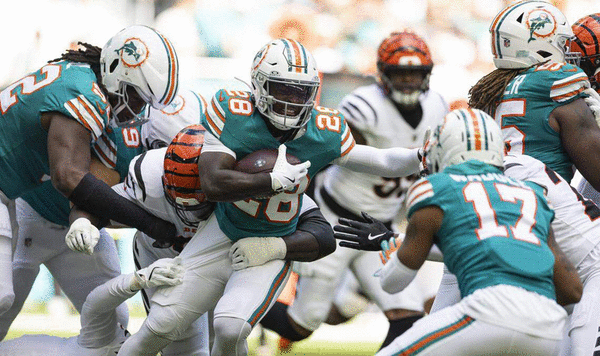
That lesson better come into play with De’Von Achane this offseason, because Miami’s Pro Bowl tailback will likely pull the same shakedown Tagovailoa did, sitting out most, if not all of the voluntary offseason works. And possibly threaten to stage a hold-in during training camp if he doesn’t get a lucrative contract extension that puts him in James Cook’s neighborhood after the Buffalo tailback landed a five-year, $51 million ($30 million guaranteed) contract extension from the Bills.
While Achane’s goal/demands/negotiating stance isn’t unreasonable, especially considering he’s arguably the team’s top talent at this point, Miami does indeed have him locked in for two more years at roughly $20 million total.
Achane, who rushed for 1,350 yards, caught 67 passes for 488 yards, and scored 12 touchdowns last year, is slated to earn $5.6 million in 2026. And past that the Dolphins can use the franchise tag, committing to pay the former Texas A&M standout $14.2 million for the 2027 season to keep other teams from bidding on him.
Taking that approach would be beneficial long-term because it forces Achane to earn the money, and protects the Dolphins from assuming all the risk on a tailback.
Keep in mind tailback is one position that is viewed as a low-priority spot on the roster since tailbacks are often treated like the tires on a car since every team needs more than one, and once the tread is gone it’s time to move onto the next.
Achane won’t be happy with the Dolphins taking this frugal approach, and he might demand a trade. But this franchise is embarking on a full-scale rebuild, and if we’re being honest, by the time the Dolphins are positioned to be good again (two to three seasons from now), Achane’s tread will likely be gone since he’s one of the NFL’s smallest tailbacks.
The second lesson the Dolphins should take from Tagovailoa’s contract extension is that competition is needed at every position, every year, and that’s one thing this franchise has run from when it comes to quarterbacks for decades.
The last quarterback competition the Dolphins had was in 2012 when David Garrard sustained a season-ending knee injury during training camp, and Matt Moore, who was chosen as the MVP of the 2011 season, got to compete with Ryan Tannehill, a first-round pick in 2012, for a single week before the franchise handed the starting job to the rookie.
Since then that spot has been gifted to Jay Cutler (2017), Ryan Fitzpatrick (2019), and then Tagovailoa.
Maybe if Miami had added a quarterback better than Mike White and Skylar Thompson in the 2024 offseason, let’s say veteran quarterback Jimmy Garoppolo, Tagovailoa’s threats to sit out training camp, and the exhibition season wouldn’t have been so scary to McDaniel.
Even now, the NFL’s chatter is that new general manager Jon-Eric Sullivan and head coach Jeff Hafley will pursue Packers quarterback Malik Willis, who has served as a backup in Green Bay, the organization Sullivan and Hafley are coming from. But Willis might only consider Miami as a possible landing spot if Tagovailoa is gone, and he’s guaranteed the starting role.
Willis will supposedly have options, and maybe massive offers. We will see where things stand two weeks from now with Willis’ courtship. But should an organization really pursue a quarterback who fears competition, even if the deck is stacked in his favor?
Again, I repeat, those who don’t learn from their past mistakes are likely going to repeat them.
©2026 Miami Herald. Visit miamiherald.com. Distributed by Tribune Content Agency, LLC.





Comments