Chiefs agree to deal to move to Kansas in 2031
Published in Football



TOPEKA, Kan. — The Kansas City Chiefs announced Monday their plans to move across the state line and build a new stadium in Wyandotte County.
The announcement came after a group of top Kansas lawmakers met in Topeka to approve an incentive package, and as Gov. Laura Kelly spoke at a news conference to announce some of the details.
The stadium will be built in Wyandotte County and will be surrounded by an entertainment district, Kelly said. A new team headquarters and a practice facility will be built in Olathe, Kan.
“Kansas is not a fly-over state. We’re a touchdown state,” Kelly said, calling today’s announcement “a little bit surreal.”
In a written statement, Chiefs owner Clark Hunt confirmed the news and added further details.
“Today we are excited to take another momentous step for the future of the franchise,” he said. “We have entered into an agreement with the State of Kansas to host Chiefs football beginning with the 2031 season.
“In the years ahead, we look forward to designing and building a state-of-the-art domed stadium and mixed-use district in Wyandotte County, and a best-in-class training facility, team headquarters and mixed-use district in Olathe, totaling a minimum of $4 billion of development in the State of Kansas.”
Lawmakers approved incentives
A council of Kansas lawmakers in Topeka voted unanimously to approve a deal negotiated with Chiefs ownership by Lt. Gov. David Toland on behalf of the Kansas Department of Commerce.
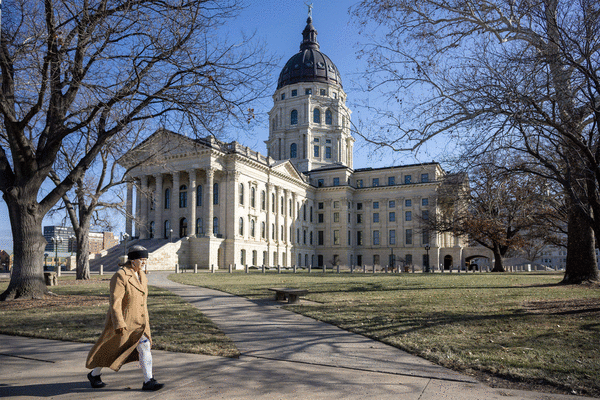
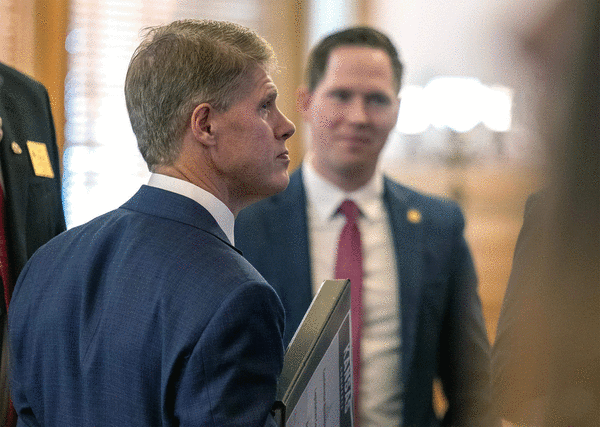
The lawmakers, eight members of Kansas Legislative Coordinating Council, met at 1 p.m. CST in the Kansas Capitol. Within an hour, they had met in executive session, out of the view of the public, and returned to vote unanimously to approve an incentive package that would allow the Kansas City Chiefs to move to Kansas.
Rep. Sean Tarwater, a Stilwell Republican, said he helped craft the souped-up stadium incentive package, and said STAR bonds are “a unique way to fund really big, cool, fun things.
“It’s a way to build things and allow the people who visit the attractions to pay for it, rather than putting it on the taxpayers’ backs.”
He had high praise for Lt. Gov. David Toland, a Democrat, who led negotiations with the Chiefs.
“I can’t really comment on the details until the governor speaks for all of the work that they did. They did a lot of really good work on this. David Toland is an incredible negotiator, and I feel like the state of Kansas got a great deal,” Tarwater said. Meeting in Topeka
Monday’s meeting at the Kansas Statehouse had loomed for days as it emerged to play a pivotal role in deciding which side of the Missouri border the Kansas City Chiefs would build their future on.
Top Republican and Democratic lawmakers in Topeka were expected to discuss the status of a possible massive subsidy deal to lure the Chiefs across the state line at the meeting of the Legislative Coordinating Council, or LCC.
The Kansas Legislative Coordinating Council, or LCC’s, meeting was a significant revelation after state lawmakers passed a supercharged bonding program, known as STAR bonds, for the Chiefs.
The influential eight-member panel includes the top Democratic and Republican leaders in both chambers of the Kansas Legislature and oversees state business when lawmakers are not in session.
Kansas plans to fund the development through a supercharged version of its Sales Tax and Revenue, or STAR bonds program, which is designed to fund regional attractions by paying back developers with future sales tax revenue generated by tourists. Per the program, the bonds can fund up to 70% of a new stadium project. It’s not yet clear how much of a new Chiefs stadium will be publicly subsidized.
A new domed Chiefs stadium is estimated to cost around $3 billion, not accounting for any practice facilities.
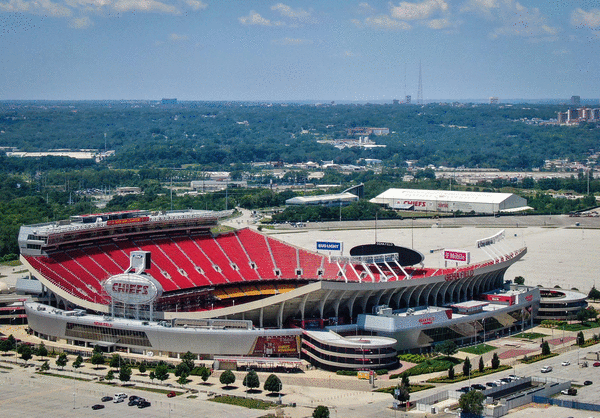
Arrowhead Stadium
The Chiefs have played at Arrowhead Stadium in Kansas City, Mo., since 1972, and it’s been home to the birth of a recent football dynasty. Their current lease expires after the 2030 season.
The seismic decision comes after a year and a half of the Chiefs playing Kansas and Missouri officials off of each other to secure the most favorable stadium deal.
The move is likely to send shockwaves across the Chiefs’ home state of Missouri, where officials have routinely touted ongoing negotiations to keep the team inside state lines.
In April 2024, Jackson County voters rejected the 40-year extension of a local sales tax that would have funded a new Royals Stadium and major renovations at Arrowhead Stadium.
When the ballot question was rejected, Kansas officials seized on the opportunity to make their own pitch.
Missouri officials remained optimistic in the lead-up to the Kansas Legislative Coordinating Council’s vote that a competing incentive offer to fund up to 50% of stadium costs with public money would be enough to keep the Chiefs from crossing the border.
“No matter how long we had to think about this as a possibility, it’s still a shock to the system,” Missouri House Speaker Jonathan Patterson, a Lee’s Summit Republican, said in a phone interview after news of the Chiefs’ move broke.
Patterson characterized the Chiefs’ move as a business decision, saying that a new domed stadium in Kansas was an offer that Arrowhead Stadium in Missouri could not match.
“As easy as it would be to now play the blame game here in Missouri, I think it’s best we regroup and get together as city, state and county leaders and see what we can do about maybe keeping the Kansas City Royals in Missouri,” Patterson said.
©2025 The Kansas City Star. Visit kansascity.com. Distributed by Tribune Content Agency, LLC.



Comments