Vahe Gregorian: Chiefs' move to Kansas for more money abandons legacy that made them special
Published in Football
KANSAS CITY, Mo. — When Lamar Hunt moved his Dallas Texans here in 1963, it was well-understood that the most pivotal force in the decision was then-Kansas City Mayor H. Roe Bartle — who liked to say he went to Hunt “on bended knee and begged him to move to Kansas City.”
There was much more to it than that, including some skullduggery along the way. But Bartle’s role is why when the move was made official in May 1963, The Star wrote that Hunt called Bartle “a great salesman” and said “he and Kansas City itself convinced me” to move.
It’s why then-Texans executive Jack Steadman persuaded Hunt to name them the Chiefs in honor of Bartle’s nickname — despite “Mules” emerging as the winner of The Star’s “Rename the Dallas Texans” contest.
And it’s why Kansas City, Mo., procured the team.
Not that the distinction held much meaning outside the area back then.
“I didn’t know there were two of them: Kansas City, Mo., and Kansas City, Kan.,” Chiefs legend Len Dawson said in our 2013 interview about the 50th anniversary of the move. “(Friends asked) which one it was. I said, ‘What do you mean?’”
The Missouri side was where the franchise moved on the promise of 25,000 season tickets to be sold (only a few over 15,000 actually were purchased in advance), about $500,000 in upgrades to old Municipal Stadium (where they paid $1 in rent annually for their first two seasons) and an office and practice field at Swope Park.
From those simpler times, the Chiefs became entwined with the very identity of Kansas City proper.
First as a trendsetting and stylish franchise of the 1960s, one known for breaking racial barriers and innovations on the field under head coach Hank Stram.
Then with the development of Arrowhead Stadium and its iconic mystique — punctuated by fans there setting the record for loudest outdoor crowd roar (142.2 decibels), as measured by the Guinness Book of World Records.
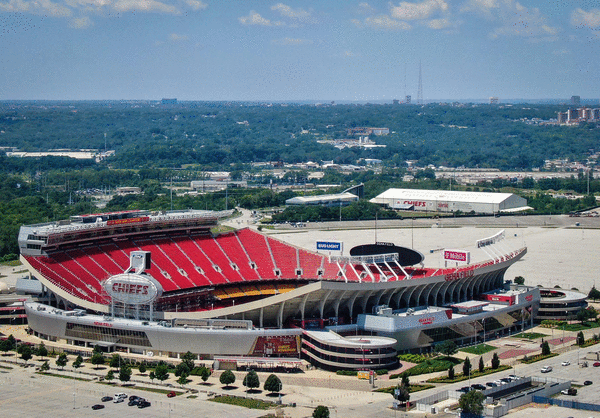
And now through the recent dynastic success that has put Kansas City on the world map as never before — including with its bucket-list mecca of a stadium that Chiefs chairman and CEO Clark Hunt only a few years ago referred to as a place where people have been “sort of making a pilgrimage.”
A place that was a pillar of Kansas City becoming a 2026 FIFA World Cup host and a game-day experience that became synonymous with the community — from whichever side of the state line you came.
So there was something jarring in the news Monday of the Chiefs’ upcoming move to Kansas for funding that will enable the franchise to build a multi-billion dollar domed stadium in Wyandotte County.
Because in the process, the Chiefs renounced a core aspect of their heritage and generations of shared experiences that became the fabric of the franchise and the identity of the city — and, yes, the extended region
The stuff dreams were made of, and that fed into an audacious ambition of becoming the “World’s Team.”
Instead of leaning into this rich tradition, one they could have enhanced with more than a billion dollars in funding on the Missouri side, the Chiefs seized on a transformative deal.
One that, STAR-bond math and methodology willing, theoretically will allow them to make a lot more money — surely in part by charging a lot more — and should help the area earn bids for future events, such as Super Bowls and men’s Final Fours.
So, good for them, I guess. And maybe for us, too. At least one day.
After the expiration of their lease at the Truman Sports Complex expires following the 2030 season, perhaps the experience at whatever the new stadium will be called will be so incredible that we’ll be more in awe than sentimental.
Indeed, one of the factors in play no doubt was all the annual trips to places like SoFi Stadium in Los Angeles and Allegiant Stadium in Las Vegas, multi-billion stadiums that Hunt in the past has referred to as having amenities he was “sure we’ll want to incorporate” when they get to the end of their lease.
Some will say Jackson County did this to itself with the vote last year, and so what if the Chiefs are moving a few miles, and that this is just the price of progress.
But, sorry, this reverberates here as simply all about the money. It doesn’t feel like something to celebrate.
Because it’s hard not to think more now about the implications of abandoning the lore and allure of Arrowhead, the third-oldest stadium in the NFL behind Soldier Field in Chicago and Lambeau Field in Green Bay, Wis.
Most of all, I picture the crater there when they likely knock down a perfectly viable and treasured site that Hunt as recently as 2022 called “state of the art.” (Speaking of which, the Royals’ future home remains a mystery beyond owner John Sherman’s past statements that they will not be playing at Kauffman Stadium in the sports complex after the 2030 season.)
And I sure find myself thinking about how the visionary who put all this into motion would view the forswearing of The House That Lamar Built — a place that the Chiefs and AFL founder considered one of his favorite sites on Earth.
At least once, he put it this way to Clark Hunt, who, per Forbes, along with each of his siblings owns a quarter share of the team.
“If he could pick one vacation spot in the world,” the son in 2022 recalled him saying, “it would be Arrowhead.”
Tempting as it is to say Lamar Hunt would be distraught over this move, alas, it’s likely more nuanced and complex than that.
Bear in mind that when he moved the team here, he spoke often of the organization as a regional enterprise.
And a key premise of the first Chiefs logo, albeit secondary to the now-wince-inducing caricature of a Native American in the foreground, is the territory over which he’s running: a six-state area also including Arkansas, Iowa, Nebraska and Oklahoma.
It’s also only fair to say this probably was no simple decision for the Hunts. As the Chiefs began studying their options in 2022, Clark Hunt said in an ideal world his “heart tells me that I hope it’s Arrowhead, right? Because Arrowhead is so special to our family.”
He added, “The important thing, though, is that we find the right solution for the Chiefs and the community and something that can last for hopefully another 50 years.”
In St. Joseph in July, team president Mark Donovan spoke to a crucial moment in the process among the siblings (while preferring not to specifically identity who said what).
After Donovan posed a question to them about whether they’d really consider options outside Arrowhead, one sibling cut to the heart of the matter: “‘Would Dad want us to stay?’”
Two of the siblings, Donovan recalled, reminded that, “‘Dad was the one who moved us from Texas.’”
From that ultimately emerged a consensus, he said: “‘Dad would want us to do what’s best for our fans.’”
Even with that spirit behind the thinking, whether this really is that remains to be seen.
Because right now it sure feels like this move is more about something lost than something gained.
____
©2025 The Kansas City Star. Visit kansascity.com. Distributed by Tribune Content Agency, LLC.





Comments