Paul Sullivan: Hall of Fame cap saga finally ends for Cubs great Andre Dawson
Published in Baseball
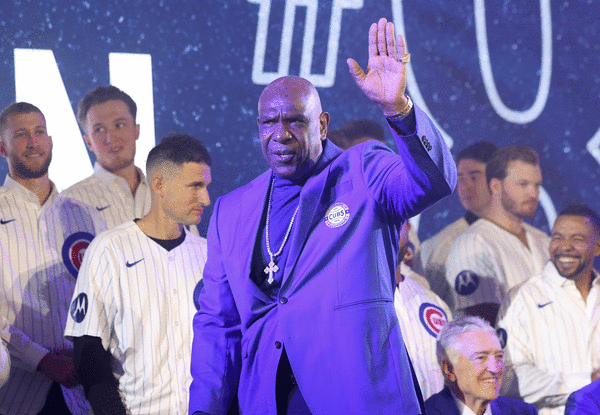
CHICAGO — It took longer than he anticipated, but Andre Dawson finally came to an agreement with the Baseball Hall of Fame regarding his plaque in Cooperstown.
Back in 2023, Dawson informed me he was asking the Hall to change his plaque, removing the Montreal Expos cap he wore and replacing it with a Chicago Cubs cap.
Simply put, he wanted to be remembered as a Cub because “that’s where my heart is.”
Dawson will indeed get a new plaque, the Hall confirmed. But instead of changing it to a Cubs cap, there will be no logo at all, as has been customary for many new members since 2014 — including Greg Maddux, Tony La Russa and Jim Leyland — whose careers weren’t primarily associated with only one organization.
Jane Forbes Clark, Chairman of the National Baseball Hall of Fame and Museum, said in a statement that the board of directors met and approved the change.
“The Hall of Fame Board of Directors voted unanimously to provide Andre Dawson with the option of having no logo on his Hall of Fame plaque, which will be recast to reflect his wishes,” Clark said in a statement. “This decision gives Andre a choice that he would have taken if it had been available when he was elected in 2010, just four years prior to the formal implementation of that alternative.”
Dawson said he was fine with the compromise.
“After our conversations (in 2023), I think I expressed what my true feelings were, and moving forward I didn’t get a sense that anything was going to get done,” Dawson said Tuesday from Arizona, where he’s conducting business and planning to take in some Cubs games. “They knew my preference all along was the (Cubs’) ‘C,’ and if that wasn’t manifested, then just give me a blank cap, such as the protocol is now with (Hall of Famers).
“It’s been resolved, and I can move forward now.”
To understand how important this matter was to Dawson, a little history lesson is necessary.
While Dawson spent the first 11 of his 21 seasons with the Expos, and only six with the Cubs, he always felt he was more associated with Chicago, where he won a National League MVP award in 1987 and earned five All-Star nods. Montreal’s owner, Charles Bronfman, didn’t treat him fairly, he believed, and Expos fans booed him whenever he returned to Olympic Stadium.
But the Hall makes the final decision on what cap an inductee wears on his plaque, and Montreal was chosen when Dawson was elected in 2010 in his ninth year on the Baseball Writers’ Association of America ballot.
“When I think about them immortalizing a cap, it would be the Chicago Cubs for a lot of personal reasons,” Dawson said at the time. “When the announcement was made last night, it was a little gut-wrenching.”
Getting in was the most important thing, so Dawson accepted the decision and didn’t make an issue of it. But 13 years went by, and he decided in ’23 to try and right a wrong, knowing it was probably a long shot.
“I don’t expect them to jump on something like this,” he told me when he made the request in ’23. “If they elect to respond, they’ll take their time. And it wouldn’t surprise me if they don’t respond.”
The Hall heard his request and eventually decided to keep the status quo. Dawson did not attend the Hall of Fame ceremonies in 2024 or ’25, upset that he was being ignored.
“I took the approach, ‘You know what, it just wasn’t that important to me anymore,’” he said. “I felt all along that since it’s your legacy, and how important that is to you, that you should have your hand in it in some form or manner moving forward. I just didn’t feel, out of respect from the Hall, that they should completely control that (decision).”
Fellow Hall of Famer Joe Torre, the former New York Yankees manager and vice chairman of the Hall board, eventually reached out to Dawson to try and smooth things over.
“I respect Joe, he’s old school,” Dawson said. “He gets it. I see a lot of myself in the way he thinks about honesty and fairness. Joe made a comment about my presence at the Hall of Fame, that I was missed, and why it was important that I should be there.
“Some of the stuff he said I could relate to. But under the same token, there’s a lot of pride and principle when it comes to me. I felt that to really right a wrong, it was a simple request from me. Joe wanted to move forward and see if there was anything he could do to talk the matter up at the committee and resolve it, and he was able to do that.”
Dawson said he’s not the least bit concerned about Montreal fans getting upset with the decision to remove the “M” from his plaque, leaving the Expos with two members — Gary Carter and Tim Raines — representing their defunct organization.
“In all honesty and sincerity, those fans lost me when I went back as a Cub,” he said. “Because they booed me for the simple reason I wouldn’t sign for a $200,000 cut in pay. If that’s what you think of me after 10 years, what I had put my body through to play in that environment, playing on Astroturf … You’re going to boo me for not taking a $200,000 pay cut? At that point, you’ve lost me.”
This was during the collusion era, when owners tried to suppress salaries by not offering free agents their market value. Dawson felt negotiations with Expos owner Charles Bronfman were leaked to the press, and said one report claimed his agent and wife were intoxicated during a meeting.
“That was the farthest thing from the truth, and it opened my eyes that this is where I am with this organization, and I might as well move on,” he said. “That’s one of the red flags, why I didn’t want to be represented as an Expo going into the Hall of Fame.”
Dawson instead showed up at Cubs’ spring training in ’87 and made the most famous gambit in free agent history — offering the team a blank contract to sign him. Cubs general manager Dallas Green called it a “dog and pony show,” but later made a low-ball offer — $500,000 plus $200,000 in incentives. It was well below Dawson’s market value.
“He didn’t know how to react, and said he needed some time to think about it,” Dawson said. “He took the rest of the day and night, and called me the next day. Then he made me an offer to refuse, because he knew I had already refused a $200,000 cut (from $1.2 million in Montreal).”
The rest is history. Dawson won the 1987 MVP with a 49-home run, 137-RBI season in Chicago and earned a spot in Cooperstown. Almost four decades after arriving in Chicago, he still considers it the best part of his life. Dawson plans to be back on opening day in a couple of weeks and said he’ll always consider himself a Cub.
“It was a historical part of my career, and where undoubtedly I had the greatest time, irrespective of how many years I played there,” he said. “My kids were born there. That’s where my heart is. That’s where it has always been. I’m grateful and thankful that while I’m still walking this earth, I’m still associated with the Cubs organization.”
Whether or not there’s a “C” on his Hall of Fame plaque, that will never change.
____
©2026 Chicago Tribune. Visit chicagotribune.com. Distributed by Tribune Content Agency, LLC.
Comments