Matt Calkins: Why the next year will be key for future of Major League Baseball
Published in Baseball
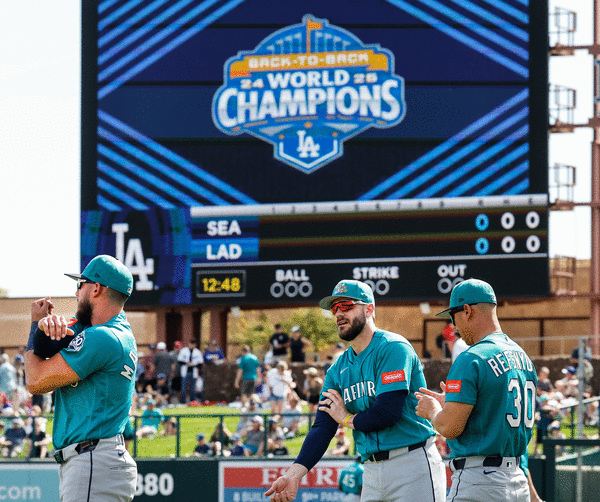
SEATTLE — It's harder to keep a stride in your step when you're feeling a pebble in your shoe.
You could say this about MLB's elite young players, just as you can their most ardent fans.
Because as stable as the sport seems to be right now — with the ungodly contract sizes and last year's exhilarating postseason — there is a looming labor war.
Could that mean forfeiting games for the 2027 season? Let's hope not. But it could transform Major League Baseball on a scale we haven't seen in decades.
The most explosive baseball news in the last week was MLBPA director Tony Clark resigning after an investigation uncovered an inappropriate relationship he had with his sister-in-law, who was hired by the union in 2023. But the story that will truly shape the future of the league over the next eight months (or more) will be what his successor does to negotiate a new collective bargaining agreement with the owners.
The biggest obstacle? Whether a salary cap will be implemented to try and bring more parity to the league. The Dodgers' back-to-back championships were perhaps the worst possible result for the players at large, as it amplified the idea that the richest teams can buy titles while the more financially constrained ones flounder.
Yes, there's a luxury tax — which forces teams whose payroll exceeds a set limit to throw money into a collective fund, but teams such as the Dodgers scoff at that. Owners want parity. Players want paydays.
Who's going to win?
You could certainly see why players wouldn't want to budge. For a while, MLB has been the only major American sports league that doesn't put a cap on how much a team can spend. It's one thing for the Dodgers to give a generational player such as Shohei Ohtani a 10-year, $700 million contract. But it's another thing to tack on players such as Kyle Tucker ($60 million a year), Mookie Betts ($32.5 million), Blake Snell ($36.4 million) and many, many others.
You're not going to see that kind of stacking in the NFL or NBA, even if the star players still get a hefty sum. And when there is an unlimited amount of money that can be spent theoretically, there is more opportunity for players across the league. Their market value goes up, and their bank accounts do, too.
Last year, over $6 billion was spent on payroll across the league. Let's say a salary cap drops that number to $4.5 billion. No player is going to starve, but contracts will decrease.
Of course, the small-market owners are likely saying yeah, $6 billion was spent — but five teams dropped over $314 million on payroll while four spent less than $110 million. This is something one simply doesn't see in the aforementioned leagues. Not anywhere near to that extent, at least. Yes, there have been instances where clubs such as the Royals or Rays win or reach the World Series — just as there have been cases where big spenders such as the Mets miss the playoffs. But the rule generally follows: spend and succeed.
My opinion? Baseball has more variables than most sports to make it so the talented team fails to win the World Series more often than it hoists a trophy. If the Dodgers didn't have four or five miraculous moments in Game 7 last year, they likely would have fallen to the Blue Jays.
But over the course of each season, the most frugal teams tend to be out of the playoff race by August whereas the least thrifty thrive. The owners are just as motivated to hold out for parity as the players are to stop a salary cap.
Where the Mariners fit into all this is tough to say. Fans (rightfully) have bemoaned their lack of spending over the years, but they were 15th in payroll last year. A cap won't save a team that only spent $86 million (the Marlins), but it could be a great benefit to Seattle, which spent $194 million.
We'll see what happens. The current CBA is set to expire on Dec. 1. The league is in good shape now, but it could be catastrophic for MLB to see a significant number of games nixed in 2027. Nevertheless, a lockout at some stage seems inevitable.
A chasm exists between the players and owners right now — both of which have strong arguments. But they need to make sure they don't let that chasm turn into a calamity.
____
© 2026 The Seattle Times. Visit www.seattletimes.com. Distributed by Tribune Content Agency, LLC.






Comments