As Tyler Skaggs wrongful death case heads to jury, Angels insurers may press for settlement
Published in Baseball
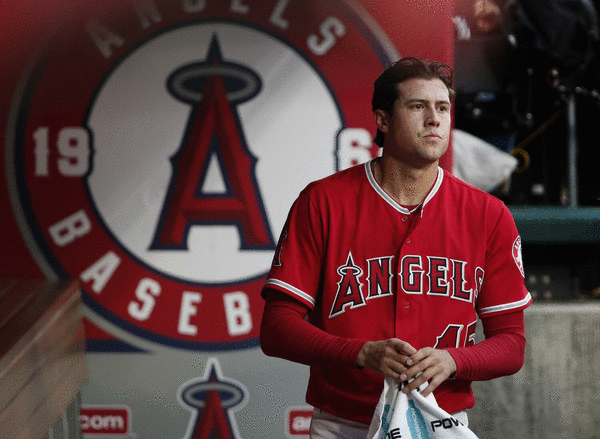
LOS ANGELES — Four years after the family of deceased Angels pitcher Tyler Skaggs filed a wrongful death suit against the Angels, and two months into often contentious testimony in an Orange County Superior Court courtroom, jurors are set to begin deliberations on whether Skaggs' widow and parents deserve hundreds of millions of dollars.
During closing statements Monday, plaintiffs lawyer Daniel Dutko argued that the Angels were negligent in failing to supervise Eric Kay, the drug-addicted team communications director who gave Skaggs the fentanyl that killed him in 2019.
However, Angels lawyer Todd Theodora insisted that Skaggs was a selfish, secretive opioid addict who for years manipulated Kay into obtaining drugs for him. Theodora told the jury that the Angels didn't owe the Skaggs family any award.
"He died when he was doing things we teach our children and grandchildren not to do — do not chop up and snort pills from the street," Theodora said.
But it's not just Skaggs' family and the Angels who have a lot riding on the jury's decision. Among those powerful stakeholders who have been watching the proceedings closely are the agencies that insure the Angels.
According to people with knowledge of the Angels' defense, the team is insured by several companies that each provide coverage with various limits, and it's possible that those insurers could facilitate a case settlement even before the jury reaches its verdict.
"Insurance companies are in the business of mitigating risk; they don't like uncertainty," said Brian Panish, a Los Angeles personal injury lawyer who was not involved in the case but has won several landmark jury verdicts. "They calculate risk and proceed from there. In this case we are talking about multiple insurance companies, a tower of insurance."
Even though the insurance companies represent the Angels, they ultimately could reduce risk for the Skaggs family and their lawyers through an 11th-hour settlement.
Legal experts say that in cases where enormous sums of money are at stake, the two sides can reach what is called a high-low agreement, with the insurance companies promising to pay plaintiffs an agreed-upon sum even if the jury awards nothing. In exchange the plaintiffs accept an agreed-upon cap to their award — even if the jury thought they deserved more.
A nightmare outcome for the Skaggs family would be the jury awarding them nothing, meaning that in addition to widow Carli Skaggs and parents Debbie Hetman and Darrell Skaggs leaving empty-handed, their high-powered legal team that has spent thousands of hours on the case wouldn't be paid. Their contingency fee — typically 35% to 40% of an award — would be zero.
A high-low agreement with the Angels would ensure that Skaggs' lawyers are paid and the family gets some money even if the jury denies them anything.
Both sides are scrambling to assess risk before the jury returns a verdict. Another source of information for the Angels has been a "shadow jury," a half-dozen or so people hired by the insurance companies to sit in on the trial and provide feedback to the Angels lawyers on their reactions to the testimony.
Next could come negotiations with little time to spare.
"Who is going to blink first?" Panish said. "The posturing and maneuvering is over. The hay is in the barn. The bricks have been laid. I'd be very surprised if they aren't talking already."
A person with knowledge of backroom negotiations between the two sides said one insurance company with a relatively low limit on its coverage of the Angels — near the bottom of the tower — has blocked progress toward a settlement. The insurance companies eventually made a "lowball offer" more than a month ago that was rejected by the Skaggs family.
"If a settlement proposal is within the insurance policy limits, there will be pressure on the defense to settle," Panish said. "But if it is above the limits, say coverage is for $50 million and the demand is $100 million, the insurance companies can't force the Angels to settle because they would have to pay the excess amount."
The facts regarding Skaggs' death are not in dispute. An autopsy concluded the 27-year-old left-hander accidentally died of asphyxia after aspirating his own vomit while under the influence of fentanyl, oxycodone and alcohol the night of July 1, 2019, when the Angels were in Texas for a three-game series against the Rangers.
Kay provided Skaggs with the counterfeit oxycodone pill laced with fentanyl and is serving 22 years in federal prison for his role in the death.
The Skaggs family legal team, led by attorneys Rusty Hardin, Shaun Holley and Dutko, argued that several Angels employees knew about Kay's own years-long addiction to opioids and ignored team and Major League Baseball policies by failing to report or punish Kay.
Dutko said Kay was operating within his scope of employment when he gave Skaggs and several other players opioid pills — a stance vigorously opposed by Theodora. Dutko referred to testimony that Kay did anything he could to please players — obtaining Viagra prescriptions and marijuana vape pens for them, booking tee times and massages, and humoring them by taking a fastball off his knee and eating pimples off the back of star outfielder Mike Trout.
"From Viagra to vape pens to opioids. Eric Kay's job responsibility was to get the players anything they wanted," Dutko said.
Theodora continually portrayed Skaggs as a conniving drug addict who callously pressured Kay to obtain pills for him and doled out pills to teammates, even pressuring Kay to deliver opioids shortly after the longtime employee and admitted drug addict came out of rehab.
On Monday, Theodora reviewed testimony from five of Skaggs' teammates dating back to 2011 and argued that not only had Skaggs' drug use escalated over a nine-year period, but that Skaggs had introduced Kay to them and personally obtained pills for the players.
"It's called the chain of distribution," Theodora said.
The Skaggs family is seeking not only lost earnings and emotional distress damages but also punitive damages. California law doesn't allow punitive damages in a wrongful death case, but precedent going back to the O.J. Simpson case makes an exception if the person suffered property damage before death. Skaggs lawyers believe Kay was responsible for fentanyl contaminating the pitcher's iPad, which was confiscated and never returned to the family.
"The jury first must find the defendant liable for economic and emotional distress damages, and then a second deliberation will determine if punitive damages are appropriate," said Edson K. McClellan, an Irvine lawyer who specializes in high-stakes civil and employment litigation. "The purpose of punitive damages is to send a message to the defendant: Don't do this again."
McClellan said a purpose of closing statements is to "sway hearts," to persuade jurors who might not have made up their minds. Both sides gave impassioned arguments that the case they presented over two months validated a verdict in their favor.
Both sides will give closing rebuttals Tuesday before the case goes to the jury. Judge H. Shaina Colover has emphasized that she wants a verdict by Friday. Unlike a criminal trial that requires all 12 jurors to agree on guilt or innocence, only nine of the 12 are needed to deliver a verdict and agree on damages in a civil trial.
____
©2025 Los Angeles Times. Visit latimes.com. Distributed by Tribune Content Agency, LLC.




Comments