Californians may need to mail ballots early as Supreme Court signals support for new Election Day deadline
Published in Political News
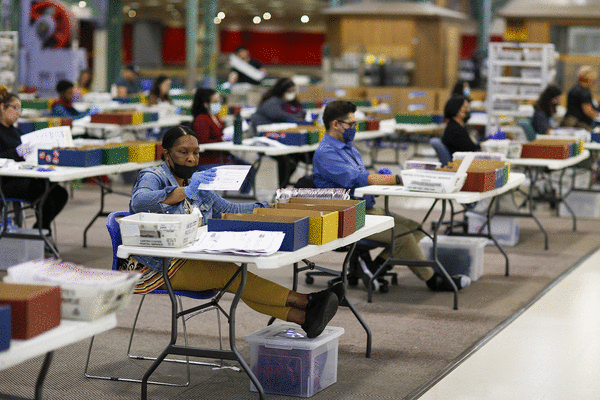
WASHINGTON — Californians may be forced to put their ballots in the mail well before Election Day to be certain they will be counted.
That’s the likely outcome of a Republican challenge to mail-in ballots that came before the Supreme Court on Monday.
The court’s six conservatives sounded ready to rule that federal law requires that ballots must be received by Election Day if they are to be counted as legal.
In the 19th century, Congress set a national day for federal elections on a Tuesday in early November, but it did not say how or when states would count their ballots. The Constitution leaves it to states to decide the “times, places and manners for holding elections.”
California and 13 other states count mail-in ballots that were cast before the close of Election Day but arrive a few days late. And most states accept late ballots from members of the military who are stationed overseas.
By law, California counts ballots that are postmarked by Election Day and arrive within seven days. In 2024, more than 406,000 of these late-arriving ballots were counted in California, about 2.5% of the total.
Other Western states — Washington, Oregon, Nevada and Alaska — also count late-arriving mail ballots.
With the midterm election looming in November, President Donald Trump has repeatedly claimed that voting by mail leads to fraud — an occurrence election experts call exceedingly rare — and the Republican National Committee has taken up the cause. The case before the Supreme Court on Monday was the GOP’s challenge of a law in Mississippi, which accepts ballots that arrive up to five days after Election Day.
While the Constitution and election laws accord the president no role, Trump has said he would like to “nationalize” elections and require voters to show proof that they are U.S. citizens.
Trump had repeatedly described elections as “rigged” and fraud as an ever-present threat, at least whenever he or Republican candidates were on the losing end.
Trump’s influence was apparent throughout the arguments before the high court.
Justice Neil M. Gorsuch asked repeatedly about the possibility that mail voters might “recall” their votes after Election Day so as to change the outcome.
Mississippi’s solicitor general, Scott G. Stewart, a former clerk for Justice Clarence Thomas, said he had never heard of such a recall and said it would be not allowed under his state’s law.
Justice Samuel A. Alito Jr. also saw a real prospect of fraud.
“We don’t have Election Day anymore. We have election month or we have election months,” he said. “Confidence in election outcomes can be seriously undermined if the apparent outcome of the election on the day after the polls close is radically flipped by the acceptance of a big stash of ballots that flip the election.”
No examples were cited.
GOP lawyers argued that the phrase “Election Day” has always meant ballots must be in the hands of election officials on that day. In their questions and comments, all six conservative justices agreed.
Democrats and many election law experts said the proposed new rule conflicts with more than a century of practice.
They said that since early in the 20th century, states have allowed voters to cast ballots by mail if they were traveling for work or were absent from the state for other reasons on Election Day.
Over time, some of those states also agreed to count ballots that were postmarked by Election Day.
Democrats argued that Election Day is like the federal tax day of April 15. While tax returns must be postmarked by then, the returns are legal even if the Internal Revenue Service receives them a few days later.
The three liberals agreed with that approach.
Justice Ketanji Brown Jackson said this dispute calls for judicial restraint, a formerly conservative value.
She said the Constitution gives states and Congress the authority to set rules for elections.
She noted that lawmakers in Congress have revised election laws in recent decades, well aware that many states counted postmarked but late-arriving ballots. “Congress just said whatever the state has decided with regard to ballot receipt deadlines is going to apply here,” she said.
She added that election laws did not empower the Supreme Court to make up the rules on its own.
A district judge rejected the challenge of Mississippi’s election law, but a 5th Circuit Court panel with three Trump appointees ruled that ballots are illegal if they are not received by Election Day.
The case before the court is Watson vs. Republican National Committee.
For the most part, this is a red state versus blue state dispute. While Democratic states like New York, Illinois, Massachusetts and California lean in favor of counting all votes, the Republican-led states have argued increased efforts are needed to prevent all possibilities of fraud.
California has been criticized for taking weeks to count all the votes, but that issue was not raised in this case.
©2026 Los Angeles Times. Visit at latimes.com. Distributed by Tribune Content Agency, LLC.


















































Comments