Angry Trump slams six Supreme Court justices who nixed his tariffs
Published in Political News
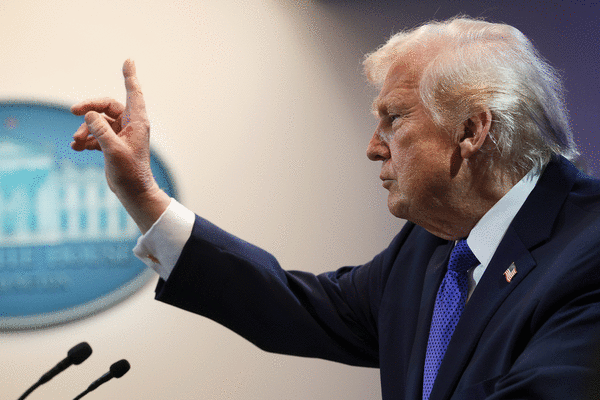
WASHINGTON — President Donald Trump on Friday criticized the Supreme Court for casting aside many of his global tariffs, easily the biggest setback of his second term — but he vowed to impose new import fees and accused the six justices who ruled against him of being corrupted by foreign entities.
“We’re going forward,” a defiant Trump, at times raising his voice, said during an impromptu appearance in the White House briefing room. “We will be able to take in more money, and they’ll no longer be doubt. … There was always doubt.”
Trump began his remarks by saying he found the high court’s decision “deeply disappointing,” adding that he was “ashamed of certain members of the court, absolutely ashamed, for not having the courage to do what’s right for our country.”
The president went so far as to suggest the six justices who knocked down the centerpiece of his economic plan had been corrupted by unnamed foreign forces.
“I think that foreign interests are represented by people that I believe have undue influence, have a lot of influence, over the Supreme Court,” he said without offering evidence. “Whether it’s through fear or respect or friendships, I don’t know, but I know some of the people that were involved on the other side, and I don’t like them. I think they’re real slimeballs.”
But he did not stop there, also turning to his regular practice of name-calling and insulting political and legal critics.
“They’re just being fools and lap dogs for the ‘RINOS’ and the radical left Democrats,” Trump said, using a popular conservative insult to argue the three conservative justices who voted against him on the case were “Republicans in name only.”
“They’re very unpatriotic and disloyal to our Constitution,” he added.
“It’s my opinion that the court has been swayed by foreign interests and a political movement that is far smaller than people would ever think,” Trump said, offering no evidence to support either claim.
With much of his already unpopular economic agenda thrown into flux, Trump lambasted the six justices — including two he nominated during his first term, Neil Gorsuch and Amy Coney Barrett — who ruled against him. “I think it’s an embarrassment to their families,” he said when asked if he regretted nominating the two jurists.
Still, Trump said the six judges who ruled against him were “barely” still invited to attend Tuesday night’s State of the Union address at the Capitol, adding “three are happily invited.”
The House Speaker, who invites the president to deliver the speech in the House chamber, controls the invitations to the address. The president has no formal control over the chamber, so even his guests are through the legislative branch.
The president defended his rejected claim that the Executive Office of the President possesses the legal authority to impose import duties without congressional authorization shortly after the high court ruled the opposite. The court’s 6-3 ruling found that the Trump administration overstepped emergency powers granted by Congress under the 1977 International Emergency Economic Powers Act, or IEEPA.
Citing the court’s majority and dissenting opinions and existing statutes, Trump said the administration has “very powerful alternatives that have been approved by this decision.”
“The good news is that there are methods, practices, statutes and authorities, as recognized by the entire court in this terrible decision, and also recognized by Congress, which they refer to, that are even stronger than the IEEPA tariffs available to me as president of the United States,” Trump said. “And in actuality, I was very modest in my ask of other countries and businesses, because … I wanted to be very well-behaved because … I didn’t want to do anything that would affect the decision of the court.”
‘Be a good boy’
The mercurial chief executive said he “wanted to be a good boy,” but on Friday threatened to do economic harm to other unnamed countries. “But now the court has given me the unquestioned right to ban all sorts of things from coming into our country, to destroy foreign countries,” he said.
Specifically, the president, reading from notes, pointed to Section 232 of the Trade Expansion Act of 1962, as well as three sections (122, 201 and 301) of the Trade Act of 1974. Also making his “alternatives” list was Section 338 of the Tariff Act of 1930. Those statues are “all clear,” he said, “but it’s a little bit longer process.”
The president said he planned to leave in place some of the tariffs he announced in April, and announced he would sign an order later Friday imposing a “10 percent global tariff under Section 122 — over and above our normal tariffs already being charged,” adding other duties would be implemented under Section 301. He claimed his goal would be “to protect our country from unfair trading practices of other countries and companies.”
The United States government took in$288.5 billion in tariff revenue in 2025, a sharp uptick from 2024 ($98.3 billion), according to data compiled by the Bipartisan Policy Center.
The president signaled he had no intention to refund any of the collected monies, criticizing the majority opinion for not issuing directions on the matter.
“It wasn’t discussed. Wouldn’t you think they would have put one sentence in there saying that keep the money or don’t keep the money, right?” Trump said, doubling down when pressed by a reporter: “I just told you the answer, right? I told you the answer. It’s not discussed. We’ll end up being in court for the next five years.”
Public opinion had turned against Trump’s tariffs as some consumer prices, already inflated after an inflation spike under President Joe Biden, went even higher when companies passed on the duties’ costs to customers. For instance, a Marquette University Law School poll conducted late last month found that 63% of respondents wanted the Supreme Court to limit Trump’s tariff powers, including 33% of those who identified as Republicans. Thirty-six percent wanted the justices to rule in Trump’s favor.
Even some GOP lawmakers had questioned the scope and severity of the global tariffs, as well as the White House’s claim it did not need Congress to bless the fees.
‘Circumvent Congress’
Sen. Mitch McConnell said in a Friday statement that “the American people already know that when Washington throws up artificial barriers, building and buying here at home become more expensive.”
“Kentuckians whose livelihoods depend on auto manufacturing, agricultural commodity markets, or demand for bourbon whiskey understand this painful reality better than most,” the Kentucky Republican added. “But as a matter of Constitutional authority, there is now no room for doubt: the use of IEEPA to circumvent Congress in the imposition of tariffs — already without precedent — is also illegal. Congress’ role in trade policy, as I have warned repeatedly, is not an inconvenience to avoid.”
McConnell said if the administration wants to try again with the global duties, it should work with Congress.
University of Chicago public policy professor Steven Durlauf said in an email that the “short-run effects of the decision are very unclear.”
“The administration is likely to look for other legal justifications for tariffs beyond the national security rationale the Court rejected. It is also unclear how tariff revenues will be returned and whether refunds move forward at scale,” Durlauf said. “Given the short-run chaos, markets and firms will trade off the potential benefits of lower tariffs against higher uncertainty. That means the near term effects on stocks, investment, and hiring are anyone’s guess.”
The debate about what Trump might do next likely will include assessments on whether the tariffs amount to sound economic policy.
“The real-world effects of Trump’s tariffs largely matched what economists predicted,” Durlauf added. “There was some upward pressure on prices, harm to employment, and little to no meaningful change in the overall trade deficit. Manufacturing employment declined, so the stated rationale was not fulfilled.”
Business Roundtable CEO Joshua Bolten in a Friday statement said the powerful industry group “encourages the administration to recalibrate its approach to tariffs, focusing on targeted actions to address specific unfair trade practices and national security concerns.”
_____
©2026 CQ-Roll Call, Inc. Visit at rollcall.com. Distributed by Tribune Content Agency, LLC.






























Comments