Commentary: Democrats must call out GOP on Trump's drug failures
Published in Political News
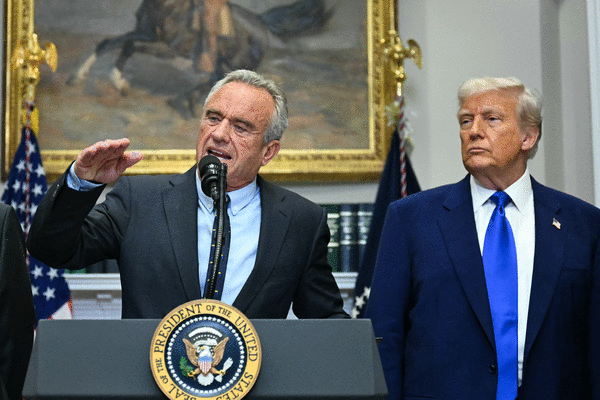
Democrats are on the verge of making affordability the defining and winning issue of the 2026 midterm election. The optics surrounding this failure of a Trump administration would be laughable if the consequences for working families weren’t so serious.
President Donald Trump and his cronies boast endlessly about a supposedly “stellar” economy, yet what Americans actually see is a president more interested in building a multimillion-dollar ballroom, cozying up to tech billionaires, and rewarding his donors rather than delivering relief to families who are barely getting by.
Let’s be clear: The American people are hurting and hurting badly.
Inflation remains stubbornly high. Grocery bills, housing costs and healthcare expenses continue to rise. A president who promised to bring down costs now seems far more energized by glad-handing wealthy foreign elites in gilded castles rather than fixing the affordability crisis at home. Even in many of the states and districts Trump carried, voters are growing frustrated, disengaged and angry. If Republicans continue to ignore these realities, affordability will become not just a weakness but a decisive liability.
Nowhere is this failure more obvious than at the pharmacy counter.
For years, Americans have paid the highest prescription drug prices in the world, regardless of whether they live in red states, blue states, or somewhere in between. Families are rationing insulin. Seniors are skipping doses. Parents are choosing which prescriptions they can afford each month. This is not a partisan issue; it’s a national disgrace in the world’s richest country.
Across the political spectrum, voters overwhelmingly want lower drug prices, and they want them now. Not in five years. Not after another political study, pilot program or corporate-friendly compromise. They want immediate, tangible relief.
Pharmacy-counter affordability is one of the rare issues where bipartisan agreement already exists and where policymakers could deliver real savings quickly, if they had the courage to stand up to pharmaceutical interests.
That’s where Democrats have an opening and a responsibility.
A responsible approach to lowering prescription drug costs through personal importation from licensed Tier-1 countries like Canada, the United Kingdom and Australia is one such solution. These are trusted allies with rigorous safety and regulatory systems. Done right, importation expands access to brand-name medications, lowers prices and maintains high safety standards.
Innovative importation models do not operate like a gray-market operator or a government funding program. It is a benefits strategy solution that enables Americans to safely access brand-name medications under the oversight of U.S.-licensed physicians and Tier-1 pharmacists. It’s practical, legal and focused on immediate savings for patients, not corporate Big Pharma profits.
This is exactly the kind of commonsense, pro-consumer and pro-patient policy Democrats should be championing heading into the 2026 midterms. It draws a sharp contrast with MAGA Republicans, who talk about affordability while blocking or ignoring solutions that threaten their Big Pharma allies and donors.
If Democrats want to win back Congress, or at the very least flip the House and re-establish a vital check on Trump’s unchecked power, this is how we do it. We hold Republicans accountable for failing to lower costs, especially where it hits families hardest: at the pharmacy counter.
There is simply too much at stake to settle for rhetoric. Democrats, we must lead on drug affordability, call out Republican inaction, and prove to voters that lowering costs is not just a talking point, it’s a promise they intend to keep.
_____
ABOUT THE WRITER
Bakari Sellers is a political analyst on CNN and served as a Democrat in the South Carolina House of Representatives from 2006 to 2014. He wrote this for InsideSources.com.
_____
©2026 Tribune Content Agency, LLC.
















































Comments