Lawmakers try to halt ICE plans for new detention centers
Published in Political News
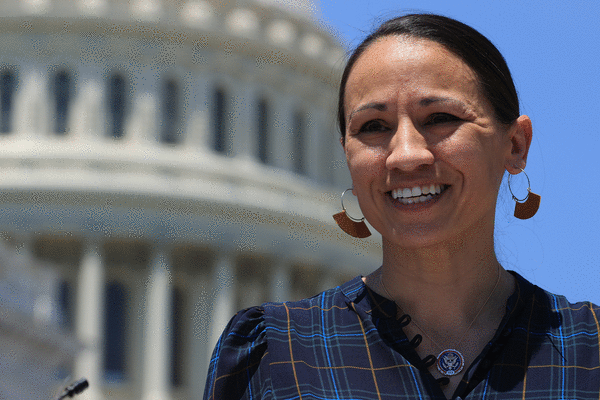
WASHINGTON — Local officials in Kansas City celebrated when a development company abandoned plans last week to sell a warehouse to the U.S. government for the purpose of becoming a 7,500-bed immigration detention center — including Reps. Sharice Davids of Kansas and Emanuel Cleaver II of Missouri.
The Democrats had raised concerns in letters to the Department of Homeland Security about the deal and are among the members of Congress from at least 10 states who have written letters or taken other action to try to halt immigration detention facilities that would affect their constituents.
“Community voices matter,” Davids said after the announcement. “This site was intended to support economic development and job creation — not to house a massive ICE detention facility that would strain infrastructure, divert resources from local law enforcement, and undermine public safety.”
DHS got $45 billion in last year’s reconciliation law specifically to expand immigration detention centers, as the Trump administration to seeks to increase the number of migrants it detains under its aggressive approach to immigration enforcement.
A spokesperson said Homeland Security Secretary Kristi Noem aims to work with officials “on both sides of the aisle” for the centers to help Immigration and Customs Enforcement “carry out the largest deportation effort in American history.”
Most objections to plans have come from Democrats in letters to DHS, who point to the way the administration has carried out that effort, including concerns about poor conditions at detention centers and the conduct of immigration agents in targeted operations in Minnesota and elsewhere, along with sentiment from communities who don’t want massive new detention centers there.
Rep. Pat Ryan, D-N.Y., gathered petition signatures against plans for a site in Chester, which he said he sent to DHS as “initial evidence of widespread community backlash to the proposal.”
Sen. Raphael Warnock, D-Ga., filed an amendment last week to the Homeland Security funding measure that would block the purchase of warehouses in the towns of Social Circle and Oakwood, plans he said had “unified opposition from local elected officials and community leaders.”
Rep. Sarah Elfreth, D-Md., said she spoke this month at a Howard County board meeting in support of an emergency measure responding to a privately owned office building in Elkridge currently under renovation for use as a detention facility.
“I spent an hour with colleagues from across the country yesterday, just focused on this issue,” Elfreth said in those remarks. “And so many of my colleagues are facing this same issue of privately run detention facilities seeking permits in their offices.”
Florida Democratic Reps. Darren Soto and Maxwell Alejandro Frost wrote to DHS and ICE after reports that ICE officials toured an Orlando industrial warehouse, which the lawmakers said is “not zoned for human residence and has inadequate facilities to accommodate waste management and general habitation.”
Objections have also been raised by lawmakers from Virginia, Maryland, New Hampshire, New Jersey, Georgia and Texas, with one of the most notable from Sen. Roger Wicker, R-Miss.
Wicker wrote DHS on Feb. 4 to raise concerns about the sale of a Byhalia, Miss., warehouse intended to become a detention center with over 8,500 beds, citing infrastructure strains like transportation, water, sewer, energy, staffing, medical care and emergencies.
Days later, Wicker announced that a conversation with Noem led to cancellation. “I relayed opposition from local officials and economic concerns,” he posted on Facebook. “I appreciate her agreeing to look elsewhere.”
Sen. Maggie Hassan of New Hampshire, a Democrat on the Senate Homeland Security Committee, pointed to Wicker’s success during a committee hearing last week when she asked the head of ICE about plans for a Merrimack, N.H., facility.
“I would hope that I would get the same treatment that Sen. Wicker got, which is to say, the town doesn’t want the detention center, so please cancel it,” Hassan said. “And I would expect that my partisan affiliation shouldn’t make any difference to that determination.”
Todd Lyons, the senior official performing the duties of the ICE director, pointed to a positive economic impact study. ICE projected the facility would give New Hampshire 1,252 jobs during retrofitting and 265 jobs in each year of operations, with a gross domestic product contribution of $151.3 million and taxes of $31.2 million, according to an ICE memo released by New Hampshire Gov. Kelly Ayotte.
ICE has a $38.3 billion plan to acquire “non-traditional facilities” such as warehouses, to increase bed capacity to 92,600 by the end of fiscal 2026, according to another ICE memo released by Ayotte.
The plan includes the acquisition and renovation of eight large-scale detention centers and 16 processing sites, as well as the acquisition of 10 existing “turnkey” facilities where ICE already operates.
“These facilities will ensure the safe and humane civil detention of aliens in ICE custody, while helping ICE effectuate mass deportations,” the memo says.
Some lawmakers have welcomed such plans. Rep. Mark Alford, R-Mo., in a Jan. 16 letter said the opposition to a facility in Kansas City would present an opportunity in Cass County.
“The county provides access to major transportation corridors, available industrial and commercial sites, and the infrastructure necessary to support a secure and efficient federal facility, without the regulatory uncertainty or political obstruction currently present in Kansas City,” Alford wrote.
Others have objected. Texas Democratic Rep. Veronica Escobar, a member of the House Homeland Security Appropriations Subcommittee, criticized new warehouses in her district during a committee hearing last week, citing issues like detainees wearing unchanged clothes for weeks due to lacking laundry and inedible frozen meals.
“They’ve purchased three warehouses in my district for $122 million that they will now have to spend probably hundreds of millions of dollars on in order to retrofit to house 8,000 human beings,” Escobar said. “They can’t even handle the 3,000 in private custody right now. So DHS is absolutely out of control.”
In Maryland, Democratic Sens. Chris Van Hollen and Angela Alsobrooks, as well as Rep. April McClain Delaney, sent a letter to the Washington County board on Feb. 10 after a vote supporting ICE, amid a controversy over the recent ICE purchase of a warehouse reportedly to convert into a center to hold up to 1,500 detainees.
“[E]stablishing such a facility in a warehouse not designed for residential confinement would pose substantial public health and safety risks and place added strain on local hospitals, emergency responders, and already stressed infrastructure, including roads, utilities, and water systems,” the lawmakers wrote.
Those lawmakers have also raised concerns about the conditions at immigration detention centers, including overcrowding and detainees signaling they were receiving insufficient care.
“These practices have no place in Maryland, are incompatible with our values, and underscore our opposition to any expansion of ICE’s presence in our communities,” lawmakers wrote in a Jan. 20 letter.
-----------
©2026 CQ-Roll Call, Inc. Visit at rollcall.com. Distributed by Tribune Content Agency, LLC.




































Comments