Editorial: A system that's for sale, more than ever
Published in Political News
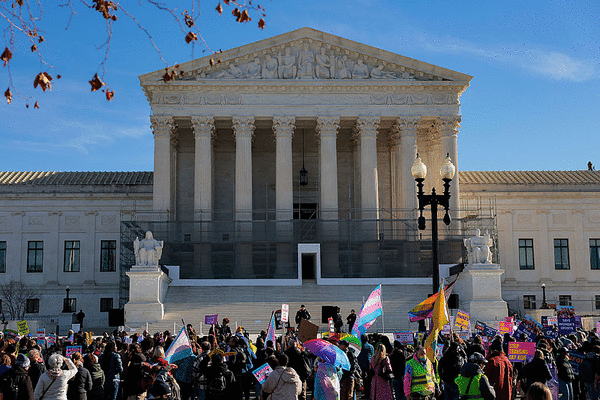
America just passed the 50th anniversary of one of its truly terrible days — one that future historians can track as the beginning of the end of our democracy.
On Jan. 30, 1976, the U.S. Supreme Court, in the case of Buckley v. Valeo, overturned three of the major federal campaign finance reforms Congress enacted after the Watergate scandal. Similar laws in Florida fell as well.
Money talks, the court said, with all the freedom of speech afforded by the First Amendment.
The court threw out ceilings on what candidates could spend overall, and how much of their own money they could spend. It green-lighted unlimited “independent” spending by outside groups, provided that it wouldn’t be coordinated on the sly — which commonly happens.
On the other hand, the court upheld limits on what supporters can contribute directly. And if they accept matching funds, as Congress provided for presidential campaigns, then spending limits could be enforced.
It all had a nonsensical inconsistency. The court conceded the presence or appearance of corruption when a politician takes a lot of campaign money from a single individual. Yet it wrote off the corrupting consequences when campaigns bundle millions from people involved in a single industry.
Wholesale corruption
Whether a politician is for sale wholesale or retail is a distinction without a difference.
The Buckley case spawned other loopholes from Congress and the courts over the years, directly culminating in the 2010 atrocity of the Citizens United case. Corporations and unions, still barred from contributing to federal campaigns directly, could spend unlimited sums independently. They no longer had to launder millions through PAC contributions from their employees and executives.
Money doesn’t just talk now — it screams. So much untraceable “dark money” is laundered through nonprofits that don’t disclose their contributors, it’s impossible for the public to know who’s buying whom on Capitol Hill, at the White House or in Tallahassee. We can’t tell who’s buying favors, but be sure of this: The politicians can.
After giving nearly $4.8 million to MAGA Inc., a super PAC run for President Trump, major nursing home executives met with him over lunch and begged for repeal of a Biden-era rule — delayed for a decade — requiring increased staffing levels to protect patients.
Less than a month later, according to the New York Times, the administration stopped defending the rule in court, then repealed it altogether. The ultimate price for that will be paid in bed sores and deaths.
The costs of presidential elections have soared from $664 million in today’s dollars in 1976 to $14.8 billion in 2024, when an additional $9.5 billion was spent on congressional campaigns.
Costlier campaigns than ever
The era of good government known as the Golden Age of Florida Politics began under a governor and legislators elected under spending limits as tight as $30,000 for a state House race. Now, House campaigns often spend far more than $1 million, and a vastly expanded lobbying corps rules the Legislature.
The late Supreme Court Justice John Paul Stevens, who retired to Fort Lauderdale, wrote in his 2014 book “Six Amendments” why the Buckley and Citizens United decisions should be erased.
He proposed amending the Constitution to say this: “Neither the First Amendment nor any other provision of this Constitution shall be construed to prohibit the Congress or any state from imposing reasonable limits on the amount of money that candidates for public office, or their supporters, may spend in election campaigns.”
Stevens was not on the court for Buckley. He was one of four dissenters in Citizens United.
It would obviously have been unfair, he wrote, if a TV debate moderator allowed Mitt Romney more time than his rivals in 2012 because he was wealthier than any of them. But that’s exactly how unlimited campaign spending monopolizes our politics.
“It is unwise,” Stevens reasoned, “to allow persons who are not qualified to vote — whether they be corporations or nonresident individuals — to have a potentially greater power to affect the outcome of elections than individual voters have.”
Democracy pays the price
A largely forgotten study by two professors in 2014 documented a vast gulf in political outcomes between public opinion and the wish lists of the deep-pocket sources of most of the campaign money. The data on 1,779 policy issues was researched exhaustively before Martin Gilens and Benjamin Page of Princeton University published their conclusions.
“Our analyses suggest that majorities of the American public actually have little influence over the policies our government adopts,” they wrote. “Americans do enjoy many features central to democratic governance, such as regular elections, freedom of speech and association, and a widespread (if still contested) franchise. But we believe that if policymaking is dominated by powerful business organizations and a small number of affluent Americans, then America’s claims to being a democratic society are seriously threatened.”
Buckley was a milestone moment in America’s descent into oligarchy. Fifty years later, it’s getting awfully late to get our country back.
____
The Sun Sentinel Editorial Board consists of Opinion Editor Steve Bousquet, Deputy Opinion Editor Dan Sweeney, editorial writers Pat Beall and Martin Dyckman, and Executive Editor Gretchen Day-Bryant. To contact us, send an email to letters@sun-sentinel.com.
___
©2026 South Florida Sun Sentinel. Visit at sun-sentinel.com. Distributed by Tribune Content Agency, LLC.









Comments