Commentary: Trump's energy promise collapses as electricity bills keep rising
Published in Political News
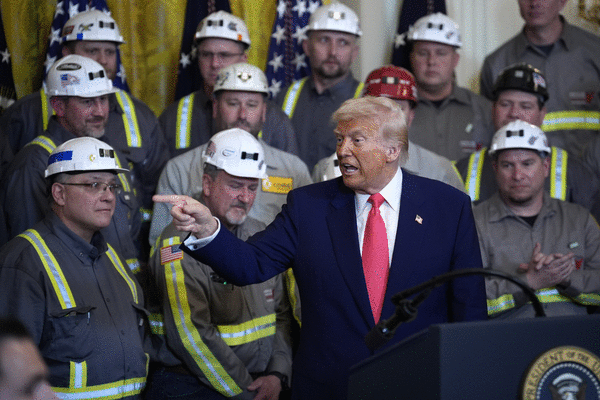
January 20 marked the first anniversary of President Donald Trump’s second inauguration. Like previous presidents, the Trump White House will be measured by how well the president has fulfilled his campaign promises. We’ve already seen headlines that so far the president has failed to cut our grocery bills, one of candidate Trump’s earliest promises. Now, there is another campaign promise that he has missed by a wide mark.
Here’s Trump in his own words: “I will cut the price of energy and electricity in half,” he said at one rally in Detroit in October 2024. “Twelve months from January 20, your electric bill, including cars, air conditioning, heaters, everything, the total electric bill will be 50, 5-0 percent, less.” Trump told voters at a separate event that “your energy bill within 12 months will be cut in half. That’s my pledge, all over the country.”
Instead, prices have continued upward. Federal data show U.S. electricity prices increased by 11% from January through September 2025, with the average household electricity bill in the U.S. 6.7% more expensive for all of 2025. This has placed additional strain on Americans’ personal finances.
Since 2020, electricity prices have risen by over 30%, outpacing the general rate of inflation. So it’s not just under Trump that utility prices have soared, it happened also under his predecessor, President Joe Biden. But Trump was the one who promised us the moon and left us with a grain of sand. And prices are projected to continue their upward trajectory through 2026.
Different locations hit harder than others
The utility rates have increased more in some parts of the country than others. Washington D.C. has experienced the biggest increase, a 23% jump in electricity costs, followed by Indiana with a 17% increase, and then Illinois, a 15% rise.
For more than a third of all Americans, electricity bills are now a “major” source of stress, polling has found, with colder-than-expected temperatures this winter pushing up heating bills by 9.2% on average last year. The average household will pay $995 on heating this winter, as families struggle with electricity prices that are the highest in a decade, according to the National Energy Assistance Directors Association (NEADA).
On top of soaring electricity bills, U.S. households have also been confronted by rising home gas heating prices, which have jumped 5.2% on average in the past year, according to the Energy Information Administration. That has resulted in a surge in utility disconnections for unpaid bills across many states, with some households going without other essentials in order to keep the lights on. In New York, the rate of disconnections rose fivefold from the previous year.
Not surprisingly, energy affordability has become a top concern for American families and businesses, replacing groceries as the number one household worry. A recent poll conducted by Ipsos found that 73% of U.S. residents were concerned about their electricity and gas bills rising this year, and 80% of Americans admitted they feel powerless over how much they are charged by the utility companies. No wonder some 68% of American adults describe the U.S. economy these days as “poor,” while 32% say it’s “good.”
Trump makes it harder for poor and working class Americans
While energy bills keep climbing, more lower and middle-income Americans have been hit with a double whammy: the Trump White House has slashed federal assistance and eliminated tax credits to help needy Americans with their energy essentials. That includes killing programs for home energy efficiency upgrades, and also attempting to scrap the Low Income Home Energy Assistance Program (LIHEAP) that helps more than six million low-income households pay their energy bills. LIHEAP still survives (for now), but it has been significantly obstructed after the Trump administration laid off the entire LIHEAP staff. The cuts have caused unprecedented delays in getting energy assistance aid to low-income households.
Meanwhile, Trump has claimed that his seizing of Venezuela’s oilfields will help drive down the cost of gas and electricity for U.S. consumers. Instead of “drill, baby, drill,” this is “take, baby, take.” But that doesn’t make sense, the U.S. already is the world's largest producer of oil by a significant margin. This is not a “more oil will solve it” type of problem. Trump has also killed programs designed to increase the use of renewable energy and reduce America’s use of oil, including killing funding for research and halting construction of five windfarms and other renewable projects that were set to provide electricity for tens of millions of American homes.
Trump is also aggressively supporting the rise of the artificial intelligence industry for national security reasons in America’s ongoing competition with China. But AI uses huge amounts of electricity for all the gargantuan data centers and server farms, which is having the effect of raising U.S. electricity demand for the first time in decades. Recently, PJM, the grid operator covering 13 mid-Atlantic and Midwest states as well as the District of Columbia, called data centers the “primary reason” for the increased price of power.
Does Trump deserve all the blame?
No question, Trump broke his campaign promise and has not come anywhere close to reducing utility bills by 50%. But the story gets more complex and interesting, the deeper you dig. That’s because electricity prices are especially high in traditionally Democratic/Blue states.
According to the business-friendly Institute for Energy Research, 86% of states with electricity prices above the national average are blue-voting states. In contrast, 80% of the 10 states with the lowest electricity prices are reliably red GOP states. In California, for example, electricity rates are the highest in the nation among the Lower 48. The Golden State’s rates are more than double the national average.
Governor Gavin Newsom and California’s state legislature have embraced numerous policies that have increased electricity rates. These include renewable mandates, cost-shifting for homeowners with solar panels (net metering), and electric car charging subsidies. But another giant cost has resulted from damage from wildfires. Some of the most dangerous fires were caused by corrupt and incompetent utilities like PG&E, yet the state has allowed these utilities to jack up power rates to avoid bankruptcy from liability lawsuits. California ratepayers are covering for PG&E’s massive blunders, which has resulted in many deaths and billions in property damage, even as PG&E has made record profits of $2.5 billion for the last two years. In 2024 alone, California state regulators agreed to six separate rate increases.
On the one hand, you could say that California’s climate policies have allowed it to be a national leader, second in the nation in total electricity generation from renewable resources and leading the country in solar generation from utilities, with solar energy providing 32% of the state's total electricity generation.
On the other hand, while originally this looked like climate leadership, as the federal government under Trump abandons renewables and climate change mitigation, and more states follow the federal lead, California ratepayers are increasingly paying a high price for shouldering more than their share of climate change mitigation. California ratepayers are understandably feeling abandoned by Newsom.
With Trump marking Year One of his second administration, many Americans are feeling frustrated and deserted by his policies. But with the next November election for picking the U.S. Congress fast approaching, will voters see the Democrats as enough of an alternative?
____
Steven Hill was policy director for the Center for Humane Technology, co-founder of FairVote, and political reform director at New America. You can reach him on X @StevenHill1776.
_____
©2026 The Fulcrum. Visit at thefulcrum.us. Distributed by Tribune Content Agency, LLC.







































Comments