This week: Defense authorization deal headlines floor action in Congress
Published in Political News
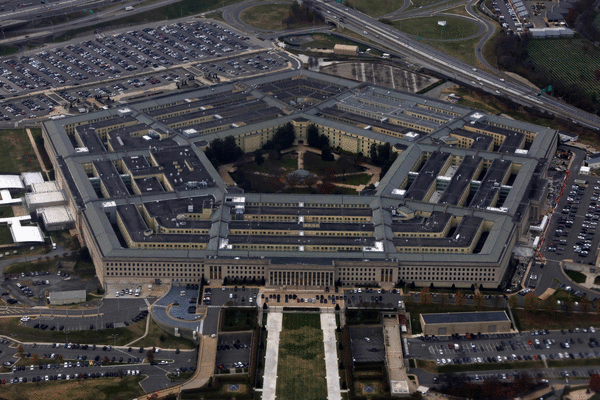
WASHINGTON — House and Senate negotiators on Sunday published the text of their compromise fiscal 2026 defense authorization bill, setting it up for House floor action this week.
The compromise bill’s $900.6 billion topline funding authorization number is more than $8 billion above both President Donald Trump’s request and the House-passed version. Senators will want to send the package to the president’s desk as soon as possible after the House acts.
House Armed Services Chairman Mike D. Rogers, R-Ala., praised the agreement, saying lawmakers would be “reforming the Pentagon’s broken, bureaucratic acquisition process so that our troops can quickly get the tools they need to deter our enemies, instead of waiting up to a decade while our adversary’s field new technologies within months.”
The compromise text, reached through an informal conference process, also includes authorizations for intelligence, the Coast Guard and the State Department, as well as several provisions directed at China and some more parochial matters.
While some financial services provisions are included in the agreement, a sweeping housing package that had been under discussion did not make the cut.
“I will continue fighting to advance President Trump’s affordability agenda by moving legislation that helps make homeownership more attainable for American families,” Senate Banking, Housing and Urban Affairs Chairman Tim Scott, R-S.C., said in a statement.
The defense policy bill will not be the only headline measure on the House floor this week, with other scheduled legislation including bills related to pipeline reviews and the electric supply chain.
Nominations stumble
Meanwhile, the Senate is continuing to work on confirming Trump’s nominations, though Senate Majority Leader John Thune, R-S.D., hit a stumbling block last week in his effort to advance an en bloc package.
Under the new process established by Senate Republicans earlier this year, most executive nominees can advance in en bloc bundles requiring only simple majority votes to get past procedural hurdles.
But that’s not true of all nominees, and last week the Republicans included Sara Bailey, the president’s director of the Office of National Drug Control Policy, in a resolution for floor consideration. The “drug czar” is among the positions not eligible for expedited en bloc consideration under the Senate’s current precedents, and so a motion to invoke cloture on a package of 88 Trump nominees required 60 votes to advance, coming up well short.
“I will not allow unqualified nominees, this White House, or the President to undermine the rule of law and our national security,” Sen. Michael Bennet, D-Colo., said in a statement announcing a blockade of the nominees.
Thune responded with a new resolution, which could move this week, including 97 Trump nominees but not including Bailey, who was previously a Fox News contributor under the name Sara A. Carter.
The Senate is also expected to vote this week in relation to a Democratic proposal to extend Affordable Care Act tax subsidies, though there was no indication the measure would muster the votes needed to advance.
Senate committees will be busy as well, with much of the attention potentially focused on the star power at a Senate Judiciary subcommittee hearing Tuesday afternoon. Gene Simmons, the bassist and co-lead singer of rock band Kiss, will testify in support of proposed legislation to require radio stations to pay artists for using their music.
“The American Music Fairness Act will close the radio loophole and finally compel these companies to pay performers for the music they use. The legislation will protect small, independent broadcasters — those not owned by huge corporations — while generating hundreds of millions of dollars in new economic activity,” Simmons wrote in an opinion piece for the Washington Post. He also previewed his testimony on Friday at the White House.
There is also a hearing Tuesday afternoon which may have broader implications for the economy, with U.S. Trade Representative Jamieson Greer scheduled to testify before an appropriations subcommittee on his office’s funding priorities.
©2025 CQ-Roll Call, Inc., All Rights Reserved. Visit cqrollcall.com. Distributed by Tribune Content Agency, LLC.
















































Comments