Editorial: There has been no victory yet for the Iranian people
Published in Op Eds
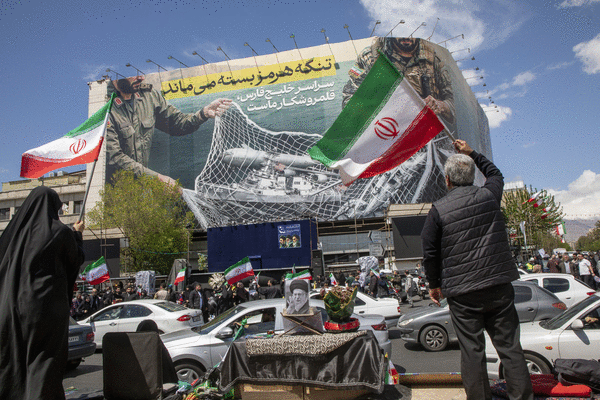
Like most Americans, we were relieved that President Donald Trump’s potentially cataclysmic pledge to kill off Iranian civilization Tuesday night did not proceed as the president’s unacceptably violent rhetoric had threatened.
A ceasefire, even a fragile ceasefire, coupled with negotiation is far preferable to the bombing of civilian infrastructure, Iranian drones hurtling toward Haifa and the potentially catastrophic human consequences of taking out power stations that fuel Iranian hospitals, which are giving care to patients who have no responsibility whatsoever for the brutality of the theocratic Iranian regime.
Even that ceasefire proved narrow and fragile almost immediately. As it took effect, Israeli forces launched heavy airstrikes on Beirut and elsewhere in Lebanon, reportedly killing more than 100 people, a stark reminder that much of the region remained very much at war.
It was hardly surprising both sides declared victory, generally a prerequisite of any deal or compromise. And we’re not about to waste time parsing the relative merits of such propagandist declarations. On either side.
As far as we can tell, Iran still is ruled by a theocratic regime. Perhaps the new, younger crew will be more reasonable and moderate, as Trump has asserted. We hope so, but we have no evidence of that.
Only three justifiable arguments were made for this war. One was eliminating Iran’s unacceptable nuclear capability. The second was eliminating its sponsorship of terrorist proxies threatening Israel and the world beyond. The third was to free the Iranian people from a brutally oppressive government and move the country toward democratic representation reflecting the aspirations and talents of its 90 million people.
Iran’s nuclear activities certainly have been hampered by the attacks propagated by Americans and Israelis, but we cannot assert with any level of confidence that its leaders will not attempt to rebuild them; Iran still has its stockpile of highly enriched uranium. We don’t doubt Iran’s arsenal of weapons has been radically reduced, which is a good thing, but notwithstanding Defense Secretary Pete Hegseth’s Wednesday talk of a “combat-ineffective” Iran, the question remains of Iran’s potential for effective combat renewal. Meanwhile, Iran’s leverage over the crucial Strait of Hormuz hardly has been eradicated; if anything, its leverage has increased as a consequence of the war.
Any fool can see that U.S. relations with Europe have significantly worsened, that the moral leadership of the United States as a beacon for freedom and honor has been compromised, and that there are no clear signs of a newly stable Middle East, nor indications of a more secure geopolitical landscape for Israel and its people.
Any diminishment of Iran’s power is a good thing. No question. But that requires you to believe that its nasty regime actually has been diminished over the past several weeks, rather than emboldened by its survival in the face of attack. And that is, to say the least, debatable.
But the most hollow aspect of all is the lack of any relief for the oppressed Iranian people. If anything, they now are more at the mercy of a regime with something new to sell them.
Surely there will be thankfulness in Iran and among the Iranian diaspora in this and other major American cities, that loved ones were not killed by the U.S. and Israeli attacks threatened for Tuesday night. But we have no indication the regime will now cease or even slow the execution of rebels and dissidents, or that it will free Iranian women from their strictures.
In short, no evidence yet has emerged that the Iranian people will be any better off now, nor Iran’s neighbors any safer.
That inevitably leads us to an accounting that little has been achieved. A hollow victory at a heavy price. Much is left to negotiate.
_____
©2026 Chicago Tribune. Visit at chicagotribune.com. Distributed by Tribune Content Agency, LLC.




















































Comments