Trudy Rubin: Iran looks likely to win strategically despite US tactical military gains
Published in Op Eds
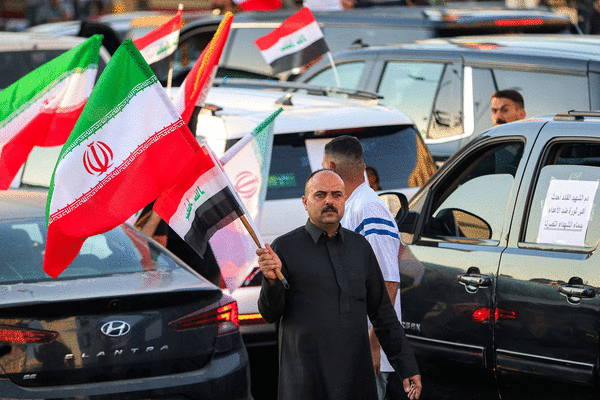
As the tenuous two-week ceasefire with Tehran wobbles already, there is a new reality in the Middle East. But it’s not the one President Donald Trump thought he would achieve when he started the Iran war.
Both sides are already quarreling over the terms of the ceasefire, and are miles apart in their positions, with opening negotiations supposed to take place in Islamabad, Pakistan, on Friday.
Yet, it is already acutely painful to think of how much the United States has sacrificed over the past 40 days of war in terms of global reputation, world economic chaos, and human life — for so little apparent gain.
Yes, the U.S. military performed tactical missions brilliantly, and much of Iran’s military-industrial complex has been crushed — as Pete Hegseth gushed in a Wednesday briefing. But this war is not the “historic and overwhelming victory” he boasted about.
At his news conference, the secretary of defense dodged questions about the most astonishing concession Trump seems to have already made — one that stabs our Mideast Arab allies in the back and leaves Tehran in continued control over 20% of the world’s oil supply. For now, Iran’s leaders and military will apparently retain control of passage through the Strait of Hormuz — a power Tehran never held before this war.
Whether Trump will allow this astonishing geopolitical concession to stand is a question haunting our allies in Europe, Asia, and the Arab Gulf. At this writing, Iran has already closed the strait again in response to continued Israeli attacks on Lebanon.
Early comments by POTUS, however, indicate he is ready to concede control of the strait to Tehran — presumably because he doesn’t want to send U.S. ground troops on a dicey mission to retake and control the waterway.
Such a shift in the Gulf power dynamics — leaving Saudi Arabia, Qatar, the United Arab Emirates, Kuwait, and the world’s oil prices at Tehran’s mercy — would outweigh any tactical gains from 13,000 U.S. strikes on Iran’s infrastructure. It is only one, if perhaps the most important, sign of the terrifying madness of a U.S. president who began this unnecessary war without any clear strategy or goals.
To understand how unprepared Trump was to launch his war in the first place, consider his abrupt decision to attack. He was apparently convinced during a White House meeting with Israeli Prime Minister Benjamin “Bibi” Netanyahu that the war would be brief and result in a popular uprising that would oust the ayatollahs. (Don’t blame Bibi; anyone who swallowed this baloney bears full blame for the results.)
Real regime change was (obviously) not achievable at this point by unarmed Iranian civilians against religious zealots with guns, yet Trump’s encouragement to protesters probably increased the death toll.
When that tack failed, Trump changed course and claimed there had been a “complete and total regime change” in Tehran due to the killing of Ayatollah Ali Khamenei and many other regime officials.
Never mind that Khamenei’s more hawkish son replaced him, and the real power now resides with the hard-line Islamic Revolutionary Guard Corps. Once Bibi’s pipe dream dissipated, Trump reverted to his fantasy that Iran could become another Venezuela, in which he would be able to work with the new regime to end its nuclear program and control the Strait of Hormuz.
As POTUS put it on Truth Social, “The United States will work closely with Iran, which we have determined has gone through what will be a very productive Regime Change!” In another post, an apparent reference to Iran’s plan to collect tolls from transiting tankers, he claimed: “The United States of America will be helping with the traffic buildup in the Strait of Hormuz. There will be lots of positive action! Big money will be made.”
Don’t rule out the possibility that POTUS is pondering whether the U.S. should get a share of the toll revenue (he once suggested America should get all of it). A U.S. share would go hand in hand with Iran’s current demand that ship owners pay in cryptocurrency. Might Trump’s sons, who are up to their elbows in crypto business ventures, seek to get involved?
Another goal was to get rid of Iran’s approximately 440 kilograms (approximately 970 pounds) of highly enriched uranium, which is buried deep under rubble after the U.S. bombed Iran’s nuclear infrastructure in June.
The uranium is still buried in the same places.
POTUS says the U.S. can surveil those sites by satellite to ensure none of it is removed, but that could have continued without the war. Trump also claims Iran and the U.S. will dig up the nuclear “dust” together. I find it hard to imagine Revolutionary Guard officers alongside U.S. intelligence officials commanding the earthmovers.
To be honest, I find it hard to imagine how talks between the U.S. and Iran will go forward, if they take place at all on Friday.
The only thing holding them together might be the deep desire of both sides for a breather. Trump appears even more eager for that break than the Iranians, as soaring oil prices (which will take months to return to prewar levels even with a ceasefire) imperil GOP election prospects in the fall.
But one thing can be definitely said: The primary goal of reopening the strait to a free flow of traffic has not yet been achieved, and how to do so remains a huge dilemma for Trump. If Iran retains control, it will have won a major strategic victory, despite all the internal destruction it has suffered from U.S. bombs.
Controlling the strait is probably more critical to Iran’s survival than a nuclear weapon, since it would be suicidal to use that weapon against the U.S. or Israel. On the other hand, to be master of the strait for the near future is a guaranteed source of money and power.
Many analysts believe Iran’s control of the strait can’t be reversed short of a permanent U.S. military presence in the Gulf or multilateral escorts by warships. So far, Trump wants no part in either military mission, which would be vulnerable to Iran’s still existing supply of missiles and drones.
So POTUS may well be tempted to leave Iran in control of the strait, rather than restart the war. Talks may drag on, leaving the entire global economy and our allies in uneasy suspension. The costs of Trump’s misguided war of choice have barely begun to be assessed.
_____
_____
©2026 The Philadelphia Inquirer, LLC. Visit at inquirer.com. Distributed by Tribune Content Agency, LLC.

















































Comments