Commentary: What an Austrian cow and Illinois' Fermilab teach us about scientific discovery
Published in Op Eds
Apparently, cows know how to scratch an itch — with a broom. This fascinating new discovery provides the first known example of multipurpose tool use beyond chimpanzees. It required finding just the right cow (her name was Veronika) in just the right paddock (nestled in the Austrian countryside) with just the right owner (a particularly observant farmer). After researchers were alerted to Veronika’s special skills, they visited her homestead. Watching her for some time, they noticed she strategically decided whether to use the bristle or stick end of a broom to scratch different parts of her body.
I can’t help but wonder just how rare Veronika is. How many cows have we collectively observed over time that have not been scratching themselves with brooms? Millions? Billions?
Finding Veronika took time, dedication, curiosity and a good dash of luck. So many cows had to be observed before finding this particularly savvy one. This story is emblematic of scientific discovery more generally. While it can be easy to focus on the bright flash of discovery, that revelation is often preceded by a long trail of results that don’t make the headlines.
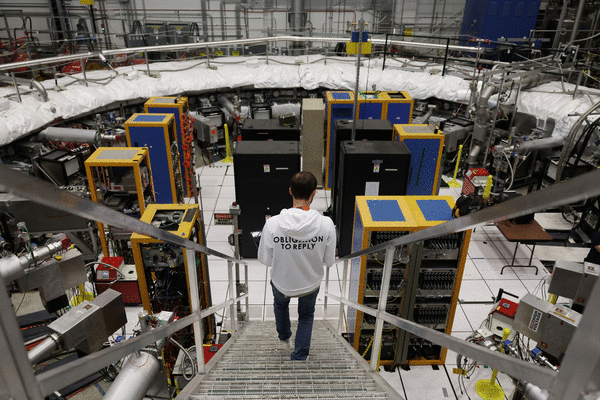
In my field of particle physics, scientific breakthroughs are often measured in decades, as opposed to years. Particle physicists study the properties of the most fundamental elements of matter, breaking atoms down into their basic building blocks. Understanding these building blocks is key to reconstructing how the universe evolved from the fiery hot plasma that permeated space after the Big Bang to the structured web of galaxies observed today.
We can re-create the conditions of our nascent universe in the laboratory thanks to feats of creativity and engineering, but this requires significant investments of time and resources. And discovery is not guaranteed. As a matter of fact, most of the time, particle physicists return having not found what they set out to look for, what we call a “null” result.
The story of how the Higgs particle was discovered illustrates this. In July 2012, The New York Times touted its discovery at CERN’s Large Hadron Collider: “Physicists Find Elusive Particle Seen as Key to the Universe.” This, indeed, was headline news. The Higgs is the cornerstone of our physics models, dictating the mass of all other particles. Its presence explains the relative stability of atoms and of all matter as we know it, from stars, planets and — ultimately — you, as you sit here reading this piece.
The Higgs was first hypothesized in the 1960s. From early on, theorists were upfront about the challenge of unearthing it in data, with some candidly writing: “We apologize to experimentalists for having no idea what is the mass of the Higgs boson. … For these reasons we do not want to encourage big experimental searches for (it).” Their words of caution were ignored (fortunately, in retrospect), and enterprising experimentalists embarked on a journey that would take nearly half a century, and the construction of three powerful colliders, to bear fruit.
The Large Electron-Positron Collider at CERN gave it a good-faith effort, but after 11 years of running and only a few tantalizing, and ultimately false, signals, the decision was made to halt operations at the start of the millennium. The Tevatron collider, located at Illinois’ Fermilab, followed suit with its own earnest search but was shut down in 2011. Again, there were hints in the data but no definitive conclusions. While these nondiscoveries could be seen as a disappointing end, the truth is they were critically informative. Based on the results from these two attempts, theorists had moved far beyond the stage of “having no idea”: Armed with the necessary information, they could now predict where the Higgs would ultimately reveal itself.
While the Higgs has no direct practical impact on people’s lives or technology, the infrastructure that was built to discover it does. For example, the World Wide Web was first established at CERN as a tool to help scientists share data across their institutions.
But after the Higgs discovery, the particle physics headlines went quiet again, with searches for other hypothesized particles yielding the sigh-inducing null result. Theorists are returning to the drawing board. Experimentalists are rethinking their detection strategies. A recent article in Quanta Magazine summarized the state of angst in the field with its title: “Is Particle Physics Dead, Dying, or Just Hard?”
It’s just hard, and that is OK. Indeed, why should we expect anything less when attempting to decode the mysteries of the universe? In this pursuit, scientists can reasonably disagree about the most worthwhile theoretical models or technologies to invest in. (Stephen Hawking famously bet against finding the Higgs — he lost $100.)
What should never come into question, however, is the importance of tackling the hard questions in the first place — specifically, those questions that get at the heart of how our world works — even if finding the correct solutions involves more dead ends than front-page news stories. (How many cows have you seen lately scratching themselves with brooms?) The cost of not trying is accepting that we will never have those answers.
Failure is a necessity in scientific research. Specifically, intelligent failures, where null results continuously redefine the limits of our understanding as we explore the unknown. Such failures provide a learning opportunity, a chance to reassess hypotheses and try again. And again.
____
Mariangela Lisanti is a professor of physics at Princeton University and a public voices fellow with the OpEd Project. She studies the nature of dark matter. Her views as expressed here are not necessarily those of any employer or other institution.
___
©2026 Chicago Tribune. Visit at chicagotribune.com. Distributed by Tribune Content Agency, LLC.

















































Comments