Commentary: Global oil crisis once again makes the case for renewable energy
Published in Op Eds
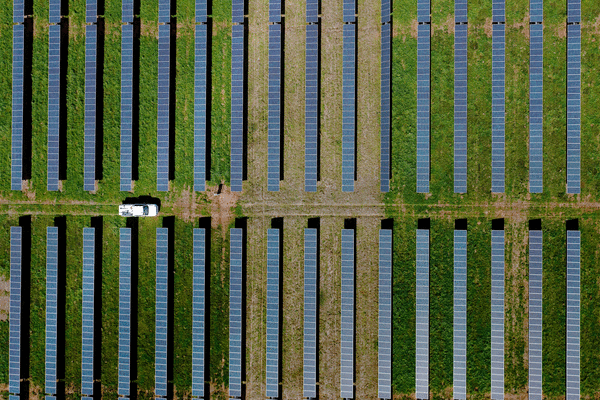
In 1979, President Jimmy Carter installed solar panels on the White House and introduced an ambitious solar strategy to Congress. This came on the heels of the oil shocks of the 1970s caused first by the Yom Kippur War between Israel and Arab states and then the Iranian Revolution — both Middle East crises that reverberated across the globe due to the region’s central role in energy markets.
Speaking of the new equipment, Carter said, “A generation from now, this solar heater can either be a curiosity, a museum piece, an example of a road not taken, or it can be just a small part of one of the greatest and most exciting adventures ever undertaken by the American people: harnessing the power of the sun to enrich our lives as we move away from our crippling dependence on foreign oil.”
Just imagine the world we would live in today if we had taken the latter path. We would be decades ahead on renewable energy development, likely the world’s leading producer of affordable renewable energy products. Most of our industries and households could run on renewable power. As Thomas Friedman put it, America could have become the “ Saudia Arabia of solar panels.” Human-driven causes of climate change would be dramatically slowed or even halted thanks to green energy advances, so we would face less extreme weather and enjoy a healthier atmosphere.
And our economy would not be held hostage by the fate of a 21-mile-wide waterway 7,000 miles away from our shores. Nor would we have need for 19 military bases across a region prized for cheap oil exports, which offer tempting military targets to our foes. The current, pointless war of choice with Iran might never have happened if we weren’t so poised to go to war again in the Middle East.
But President Ronald Reagan had other priorities when he came to office in 1981, so he gratuitously ripped out the White House solar panels and slammed the door shut on Carter’s grand solar initiative. He slashed funding for renewable energy research and development and tax breaks for solar and wind technologies, stalling the energy transition for decades to come.
Why would a U.S. president abandon this investment in our energy security after the danger of our reliance on foreign oil was so nakedly exposed?
The answer is the fossil fuel industry. One would be hard-pressed to find a better example of the danger special interests pose to our national security than fossil fuels. The U.S. government has subsidized the industry since 1913, and special protections for big oil still cost American taxpayers billions of dollars each year. President Donald Trump’s “Big Beautiful Bill” increased existing subsidies for the fossil fuel industry last year by $4 billion, for a total of$34.8 billion a year. That windfall makes the $445 million that fossil fuel companies spent in support of Trump’s campaign look like a bargain, as their profits continued to soar. Not only have we not invested in it, but renewable energy hasn’t even had a fair chance to compete.
This tremendous investment in fossil fuels should at least have made America more energy-resilient. Thanks to the shale gas revolution that began in 2008, the United States is now the world’s largest oil and gas producer, so one would think we wouldn’t be so vulnerable to supply shocks so far away. But the United States still imports 30% to 35% of the oil it consumes. Although we get little from the Middle East, the price of this global commodity depends on the global supply. When the price rises around the world, ordinary Americans pay for it, while big oil companies rake in record profits and have little incentive to worry about energy security at home. This is the scenario playing out today with the entirely predictable crisis in the Strait of Hormuz.
Trump might have seen this coming and doubled down on the efforts of the Joe Biden administration to boost renewable energy production at home. But instead, he went full Reagan, cutting solar and wind investments, canceling some $35 billion in renewable energy projects, slashing subsidies for production and purchase of electric vehicles, and rolling back energy-efficiency standards. Not only has his administration ended all government support for renewables, but it is using government regulatory power to punitively obstruct renewable energy projects too.
This hasn’t just left us more vulnerable to energy shocks; it also has allowed China, our greatest geopolitical adversary, to take the global lead in the renewable energy transition and the economic benefits that go with it. The United States may have doubled down on fossil fuels, but the rest of the world is forging ahead with the better energy bet for the future, and China will be supplying the equipment for it.
Carter’s solar panels did end up in museums after all, instead of foretelling our energy-independent future. Perhaps it’s fitting that one sits in the Solar Science and Technology Museum in Dezhou, China, in the collection of the world’s largest manufacturer of solar hot water heaters today.
____
Elizabeth Shackelford is a senior adviser with the Institute for Global Affairs at Eurasia Group and a foreign affairs columnist for the Chicago Tribune. She is also a distinguished lecturer with the Dickey Center at Dartmouth College. She was previously a U.S. diplomat and is the author of“The Dissent Channel: American Diplomacy in a Dishonest Age.
___
©2026 Chicago Tribune. Visit at chicagotribune.com. Distributed by Tribune Content Agency, LLC.



















































Comments