Editorial: America is not ready for a long war in Iran
Published in Op Eds
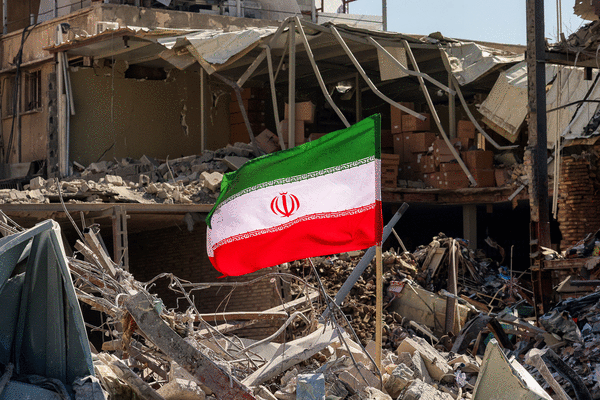
It is now clear that the joint United States-Israeli war on Iran will not result in a quick capitulation by the Islamic Republic or an uprising by the Iranian people, as was clearly hoped for by the Trump administration.
This was sealed Friday by President Donald Trump’s demand that the Iranian regime “unconditionally surrender” — a goal that, in all likelihood, will only be achievable by marching U.S. troops into Tehran, and is even then by no means certain.
Trump has also indicated that he will settle for no less than an American puppet regime in Tehran, mirroring the result the administration appears to have achieved (at least for now) in Venezuela. The president has gone as far as demanding a personal role in selecting Iran’s next leader.
In the very first days of the war, the Editorial Board argued that Trump needed to articulate clear war aims to avoid another “open-ended and ruinous commitment” in Western Asia. The administration appears to be settling on the broadest possible aims — regime change and possibly nation-building — ensuring U.S. involvement in Iran not for days and weeks but months and years. And that’s assuming the goals are achievable in the first place.
In the context of an already slowing economy (confirmed by a disastrous jobs report on Friday) and the destabilizing paradigm shift promised by artificial intelligence, the effects of a protracted war in such a sensitive region will likely make the coming months among the most economically uncertain and politically delicate in recent American history — comparable to the early months of the COVID pandemic and the early fallout of the 2008 financial crisis.
Yet there is little to no evidence that the Trump administration appreciates, or has adequately planned for, the seriousness of the potential knock-on effects of its Persian adventure for geopolitics and for everyday Americans.
Mounting costs
Every day the war continues on its current trajectory, the costs to the global economy will mount. The gulf states of Kuwait, Saudi Arabia, Bahrain, Qatar and the United Arab Emirates are currently absorbing the brunt of the crisis, both economically and militarily. Whether these nations, plus Israel and the United States, have sufficient munitions to protect themselves from Iranian barrages in a protracted conflict — or if Israel/U.S. forces can end the threat first — remains a key unknown.
Yet even if the gulf states’ defenses hold, Iran has already damaged significant energy infrastructure. Meanwhile, its closure of the Strait of Hormuz, which connects the Persian Gulf to the Indian Ocean, has blockaded oil shipments. These states are forced to slow and eventually to stop production as their storage facilities — themselves potentially vulnerable targets — fill up. The result is already the most significant supply shock in the history of oil production, greater even than the 1973 OPEC oil embargo.
The market price of unrefined oil has already risen by nearly 50% since hostilities began. The trend will not abate until trade returns to something like normal. Americans can expect $4 gas shortly, and possibly $5 or more if Iran retains the ability to choke the gulf for several more weeks. Other industries susceptible to the cost of petroleum, such as airlines, could be in dire straits within just a few weeks.
Despite this predictable result of launching a major assault on Iran, the Trump administration has only filled the country’s Strategic Petroleum Reserve to 58% capacity, representing about 20 days’ supply. Because of America’s lack of preparations and haphazard strategy, despite overwhelming air superiority for the U.S. and Israel, time appears to be on the side of the Islamic Republic.
Unserious leadership
Given the gravity of the situation, we are particularly concerned by the attempts by the White House, and in particular the Department of Defense under Secretary Pete Hegseth, to present this war as an exercise in American machismo. The administration, for instance, has taken to releasing footage of U.S. bombing runs crudely interspersed with scenes from action movies or, on Friday afternoon, footage of homerun at-bats.
It’s a ten-year-old boy’s idea of effective propaganda. Indeed, it is a lesson that must apparently be learned again and again through history that warfare is not primarily about competing exertions of masculinity.
This would be embarrassing enough were it not for the enormous stakes of this conflict for the world in general and the American people in particular. In everything from the unaffordability of housing to the ongoing shakeup caused by the advent of AI, everyday Americans are facing profound uncertainty about the short- and long-term financial stability of their families. They are looking for a steady hand to navigate rough seas, not chest-thumping expressions of bravado.
The right stuff
There is only one way to minimize the costs of opening a war with Iran while still achieving some positive goal: Sharply limit the war’s scope. Iran’s ability to project power has been significantly degraded in the past week. Let that be enough.
Make no mistake: Regime change or certainly “unconditional surrender” will be possible only with a major ground invasion of Iran. This, too, the administration is not prepared for: It has moved into the region far fewer resources than were in place for either Gulf War, while the adversary is four times larger than Iraq in size and twice as large in population.
The six-month operation the Pentagon is reportedly planning, would be far too long in terms of the costs imposed on everyday Americans and the world economy and far too short to achieve Trump's new and extreme goals. An extended war with Iran would invite a disaster far greater than the very limited goods it would obtain. It would almost certainly become one of the “forever wars” Trump once campaigned against.
Now is not the time for machismo, but for sober strategizing. Blowing things up is part of winning, but it’s not winning itself. That requires virtues much harder to come by: judgment, understanding, humility and the ability to accept a limited victory that’s in America’s, and the world’s, best interests.
_____
©2026 PG Publishing Co. Visit at post-gazette.com. Distributed by Tribune Content Agency, LLC.





















































Comments