Commentary: Can AI fill out a winning March Madness bracket?
Published in Op Eds
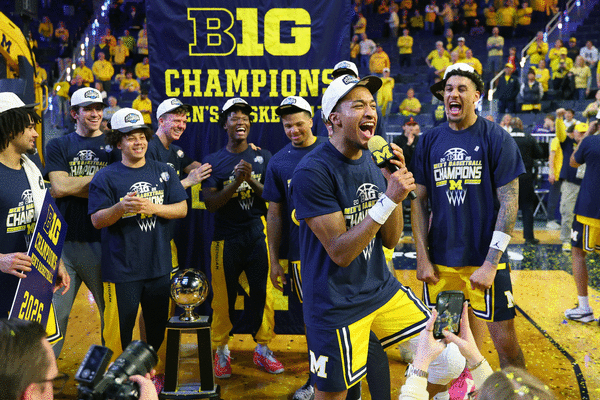
The end of the college basketball season is fast approaching. Selection Sunday is less than a week away, with dozens of teams waiting to see where they will be seeded and, for some, if they fall on the right side of the bubble. This also means that college basketball fans are sharpening their pencils to fill out their March Madness bracket.
Whether it is about winning the ESPN Tournament Challenge, taking the top spot in the office bracket pool, enjoying bragging rights among friends or taking simple personal enjoyment in picking the right 12-5 upset, millions of people partake in this annual event.
Thanks to technological advances, one question is: Will artificial intelligence tools such as ChatGPT and Google Gemini help you put together a winning bracket?
The answer is more nuanced than a simple yes or no.
Yes, these AI tools can put together a bracket. The more salient question is whether such a bracket would perform any better than a person using their best judgment in picking the winners of the 63 games that constitute the main bracket (not including the winner of the four play-in games).
Picking the winner of all 63 games is akin to picking the winning number in a lottery. There are over 9 quintillion possible bracket combinations. That is a nine followed by 18 zeroes. To put this into perspective: There are 292,201,338 possible combinations of Powerball numbers that can be drawn and 290,472,336 possible combinations of Mega Millions numbers that can be drawn. A person is over 100 times more likely to win both the Powerball and the Mega Millions jackpots than get a perfect March Madness bracket. No amount of AI can overcome such long odds.
Of course, not all the March Madness bracket games are toss-ups. The No. 1 seeds have a near flawless 158-2 record in the Round of 64 since 1985. AI systems know not to treat this game like a toss-up, with each team having an equal chance to win. Using historical performance data, the odds of picking all 63 games correctly drops to around 6.5 billion to one, making it still 22 times more likely you’ll win either the Powerball or Mega Millions jackpot than get a perfect bracket.
What makes filling out winning brackets so challenging is that the tournament is single elimination. One early-round upset can derail the hopes of the most talented team. Recall that in 2023, when No. 1 seed Purdue lost to No. 16 seed Farleigh Dickinson, every bracket that had Purdue advancing to the Final Four was busted. The same was true in 2018 when No. 1 seed Virginia lost to No. 16 seed University of Maryland Baltimore County. Note that both Purdue and Virginia got some revenge in following years, as each advanced to their respective national championship game, with Virginia winning the crown.
What AI can do is use all the available historical data that it has been trained on to recognize patterns in constructing a bracket. Yet patterns capture trends, not outcomes. Given that there is uncertainty surrounding the result of every game, AI is likely to perform no better than an informed person picking games. In fact, if all you want to do is put together a single bracket, picking the favorites will give you the best odds of having a reasonable scoring bracket.
But what if you can put together several brackets? This is where AI is best positioned to shine.
AI can use historical data and pick multiple combinations of upsets with an eye on one of the brackets scoring well, even if most do not. This is in line with the number of brackets submitted to the ESPN challenge every year (with over 24 million submitted in 2025 ) and how the best score among them is in line with the brackets that AI can create.
So for those of you who plan to use ChatGPT or Gemini to fill in your bracket, the results you get will likely be no different than if you use common sense and put together your bracket by hand. Much like how a broken clock is right twice a day, AI may give you a great bracket. It is even more likely to come up with one that is busted after the first round.
____
Sheldon H. Jacobson is a professor of computer science at the University of Illinois Urbana-Champaign. His website, Bracketodds, uses AI to help March Madness fans enjoy the analytics of the tournament.
___
©2026 Chicago Tribune. Visit at chicagotribune.com. Distributed by Tribune Content Agency, LLC.































Comments