Allison Schrager: Think the US economy is unfair? Blame the upper middle class
Published in Op Eds
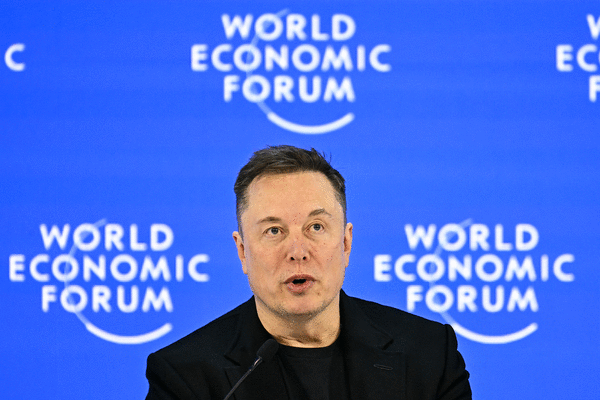
Billionaires are now Public Enemy No. 1 in America. Majorities of voters, in both parties, think the gap between the rich and poor is a big problem and that the rich have too much power. To be fair, this economy does seem to be making a lot of people anxious and unhappy, but it’s not Elon Musk or Marc Zuckerberg’s fault. If anyone is to blame, it is the upper middle class.
In other words, if you are reading this — or, come to think of it, writing it — you. Us. We are the problem.
An unsung story of the last few decades is the rise of the upper middle class. In the 1960s and ‘70s, the U.S. had a robust middle class, and the national income distribution looked like a bell curve. The middle class has since been hollowed out, not because people got poorer but because many families joined the ranks of the affluent.
The distribution of income changed as more people moved into the 75th and 90th percentiles of household income. That translates into earnings between $150,000 and $300,000, or even $400,000 if you live in an expensive city. There is also a small cohort of Americans who became very, very rich. The top 1% — and especially the 0.01% — moved even further apart from everyone else.
This is all mostly a positive development. Some Americans got super rich, many more became more prosperous, and fewer overall are poor. But it feels like a crisis because the economy has not fully adjusted to this new income distribution. Too many affluent people are chasing a limited number of high-end goods and services that feel like necessities: city apartments, an elite-university education, luxury vacations, innovative health care, concert and sports tickets, and so on.
Consider housing. A popular narrative is that a lack of supply is why home prices have increased 70% since the 1980s. While supply is certainly an issue, there is also research showing that there are more affluent buyers whose wealth has grown faster than the number of available homes. There is also a study saying that much of the increase in housing costs in cities between 2000 and 2020 can be explained by an increase in income. Income growth explains why homes are bigger and have more amenities, too.
Granted, none of this makes anything more affordable. If you are not a member of the new mass affluent class, then you are getting outbid on a house that you may want, or you may have to settle for a smaller home with fewer features, or maybe there just isn’t anything for you on the market at all. Even if you are mass affluent (or on your way), you might have trouble finding a house you can afford.
The same dynamic helps explain why so much else feels so expensive. It’s easy to blame algorithms and the secondary market for expensive concert tickets, but a market exists for $1,000 Taylor Swift tickets because many families are willing and able to pay that much for an event with a limited number of seats. Higher incomes also mean more demand and thus higher prices for less discretionary goods and services such as private schools (or homes in areas with good public schools) or even health care.
Some people are genuinely struggling with affordability because they aren’t mass affluent, and more of the economy is now geared toward goods and services out of their price range. Less deserving of sympathy (though still somewhat sympathetic!) are the affluent frustrated when their expectations don’t match reality. A family with income of $300,000 may feel like it should be able to afford a great home in an expensive area, send the kids to private school and take nice vacations. But in many areas of the U.S., it isn’t.
The mismatch between affluent demand and supply will probably work itself out. Either the market will find a way to offer more high-end goods and services for cheaper, perhaps through technology, and the trappings of elitism will become less elite — or it won’t. In that case, some people will adjust their expectations by moving to a cheaper area, taking cheaper vacations or cooking more at home.
Economies evolve. When they change quickly, the allocation of resources can be thrown out of equilibrium. Sometimes the government steps in, and sometimes the market adjusts. That becomes less likely when the frustrated mass affluent turn to populism, which promises to fix the problem with price controls, punitive taxes on the very rich or industrial policy. Imposing these solutions will reduce innovation and create shortages, making the problem worse.
And billionaire hatred certainly doesn’t help, especially if they are the ones who are making things cheaper. At the very least, you’re not competing with them for concert tickets.
____
This column reflects the personal views of the author and does not necessarily reflect the opinion of the editorial board or Bloomberg LP and its owners.
Allison Schrager is a Bloomberg Opinion columnist covering economics. A senior fellow at the Manhattan Institute, she is author of “An Economist Walks Into a Brothel: And Other Unexpected Places to Understand Risk.”
©2026 Bloomberg L.P. Visit bloomberg.com/opinion. Distributed by Tribune Content Agency, LLC.














































Comments