Editorial: Vigilance, not paranoia, needed in face of biological threats
Published in Op Eds
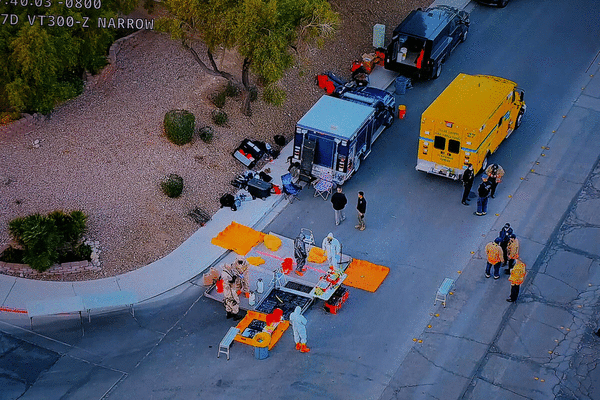
The reported discovery of an illegal laboratory in Las Vegas should not trigger panic, but it should trigger seriousness. It is not evidence of an active biological war underway in the United States. It is something more subtle and more troubling: a reminder of how exposed modern societies have become in an age where powerful biological tools are widely accessible and increasingly easy to conceal.
Federal and local authorities are investigating the apparent lab, located in a Las Vegas home, and report that they uncovered “evidence of possible biological material to include refrigerators with vials containing unknown liquids.” Two people became “deathly ill” after exposure to the lab, according to police documents.
The owner of the property is a Chinese citizen who’s facing charges in a separate 2023 case involving a California biolab, police said, where “investigators reportedly discovered materials possibly associated with infectious diseases, including hepatitis, COVID-19, HIV, malaria and other potentially dangerous pathogens.”
There’s no reported indication, as conspiracy theories have floated, that these labs were part of any biological terror plot or intelligence operation. The California case charges the property owner with selling fake and unapproved medical test kits. But these discoveries of biolabs raise questions about how serious the threat of hidden biological hazards is in American communities and whether law enforcement is sufficiently vigilant.
Not long ago, dangerous biological research required vast government facilities, specialized infrastructure and visible oversight. That world is gone. Today, advanced biotechnology can operate quietly, cheaply and out of public view. Equipment once limited to state or academic institutions can now fit inside garages, warehouses or storage units.
This shift has transformed biosecurity from a niche regulatory concern into a frontline national issue. The most unsettling aspect of the case is not who allegedly operated the lab, but that an unlicensed operation could exist at all in a major American city like Las Vegas without detection. That reality points to gaps in enforcement, inspection authority and interagency coordination. If such gaps exist in one city, it is reasonable to assume they exist elsewhere.
Biological threats do not require uniforms, missiles or declarations of war. They thrive on ambiguity — unknown samples, unclear intent and undocumented activity. In this realm, uncertainty itself is dangerous. Intent is often understood only after exposure or harm has already occurred. That is why clandestine biological activity, regardless of scale or sophistication, must be treated as a serious matter.
At the same time, hysteria is not the answer. Sensationalism weakens public trust and allows legitimate concerns to be dismissed as exaggeration or conspiracy. But silence and minimization are just as corrosive. When authorities fail to communicate clearly about what happened, what risks were present and how safeguards will be strengthened, speculation fills the void.
The lesson here is about preparedness, not paranoia. For decades, the federal government has been alert to the danger of biological threats to the nation. The Department of Homeland Security oversees a biological defense program responsible for identifying and responding to the introduction of threatening biological agents. This moment should prompt a sober reassessment of whether those safeguards are sufficiently effective and whether other hazardous and illicit home labs have fallen through the cracks.
The warning from Las Vegas is quiet but unmistakable: In a world where biology is portable and powerful, vigilance is no longer optional.
_____
©2026 The Baltimore Sun. Visit at baltimoresun.com. Distributed by Tribune Content Agency, LLC.







































Comments