Editorial: English-only license dictate won't make Florida safer
Published in Op Eds
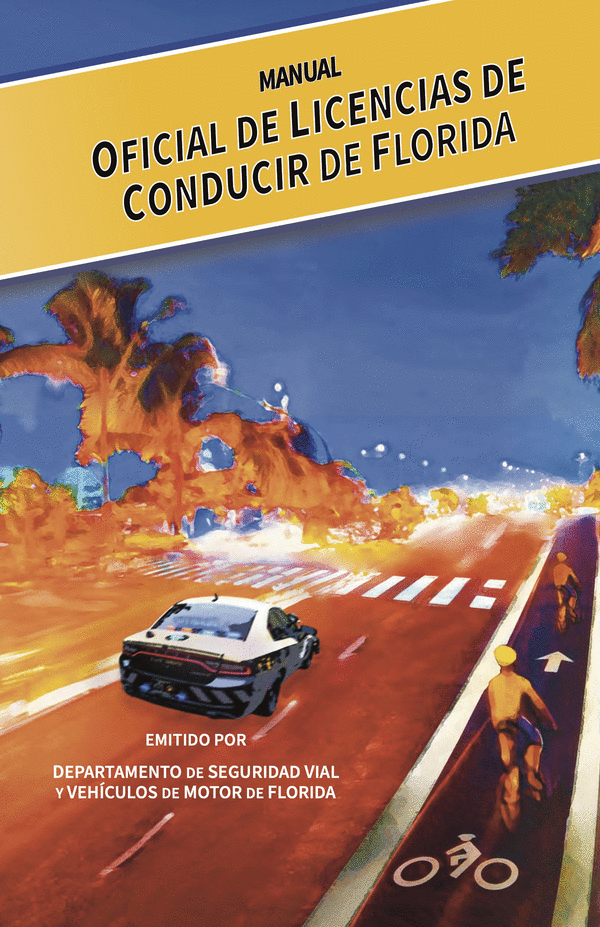
We have a question for officials at the Florida Department of Highway Safety and Motor Vehicles, though we’re not sure they will answer it:
What are they really trying to accomplish with the new English-only rule that goes into effect Friday at driver’s license offices across the state?
Because nothing about this new rule will change the reality of Florida’s demographics. In more than one-third of Central Florida households, English is not the predominant language. And roughly 12% of adults in this state are considered “low English proficiency,” meaning they struggle with communication in that language. That includes some natural-born U.S. citizens, particularly those who came here from Puerto Rico, where Spanish is the predominant language.
So. Hundreds of thousands of Florida residents don’t speak English very well. Yet many of them seem to drive just fine. Florida’s road signs are based on international standards that, for the most part, rely on pictograms and colors to convey their messages. Red octagons mean stop. Upside-down triangles tell drivers to yield. You know the drill.
Florida officials can’t simply assert — as they did last week — that non-English-speaking drivers are more dangerous, or that this new requirement is needed to make the state’s roads safer without bringing forward some evidence to prove that claim is true.
The likely impact
We think it’s actually likely to make driving more dangerous, for everyone.
Here’s why we feel that way. For starters, this rule was put into place with zero notice — not even to county tax collectors, who now oversee the nuts-and-bolts operation of licensing Florida’s nearly 19 million drivers. It dropped last Friday, and it goes into effect on Feb. 6. The state has already deleted Spanish and Haitian Creole versions of the Florida Driver’s Handbook from its website. (We were able to download them, and we’ll post them on our website Wednesday morning.)
That puts local residents who aren’t English-proficient in a quandary. They can, if they choose, rush to the local DMV office before Thursday night. Osceola County Tax Collector Bruce Vickers, reached by phone Monday afternoon, says his offices have been hit hard by people hoping for an appointment, and that he’s doing everything in his power to accommodate them, including working the front lines himself. As he hung up, we heard him greet his next customer in Spanish. But there are only so many who will make it through before the cutoff.
What happens to those people who don’t get appointments this week? Many of you might be thinking, “well, they should learn English.” While that’s a worthy goal, nobody who isn’t already proficient will learn the language by Friday morning.
Next, non-English speakers can try to take the test anyway, and even take it multiple times. But until they pass, they won’t have licenses. And passing will be tough. Not only are non-English testing materials prohibited, people who want to take the test can’t use interpreters during the written or skills exams.
Or they can just shrug it off. That doesn’t mean they won’t be driving: As Orange County Tax Collector Scott Randolph points out, living and working in Central Florida is nearly impossible without a car for most residents who aspire to something more than a life of poverty. But they won’t have the review of fundamental road rules that the written and practical tests cover. The state won’t know whether they are competent to get behind the wheel or not, because they won’t have the chance to prove themselves.
The ripple effect
Guess what else they won’t have? Insurance — which unlicensed drivers can’t buy. This is going to carry a big financial impact, especially on the people who end up in a collision with an at-fault driver who is unlicensed due to the new dictate. Making matters worse, Florida doesn’t require any driver to carry uninsured motorist coverage. That could put many drivers who speak English perfectly well on the hook when their family vehicle is totaled by someone who can’t get liability coverage.
Finally, legal residents who are caught driving without a license could find themselves subject to deportation. That’s more pointless pain for families who have tried to follow the law but are now living in fear.
In light of the facts, it’s clear that the state’s pretended rationale for this action is paper-thin. So what’s really going on?
It could be a numbers game. Some Florida officials — including Gov. Ron DeSantis and James Uthmeier, who was the governor’s chief of staff before being appointed attorney general — clearly see beating up immigrants as a sure path to political success. We suspect they’ve overshot the mark. Immigrants who are living and working legally in Florida might not sympathize with foreign nationals who don’t follow the rules. But they are more likely to be angered at the number of law-abiding green card holders who are suddenly stripped of their car keys because of an arbitrary political move by calculating leaders. That goes double for Puerto Ricans, who are American citizens no matter what language they speak.
The only sure benefit here is for trial attorneys, who will stampede over the chance to take the state to court. The most likely grounds: Violation of federal equal protection laws, which prohibit discrimination on grounds of national origin or language. There’s also the valid question of whether Florida’s Department of Highway Safety and Motor Vehicles had the authority to snap this new dictate into place without going through the state’s administrative rules process, which often takes a year or more to complete.
As you can see, there are still a lot more questions here than answers. In the long run, as those answers become more clear, we suspect that well-intentioned state leaders will reverse course. But in the meantime, heaven help the Floridians — English-speakers among them — who get into a collision with the law of unintended consequences.
____
The Orlando Sentinel Editorial Board consists of Opinion Editor Krys Fluker, Executive Editor Roger Simmons and Viewpoints Editor Jay Reddick. Use insight@orlandosentinel.com to contact us.
©2026 Orlando Sentinel. Visit at orlandosentinel.com. Distributed by Tribune Content Agency, LLC.











































Comments