Commentary: Immigration judges should be real judges, not political pawns
Published in Op Eds
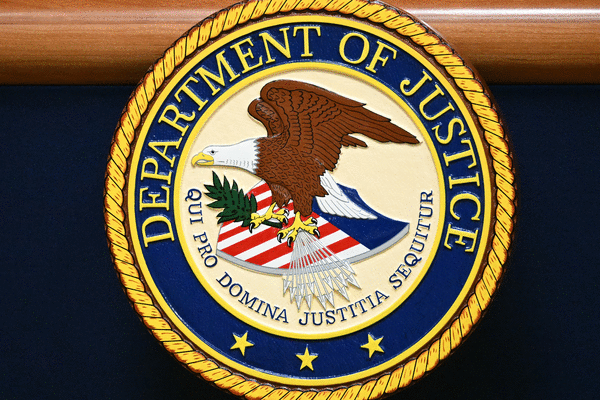
Life-or-death decisions in thousands of cases are made every year by immigration judges— but don’t let their title give you the wrong idea about their position.
In America we have the expectation that judges are independent, allowing them to rule without “fear or favor” in the cases that come before them. But immigration judges have never had the independence we associate with “real judges.”
Immigration courts are not part of the judicial branch like other courts, but are located within the Executive Office for Immigration Review of the Department of Justice. Its judges are appointed by the attorney general, to whom they must answer. Unlike federal judges, immigration judges do not have lifetime appointments. Even after they complete a required two-year probationary period, they can be removed by the attorney general, making them susceptible to political pressure in a way that federal judges are not.
Immigration courts have also been starved of resources: Money has poured into enforcement, resulting in increasing numbers of noncitizens ending up in court, while a similar increase in court funding has not materialized. This has led to a crushing backlog of cases, currently almost 3.5 million. Immigration judges have been under constant pressure to work faster.
Proposals to reform the immigration courts to give its judges real independence go back decades. There have been repeated calls to make immigration judges part of the judicial and not the executive branch and to provide them with adequate resources. The most recent proposal was in 2022 with the introduction in the House of the Real Courts, Rule of Law Act.
Unfortunately, like many prior immigration court reform proposals, that legislation did not move forward, and now the Trump administration has taken advantage of its executive power over the courts to turn them into another cog in its mass deportation machine. It has made clear that the role of immigration judges is not to fairly decide cases, but to remove as many noncitizens as possible, as swiftly as possible.
The administration wasted no time in its attack on the immigration courts; on its first day in office, it replaced top officials at the Executive Office for Immigration Review, who provide directives to judges on decision-making. The new leadership produced a dizzying number of policy memos telling judges how to handle cases, including adopting procedures making it easier for Immigration and Customs Enforcement to carry out the notorious courtroom arrests of noncitizens who appear as required for hearings.
The replacement of the office’s leadership was followed by the wholesale firing of immigration judges across the country. Of the slightly more than 700 serving at the beginning of Trump’s term, to date, more than 100 have been fired, while a similar number have resigned or retired — a startling rate of attrition in just a year.
Who were the judges who were fired? Unsurprisingly, it was those perceived as getting in the way of the administration’s mass deportation program. Judges who had a high rate of granting relief to noncitizens were on the chopping block. The administration fired them without cause, and indeed, cause would have been difficult to prove: Many of these judges had received exemplary performance reviews up until their terminations.
One policy memo from the restaffed Executive Office for Immigration Review had foreshadowed dismissal of judges who ruled on behalf of immigrants too frequently for the administration’s liking. It stated that although immigration judges “are independent in their decision-making in the cases before them,” any who were “adjudicatory outliers” or had “statistically improbable outcome metrics” (meaning too many grants of relief) could face consequences, including removal. Of course, judges who had exceptionally high denial of cases were not fired for being outliers.
Also targeted for termination were judges appointed by the Biden administration, many of whom were still within their probationary period.
The last year’s purge is having its intended effect: As of August 2025, the national asylum rate had dropped by half to 19.2%, a historic low.
The Trump administration’s plan for filling the staffing gap is just as troubling as the purge itself: replacing permanent judges with temporary ones, eliminating any meaningful professional requirements for these temporary judges and militarizing the role, with lawyers from the service branches being appointed to these positions.
Although these military lawyers are uniquely vulnerable to political pressure and for the most part are not familiar with immigration law — an area characterized as secondary in complexity only to the tax code— they are likely to be professionals committed to the law. That may be an obstacle to the administration’s attempt to deny due process and deport people who have a valid claim to stay in the U.S.
The proof is already in that newly appointed judges who are not sufficiently on board with the administration’s mass deportation program will not last long. Christopher Day, a U.S. Army Reserve lawyer appointed to serve as an immigration judge in Annandale, Va., was fired after a month on the bench; his downfall was evidently granting relief at an unacceptable rate.
The appointment of temporary judges loaned from the Pentagon raises particular questions about legality because the Posse Comitatus Act prohibits the military from participating in civilian law enforcement (which immigration is) without congressional authorization. None other than now-Justice Samuel A. Alito Jr., in a memo dating to his days in the Reagan White House, concluded that serious legal questions would arise from military lawyers being assigned to perform civilian law enforcement.
Members of Congress — primarily Democrats — have criticized the firings, and in December, two from California (Sen. Adam Schiff and Rep. Juan Vargas) introduced legislation to prohibit the appointment of military attorneys, to limit temporary appointments and to require appropriate training.
It is unclear how proposed reforms or challenges to the wholesale dismissal of immigration judges will turn out. What is clear is that the Trump administration is perverting justice, capitalizing on the unfortunate fact that immigration judges are not real judges and so lack the protections accorded to members of the federal judiciary.
One can only hope that the Trump administration’s attack on the immigration courts will bolster support for long-needed reforms. Immigration courts should be real courts, independent of the executive branch so that judges can make principled decisions, applying the law to the cases before them, without bias, and with justice for all.
____
Karen Musalo is a law professor and the founding director of the Center for Gender and Refugee Studies at UC Law, San Francisco. She is also lead co-author of “Refugee Law and Policy: A Comparative and International Approach.”
_____
©2026 Los Angeles Times. Visit at latimes.com. Distributed by Tribune Content Agency, LLC.


















































Comments