Editorial: Removal of slavery exhibit from the President's House will not whitewash history
Published in Op Eds
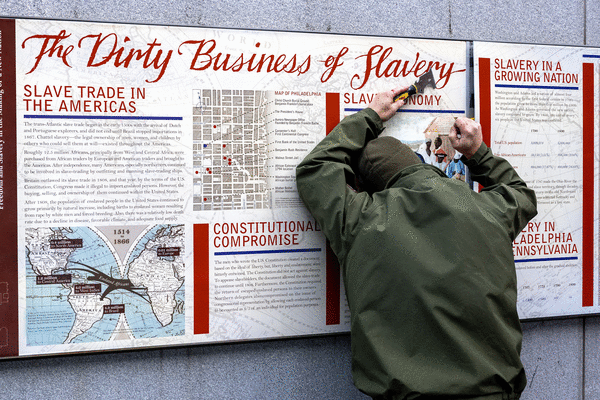
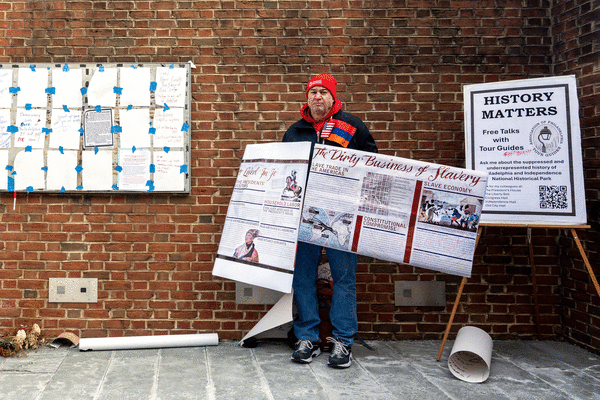

Despite widespread pushback, the Trump administration and the National Park Service removed exhibits on slavery from the President’s House, a recreation of the executive residence that once housed George Washington and John Adams.
The exhibits detailed facts about slavery in early America, including how Washington engaged in a human shell game with enslaved members of his own household. After the passage of Pennsylvania’s Gradual Emancipation Act in 1780, enslaved people were shuttled between Philadelphia and Mount Vernon every six months to obey the letter, if not the spirit, of the law.
The exhibits, part of Independence National Historical Park, also memorialized the nine people first brought into bondage to the city with our nation’s first president. It is important to note their names and their stories.
Austin was a waiter who died while traveling on one of those trips back to Virginia. Paris was a young stable hand whose tenure in the city was short. Hercules was a celebrated chef who eventually escaped from Mount Vernon. Christopher Sheels served as Washington’s valet. Richmond was the son of Hercules and worked various roles despite being just 11 years old. Giles drove Washington’s carriage. Oney Judge, a maid, famously fled bondage in Philadelphia, attracting the president’s ire. There was also Moll, a nanny, and Joe, a footman. Joe had to leave his wife and children behind in Virginia during his time working at the President’s House.
Evidence shows that the people whom Washington enslaved were well aware of the hypocrisy surrounding their situation. In a nation formed on the premise that “all men are created equal,” they found themselves bound by birth to a life of servitude, working in the household of the new republic’s first leader. Their stories once adorned the President’s House. Now, blank spaces stand in their place.
The Trump administration has cited a desire to avoid any historical marker that “inappropriately disparages Americans past or living.” Washington is one of the most admired men in U.S. history. His military leadership and willingness to cede executive power are worthy of our esteem. But Washington, like Thomas Jefferson and many other founders, fell short when it came to slavery. Removing panels cannot change that fact.
What the desecration of the President’s House does is disparage not just the enslaved members of Washington’s household, but the millions of Americans who, in the words of Mayor Cherelle L. Parker, “endured a great deal of pain so that America could realize its promise.” It also insults the efforts of the Philadelphians who fought to build the exhibit and have a vital part of America’s history recognized.
Thankfully, there is a strong local effort to fight the removal.
Parker cited a 2006 agreement between the city and the National Park Service, which her administration says requires consultation before any alterations are made. The city has filed a lawsuit to restore the panels and is hosting a public hearing on Friday. Perhaps while the court fight plays out, a temporary alternative can be installed at City Hall, by the Constitution Center, or in Fairmount Park.
Parker’s outrage is also a welcome change. While the mayor has mostly refrained from picking fights with the White House, she chastised President Donald Trump and park service officials, saying: “You cannot erase our history. You will not erase our history!”
Gov. Josh Shapiro has joined the city’s lawsuit. An amicus brief filed by his administration said: “There is no virtue in refusing to acknowledge certain aspects of our history because it is painful to do so. The removal of the slavery exhibit from the President’s House undermines this commitment and denies Pennsylvanians and others the opportunity to learn more about a part of our history that cannot be ignored.”
This sentiment is the right way forward.
As the United States celebrates its 250th anniversary, Americans will undoubtedly hear much about this country’s triumphs. That includes those who fought and died — including many who had been enslaved themselves — to keep our country united and begin to address our nation’s greatest mistake.
Generations after the Civil War, Americans were a pivotal part of the coalition that defeated the forces of fascism in Europe. The United States has put people on the moon, helped vanquish diseases like polio, exported its diverse and vibrant culture, and inspired democratic reformers across the world.
Failing to acknowledge our failures can only undermine that legacy.
©2026 The Philadelphia Inquirer, LLC. Visit at inquirer.com. Distributed by Tribune Content Agency, LLC.













































Comments