Mark Gongloff: The next Dust Bowl is becoming more likely
Published in Op Eds
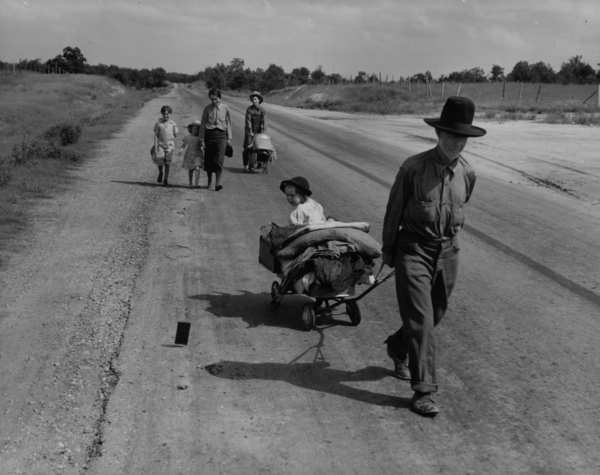
About 90 years ago, American farmers in the Great Plains had so ravaged the thin soil there that a series of droughts turned the region into a vast expanse of dust, which formed monstrous storms and polluted the skies in cities hundreds of miles away. Around that same time, many places in the U.S. suffered from the most extreme heat waves in the country’s history, setting temperature records that stand today.
The two phenomena — the Dust Bowl and those epic heat waves — were connected. The former produced the latter, which in turn refueled the former, and so on. A new study released this week by the weather forecasting firm AccuWeather suggests the conditions that produced the vicious cycle of drought and heat in the 1930s are returning to the US. This time, it appears to be due to the heating of the planet by greenhouse gases, meaning these changes will be essentially permanent, unlike conditions 90 years ago.
This doesn’t mean we’re doomed to another Dust Bowl. It does mean we’re potentially in for a much drier, hotter future than many of us might expect, one where heat waves will be more extreme and farming and finding fresh water will be more difficult in many parts of the country.
“If this trend continues, because of the drought and heat interaction, it suggests warming could exceed what the common climate models are suggesting,” AccuWeather founder Joel Myers told me.
Crunching decades of data collected at 44 weather stations across the country, AccuWeather found the average temperature in the US has risen by 3 degrees Fahrenheit, or 1.66 degrees Celsius, over the past 70 years. This would seem to be a faster rate of warming than the global average, which has risen by about 1.3C since the late 1800s.
That’s only half of the bad news. AccuWeather also found that the relative humidity in the air has fallen 5.3% since 1995, on average, after staying fairly steady for the first 40 years of data. Average rainfall has decreased 2.7% during that time, even though the likelihood of torrential downpours that bring more than 4 inches of rain in 24 hours has jumped by a massive 70%.
In plain language, we’re getting less rain. But when we do get it, we get it in destructive deluges that don’t help much to irrigate crops or replenish groundwater.
Hotter air holds more moisture, according to physics. Every 1 degree Celsius of warming means air can hold 7% more water. So why hasn’t the moisture in the air risen in lockstep with the heat in the US? One reason is that the ground has only so much water available to evaporate into the air, Myers pointed out. Decades of warming have wrung many parts of the US dry.
The total amount of water vapor in the air is still increasing. That’s more bad news for the climate, because water vapor is a massive greenhouse gas. Globally, it hit its highest level on record in 2024, according to the EU’s Copernicus Climate Change Service. But in the U.S., at least, though it has also risen, it hasn’t kept up with the rise in temperatures. That’s why the humidity relative to temperature has fallen here.
This is where the vicious cycle connecting drought to heat kicks in. Hotter air dries out the land through evaporation. That means there’s less water in the soil to absorb heat and draw it deeper into the Earth. So the heat stays on the surface, keeping the air hotter. Rinse, repeat, lose your farm.
This cycle helps explain why the 1930s were so freakishly hot in the U.S. but relatively cool in the rest of the world. Kansas and North Dakota each set their record high temperatures of 121F in July 1936. Oklahoma hit 120F twice in that same month. The return of rain at the end of the decade ended the Dust Bowl, and soil-conservation efforts by the federal government helped prevent its return. The heat-drought cycle was broken then. It may yet make a comeback.
If you make a global map showing how summer maximum temperatures have changed between the 1930s and today, as climate scientists Andrew Dessler and Zeke Hausfather have, you’ll see one blue blob in the middle of the US, representing how heat extremes have fallen there in the past 90 years. But the rest of the world is as red as a cooked lobster. Climate-change deniers like President Donald Trump constantly draw attention to the blue blob, but that’s the exception, not the rule. The vast majority of the world’s temperature records have been set in just the past 25 years.
And though those 1930s heat extremes haven’t yet been reached again, average temperatures are nevertheless rising across the country, just as they are around the world. All that heat is drying out the land. About 6 billion people live in places where fresh water supplies are dwindling rapidly, according to an Arizona State University study of satellite data last year. A 2022 survey of hundreds of wells around the world found that groundwater had fallen in 71% of them since the turn of the century.
Even as climate change makes clean water more scarce, the Trump administration is doing everything it can to worsen the problem. Its Environmental Protection Agency — an increasingly ironic name — has proposed gutting protections for wetlands based on a nonsensical definition of “water.” This will not only threaten groundwater replenishment but make flooding and pollution worse. Those wetlands also absorb carbon dioxide, meaning their disappearance will further hasten global heating.
Trump’s other moves include manipulating California’s dwindling supply on dubious pretenses and vetoing a Colorado water project 60 years in the making, possibly to get even with Representative Lauren Boebert for voting to release the Epstein files. “(N)othing says ‘America First’ like denying clean drinking water to 50,000 people in Southeast Colorado,” Boebert wrote of the veto.
As with the hundreds of other blows Trump has delivered to the environment, the EPA’s wetlands assault is ostensibly meant to boost the economy. It’s as shortsighted as those American farmers who, when wheat prices fell in the 1920s, worked already stressed soil even harder, hastening the Dust Bowl. A repeat is not inevitable. But on our current trajectory, it’s not out of the question, either.
____
This column reflects the personal views of the author and does not necessarily reflect the opinion of the editorial board or Bloomberg LP and its owners.
Mark Gongloff is a Bloomberg Opinion editor and columnist covering climate change. He previously worked for Fortune.com, the Huffington Post and the Wall Street Journal.
©2026 Bloomberg L.P. Visit bloomberg.com/opinion. Distributed by Tribune Content Agency, LLC.

















































Comments