Editorial: There's no partisan monopoly on bad ideas to combat the high cost of living
Published in Op Eds
Politicians all along the ideological spectrum are in agreement on the big issue currently animating Americans. Stuff is too expensive.
President Donald Trump, after mocking talk of “affordability” as a “hoax” last year, has pivoted now to proffering a slew of questionable, quick-fix policies to lower prices for Americans.
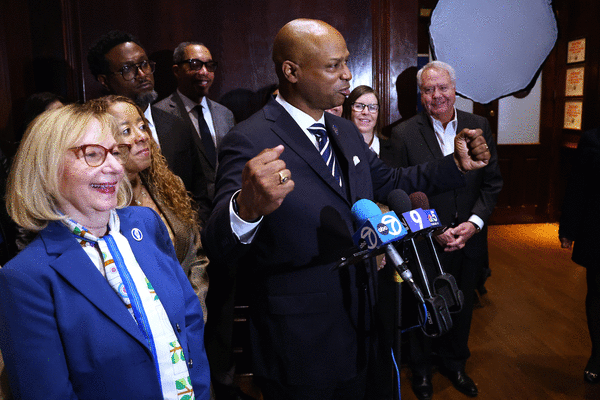
Here in Illinois, Democratic House Speaker Emanuel “Chris” Welch, speaking Jan. 6 before a City Club of Chicago audience, said of the 2026 legislative session, “Everything’s about affordability and that’s going to be our focus.”
Fine and dandy. But where things start giving us pause is when these politicians get specific.
From Trump, we have his recent pronouncement that he backs a one-year cap on credit-card interest rates of 10%. Current rates are roughly double that level.
Of course, that sounds on its face like a relief to those who pay interest on their credit-card purchases. But it doesn’t take more than a few seconds of thought to realize that if banks and other lenders are forced to slash their interest rates, they will sharply restrict what sorts of consumers they’ll finance. Credit cards aren’t a convenience for most of us; they’re a necessity — especially in a world in which cash purchases are a relative rarity.
When it comes to credit cards, the only thing that will make a consumer angrier than the nosebleed interest rate is not being able to get one at all.
Sadly, Trump doesn’t have a monopoly on this bad idea. Sen. Elizabeth Warren, the Massachusetts Democrat who’s been a harsh critic of banks for decades, says she’d love to work with the president on a bill to cap credit-card interest. This page has consistently urged Republicans and Democrats to work together, but that’s the sort of bipartisanship we can do without.
In Illinois, Welch has offered a few ideas of his own, which he says may well be pursued during this spring session in Springfield. For example, he wants to give the Illinois Department of Insurance the authority to reject homeowners insurance rate hikes if they exceed a certain level.
Again, on its face, this is likely to earn cheers in many quarters, particularly after Bloomington-based insurance giant State Farm jacked up its homeowners rates in Illinois by 27% on average last year.
But Illinois has one of the most competitive insurance markets in the U.S. thanks in no small part to its light regulatory touch on rates. We’ve supported forcing insurers to be more transparent with the public on their losses in the state when substantially boosting their rates. But a crackdown is just as likely to reduce competition that keeps prices reasonable as it is to give consumers relief.
In short, the command-and-control levers politicians have at their disposal to reduce the cost of living often are fool’s gold, creating their own unintended consequences.
That doesn’t mean, however, that these political leaders are powerless to help. Far from it. Where they can improve our economic lives is by reining in their own impulses that contribute to making daily life more expensive.
For Trump, of course, the most obvious example is his insistence on imposing stiff tariffs on imported goods. After incorporating anticipated behavioral changes by importers and others, the average effective U.S. tariff rate as of Nov. 1 was 11.2%, according to the Tax Foundation. In 2024, that figure was just 2.5%.
The U.S. inflation rate hasn’t spiked as much as some anticipated after Trump’s tariff binge, but it remains well above the Federal Reserve’s target of 2%. Calibrating tariffs’ precise contribution to inflation is difficult, but certainly those levies on foreign goods are a factor. Without them, daily life would be cheaper.
In the case of Welch and the Democratic House Caucus in Illinois that he leads, their contribution to cost pressures arise in large part from a budget approach that leans heavily on revenue increases rather than efficiencies each year. Late last year, they raised the sales tax in the Chicago area by 0.25 percentage points, for example, as part of the sprawling bill to bail out the region’s transit agencies. One can debate the trade-offs in that measure, but the bottom line is that Chicagoans will pay a 10.5% sales tax when the bill takes effect — the highest sales tax of any major U.S. city.
It’s difficult to think of a more negative public-policy effect on the daily cost of living than that.
Additionally, the state over the years has reduced the share of various other taxes it shares with municipalities, putting pressure on those local governments to raise property taxes. Property taxes in Illinois are among the highest in the U.S., significantly denting the monthly finances of homeowners and inflating rents for apartment dwellers.
Again, that’s about as direct an effect on the cost of living as there is.
So, whether you’re a Republican or a Democrat, when you hear a politician talk about how much they feel your pain and how they’re going to put the hammer down on (name your greedy industry or company of choice), we’d advise you to contemplate instead how your representative, senator, governor or president can change matters directly in their control to make your situation better.
___
©2026 Chicago Tribune. Visit at chicagotribune.com. Distributed by Tribune Content Agency, LLC.





























Comments