Marc Champion: Iran's Khamenei is now ruling by naked power alone
Published in Op Eds
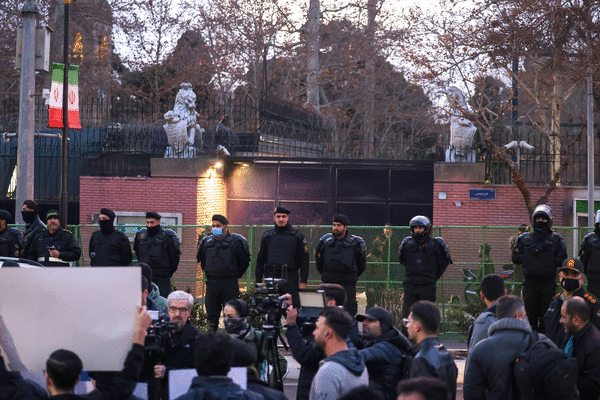
There are few moments as clarifying as a true crisis and Iran’s revolutionary, Islamist regime is in the depths of one. So what are we learning?
One revelation from the recent wave of protests concerns the nature of the governing structure that Supreme Leader Ali Khamenei has shaped and overseen for all but 10 of the Islamic Republic’s 46 years. It’s clear that the remaining tools he had for controlling most of his citizens without killing or jailing them have been swept away.
When the historian and philosopher Hannah Arendt anatomized the transition from “authority” to “power” in political systems, she had in mind the 20th century rise of totalitarian fascism and communism. Her model applies just as well to today’s Iran.
Authority, said Arendt, requires a level of consent from those ruled. Power, by contrast, relies on coercion. Iran has been moving relentlessly along the sliding scale between the two since 1979’s Islamic revolution. It now depends fully on power. Consent for its rule is absent, other than from a hardcore base of beneficiaries and true believers in a revolution made by men now dead or in their 80s.
You can measure the regime’s transition away from authority by the number of judicial and extra-judicial executions it carries out each year, and those figures have been rising sharply. It’s a rare area in which the Islamic Republic leads internationally, trailing only China.
The year 2026 looks well placed to break all previous Iranian records. By Jan. 13, security forces had already killed at least 734 protesters based on reports from just 10% of hospitals and half the nation’s provinces, according to Iran Human Rights, a Norway-based non-profit, estimating that the true figure is in the thousands. These were extrajudicial killings; using live rounds for crowd control is a choice. At the same time, Iran’s prosecutor general has described participants as “enemies of god,” a charge that carries the death penalty, and promised expedited trials. Last year, absent protests, the government executed at least 975 people.
We have long known that Iran’s clerical regime is cruel to its people and destabilizing for the region. What has changed is that relative moderates within Khamenei’s system — often misidentified as reformers — can no longer occupy the grey zone that allowed him to maintain some form of social contract with Iranians who wanted change, but feared the chaos and unpredictability of another revolution.
President Masoud Pezeshkian is one of those Khamenei-loyal moderates. After Iran’s humiliations by Israel and the U.S. last year he argued for — and achieved — a relaxation on the enforcement of hated religious and social restrictions, including on female clothing and popular music. The result was an unprecedented explosion of women appearing in public with their hair uncovered, as well as public rock and pop concerts.
What Pezeshkian could not achieve was to control the plunging currency and soaring living costs that provoked bazaar traders — generally male and conservative — to take to the streets and call for Khamenei’s resignation, or indeed his death. Protesters from the top to bottom of Iranian society have joined them.
The president failed because those economic woes are caused only in part by Western sanctions. The bigger problems lie in the corrupt, kleptocratic and militarized nature of a political system that has put an ever-growing share of the economy into the hands of Khamenei’s ruling circle and their shock troops, the Islamic Revolutionary Guard Corps. Only regime change can fix that.
When the protests began, Pezeshkian and others who favor more conciliatory methods for ensuring regime survival had called for restraint and dialogue. But as it became apparent that protesters would be satisfied only by ending the Islamic Republic, including his own rule, he joined hardliners in dismissing them as U.S.-Israeli-backed rioters and terrorists.
The result is a final undressing of Khamenei’s totalitarian system. It now relies entirely and nakedly on coercion, a situation that will likely continue even if it survives the protests. I’d like to agree with Germany’s Chancellor Friedrich Merz, when he said on Tuesday that Khamenei and his republic must now be in their “final days and weeks” because governments that must rely on force are by definition in their last gasps. History, however, suggests that same violence can keep them in power for years, even decades.
We won’t know if the republic will fall until it does. But the question gets to another clarifying moment of these protests. For if it’s extraordinarily difficult for an unarmed population to overthrow a regime that retains the will and ability to kill, it’s even harder for an outside power.
If President Donald Trump could pull off in Tehran the kind of quick, limited military action he used to remove former President Nicolas Maduro in Venezuela, most Iranians would almost certainly be grateful. It’s just unlikely that he can, and even Maduro’s regime remains in power. Trump says he has lots of options for intervening to halt the killing and remove Khamenei, and no doubt he does. But few of those options are good, as U.S. foreign-policy scholar Hal Brands has written for Bloomberg Opinion.
Trump chose one item from the menu on Monday, and it’s far from the worst. He announced a 25% U.S. tariff on any country that does business with Iran. That, if enforced, would hurt the Iranian economy and Khamenei’s revenues, but also the main customer for its oil exports, China. Last time Trump boosted tariffs on China he had to back down because of retaliation.
Even if successfully enforced, there’s no guarantee sanctions would persuade Khamenei to change course on a policy that he — correctly — considers core to his political, and even physical, survival. Sanctioning Iran’s ability to raise revenue by exporting oil would not directly impact the ability of the IRGC to shoot protesters. Using air strikes or cyberattacks to bring about regime collapse would be at least as uncertain and could backfire.
The task is made harder because this, as is more evident than ever, is a Jekyll-and-Hyde state. How to destroy an increasingly monstrous regime without harming the people you’re trying to help remains an extraordinary challenge. That calculation changes the more protesters Khamenei’s security forces kill, and Trump could well see this a chance to remove a hostile regime that’s worth the risk. But even with U.S. military intervention, this will be a job only Iranians can do.
____
This column reflects the personal views of the author and does not necessarily reflect the opinion of the editorial board or Bloomberg LP and its owners.
Marc Champion is a Bloomberg Opinion columnist covering Europe, Russia and the Middle East. He was previously Istanbul bureau chief for the Wall Street Journal.
©2026 Bloomberg L.P. Visit bloomberg.com/opinion. Distributed by Tribune Content Agency, LLC.













Comments