Commentary: What hard times make possible
Published in Op Eds
Crises’ crucibles often forge potent alliances. Before the American Revolution, John Adams steadfastly welcomed any and all “terrible news” of British despotism. “The worse, the better,” he invariably remarked, knowing that the crown’s attacks on liberty would unite the colonists.
World War I’s trials channeled Progressive Era reforms. A pervasive sense of national emergency drove the New Deal innovations of the 1930s, in the wake of the Great Depression. Hard times built coalitions. “A crisis is a terrible thing to waste,” as the fella says.
Not all ailments are alike, naturally. Useful prescriptions depend on correct diagnoses. Amid ongoing attacks on the rule of law, scholars and pundits have pointed to a “crisis of faith” in democracy itself, citing institutional decay and “democratic erosion.”
Others blame a civic education “crisis.” Justice Sonia Sotomayor recently questioned whether Americans know the difference between presidents and kings. Still others single out a crisis of “civility,” suggesting that the country has become meaner, losing its character and manners.
Each of these explanations has value. But they understate a simpler root cause: what the political scientist David Easton characterized as a failure of “outputs.”
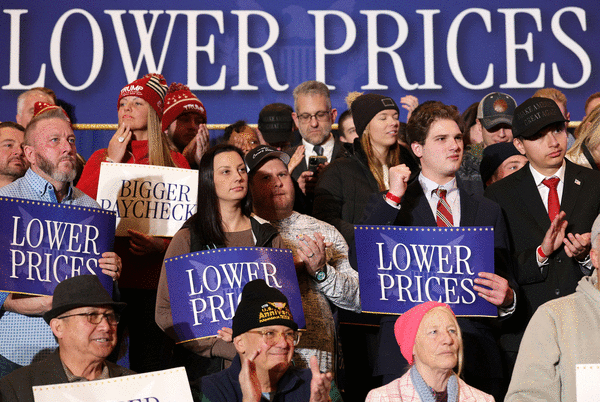
Bluntly stated, the system is not delivering for hard-working Americans. Kitchen-table issues, in recent polls, consistently outrank ideological ones. Given the alternatives, that’s not horrible news, and while that diagnosis may seem increasingly obvious, given recent elections, the potential prognosis and prescription’s fine print might surprise you.
Easton’s vision of functional government is simple: people make demands, leaders react with policies, laws, and symbolic acts, and voters respond to those outputs. “Specific support” for politicians can fail, but it takes repeated failures for the deeper reservoir of “diffuse support” – a backup tank of faith in the entire system – to run dry.
We are now draining that reserve. Very few Americans oppose democracy, but two-thirds are living paycheck-to-paycheck, and good manners and democratic theory won’t cover food, rent, or health care. Neither will starry-eyed dreams of Venezuelan oil profits.
Hardships don’t cause output crises; they reveal them. The storm of rising household expenses has only exposed the cracks in the foundation: the long erosion of the middle class and surging income and wealth gaps. Families of color have been hit hardest. Over 40 percent of the country, including nearly 50% of children, are poor or low income, medical debt is the primary cause of bankruptcy. As of December, only 34 and 36% of U.S. adults believe either the president or the Democratic party care what they think “even somewhat.” This isn’t about Republicans or Democrats or cultural wedge issues. Americans simply don’t believe they are being served by their government. That opens the window for reform.
In the past, periods of “system stress” brought real change, well past watered-down compromises. The pocketbook politicians who dominated the 20th century, who carried the United States through war, depression, and inflationary crises, were far from middling. Woodrow Wilson, Franklin D. Roosevelt, and Harry Truman, by treating fair prices, living wages, and economic security as central majoritarian claims, helped build modern America. Bold pragmatic appeals enabled strong policies that protected workers and consumers.
Near record-low trust in the U.S. government can be repaired by restoring that legacy. It won’t be easy. Automation, digitization, and globalized financial markets and supply chains have challenged liberal nations to maintain robust social protections. Cost-of-living concerns, after all, are also roiling France, Germany, Canada, and Britain. Scholars are split over just how to embed social values within an increasingly fragmented world economy. Lasting repairs may require democracies to regain control over the terms of their global exposure.
In the short term, hope can act as a pressure valve. John F. Kennedy explicitly pitched generational renewal. FDR was well-known but untainted by Herbert Hoover’s failures. Truman ran against a “do-nothing Congress.” Ultimately, tangible results will help to restore faith in the system. But fresh faces can buy precious time. Republicans are already fighting over the future of the party, younger voters are turning out at high levels, and the “bright lights of the next generation” of Democratic activists and leaders are prepared and waiting.
Liberals would be misguided to greet recent Republican setbacks with too much jubilation or relief. The president is a symptom of cultural backlash but also of political fatigue. Over 30% of Gen Z identify as “pure” independents. Some seven in 10 adults under 50 want a third political party, far more than a return to business-as-usual. The wrecking ball savaging U.S. institutions will make repair work more difficult. But to move forward, liberals will need to welcome back disillusioned voters, with grace and humility.
Prosperous empires throughout history have suffered failures born from complacency. But instances of a contrasting dynamic are also plentiful. Disasters have also birthed lasting, unexpected benefits. “In the Chinese language,” as Kennedy once framed it, “the word ‘crisis’ is composed of two characters – one representing danger, and one representing opportunity.”
____
Jamie Holmes is the author of multiple books, including the forthcoming "The Free and the Dead: The Untold Story of the Black Seminole Chief, the Indigenous Rebel, and America's Forgotten War."
_____
©2026 Tribune Content Agency, LLC.






































Comments