Editorial: Minnesota the tip of the fraud ice berg
Published in Op Eds
It’s a lot easier to waste someone else’s money.
Before the recent tragic shooting, the biggest story out of Minnesota involved massive fraud. Content creator Nick Shirley’s massively viral video appeared to show that some day care centers, supposedly serving scores of kids, were essentially ghost towns. One even had a sign that spelled learning as “learing.”
It wasn’t the only scandal. Last March, the Department of Justice secured the convictions of Aimee Bock and Salim Said in a scheme related to a pandemic program to provide meals to children. Their sham organization was called Feeding Our Future. What they actually fed were their own pocketbooks.
“The defendants falsely claimed to have served 91 million meals, for which they fraudulently received nearly $250 million in federal funds,” Acting U.S. Attorney Lisa D. Kirkpatrick said at the time. “That money did not go to feed kids. Instead, it was used to fund their lavish lifestyles.”
Attorney General Pam Bondi recently put the total cost of that fraud at between $300 million and $400 million.
Then there was a scheme among Somali residents in Minnesota to falsely claim their children had autism. That unlocked government money for bogus services. Bondi said the cost of the program supporting autism treatment shot up from $20 million to $200 million. There was also a program to help people with housing. Fraudsters billed taxpayers for services they didn’t provide. The program was projected to cost less than $3 million a year. Instead, taxpayers ponied up more than $120 million a year.
The Department of Justice has charged around 100 people connected to fraud in Minnesota. More than 60 have already been found guilty.
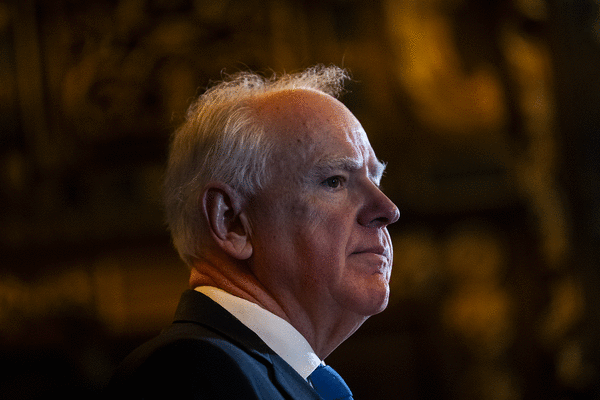
The abuse was so grotesque that Minnesota Gov. Tim Walz, beset by the controversy, announced that he wouldn’t run for re-election.
Unfortunately, it would be incredibly naïve to think this is only a Minnesota problem given the vast amounts of money that the government hands out on an annual basis. In 2023, The Associated Press conducted an analysis of COVID funding. It found that thieves likely stole more than $280 billion. Yes, that’s billions.
“Another $123 billion was wasted or misspent,” the AP’s analysis found. “Combined, the loss represents 10 percent of the $4.2 trillion the U.S. government has so far disbursed in COVID relief aid.”
This level of fraud isn’t compassionate. It’s cruelty toward American taxpayers and an affront to those truly in need. Certainly, many actions are needed here — including criminal investigations.
But an obvious place to start is increasing eligibility verification. And if some state governments aren’t competent enough to implement those, re-examining what they do with their federal funding is a logical step to take.
_____
©2026 Las Vegas Review-Journal. Visit reviewjournal.com.. Distributed by Tribune Content Agency, LLC.







































Comments