John M. Crisp: The last thing Trump wants in Venezuela is democracy
Published in Op Eds
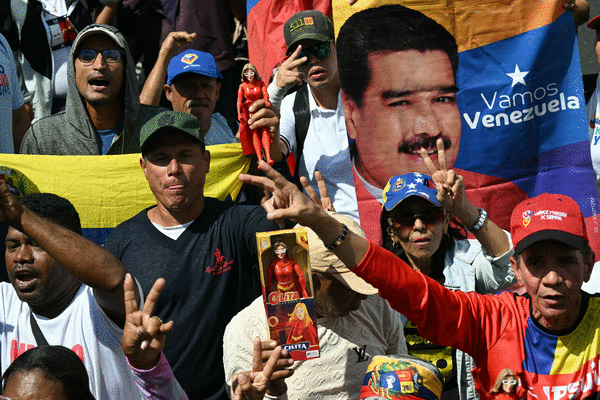
We don’t have to go far to find a convincing explanation for President Donald Trump’s Jan. 3 attack in Venezuela; it’s transactionalism.
This doesn’t require much speculation. In fact, Trump deserves credit for transparency: “We’re going to be taking oil.” Access to and control of Venezuela’s oil reserves will belong to the United States for the foreseeable future. More than a year? “I would say much longer,” Trump said.
Other explanations are less convincing.
From the beginning, interdiction of drug trafficking seemed like a flimsy rationale for moving the world’s largest aircraft carrier into the Caribbean. Certainly, explosions at sea produce compelling video, but they also destroy whatever evidence there might have been that boats are actually carrying drugs or that they represent such a threat to Americans that they justify violating U. S. or international law.
Besides, we’re unlikely to eliminate drug trafficking as long as America is a very willing drug-consumption market. Americans want illegal drugs; criminals want to sell them. What does that have to do with attacking Venezuela?
Still, stopping the flow of illegal drugs into the U.S. might be a more convincing rationale than the notion of installing a democracy in place of the socialistic-authoritarian regime that has ruled Venezuela for nearly three decades.
In the ramp-up to the attack, the Trump administration made much of the illegitimacy of the presidency of Nicolas Maduro, whose reelection in 2024 is widely regarded as fraudulent. The opposition party ran Edmundo Gonzales against Maduro after the party’s leader—Maria Corina Machado—was eliminated as a candidate by Maduro. Most experts believe that Gonzales was elected by a wide margin.
The establishment of democracy anywhere seems like a worthy objective, but how well has that worked for us in the past? Trump’s attack on Venezuela doesn’t appear to have been very well thought through, but it’s likely that some of the planners recognized early that replacing the Maduro regime with the duly elected Gonzales would require an enormous commitment of military resources in pursuit of an unrealistic goal.
Thus, the Maduro regime remains in place, minus Maduro.
This raises an interesting question: Does Trump really want a democracy in Venezuela? For that matter, do we?
For the last century, few features more accurately represent American foreign policy toward oil-rich nations than our willingness to tolerate autocratic governments, as long as the oil keeps flowing.
Saudi Arabia is the prime example. Since the 1940s, this nation’s monarchy has grown wealthy from oil revenue, while repressing women, gays and any political opposition and maintaining barbaric punishments such as beheadings and amputations for theft. The same applies to other Gulf States, as well as to Iraq under Saddam Hussein, Libya under Muammar Gaddafi and Nigeria.
What can a nation do? Is it our fault that many of the countries that happen to have the most oil also happen to be autocracies?
But it’s not just that we have to tolerate autocracies in order to get oil. Sometimes we prefer them.
When the democratically elected prime minister of Iran, Mohammad Mossadegh, tried to take control of his nation’s oil supply in 1953, the C.I.A. coordinated a coup that arrested and removed Mossadegh and re-empowered the autocratic Shah, who ruled by terror and oppression until 1979. The coup still reverberates today.
But that’s the trouble with democracies: Sometimes democrats develop pesky ideas about controlling their nations’ natural resources for the benefit of their nations’ citizens. Autocrats, on the other hand, tend to be more pragmatic and, like Trump, transactional. In other words, their principles are fewer and weaker, meaning that they can be more easily coerced or bought off.
So it’s entirely possible that the last thing that Trump wants for Venezuela is democracy. The current regime is already compromised and compliant. It’s more likely than a democracy would be to supply oil on Trump’s terms. And if they don’t, he’ll have fewer qualms about attacking a regime of corrupt autocrats than duly elected democrats.
Besides, democracy is so inefficient; autocracy is the way to get things done, quickly and without bothersome oversight. Just ask Trump.
_____
_____
©2026 Tribune Content Agency, LLC





































Comments