Commentary: For animals' sake, let's not start the New Year with a bang
Published in Op Eds
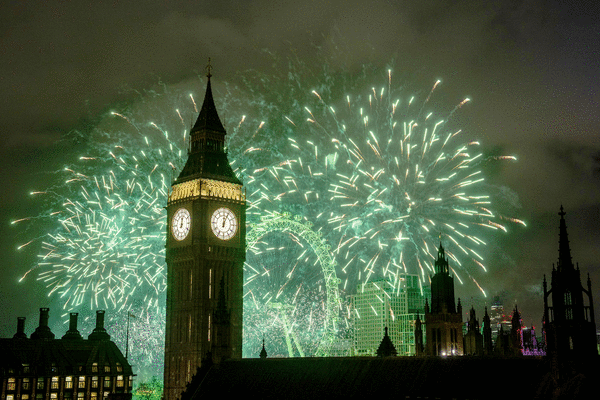
What are you doing New Year’s Eve? Showing up at a friend’s doorstep to smash a plate? Eating a dozen grapes in sync with the 12 chimes of the clock? Perhaps you’re planning to bang a loaf of bread against the wall and then deep-clean your house before midnight. Or maybe you’re bringing luck, love or peace in the new year by putting on a pair of color-coded underwear.
All of these are beloved New Year’s Eve customs in various parts of the globe. But there’s one “tradition” that deserves to be left in the days of auld lang syne: lighting off fireworks.
Explosions in the sky aren’t awe-inspiring for animals — they’re terrifying. While we can count down to midnight and brace for the booms, wildlife have no warning or way to prepare for the deafening din and blinding lights. Startled awake, disoriented and panicked, many animals flee for their lives and are severely injured or even killed.
In the Netherlands, where revelers fire off thousands of tons of pyrotechnics on New Year’s Eve, scientists used weather radar to track birds’ reactions. Before midnight, all was calm. But soon after, the explosions started, and radar activity exploded, too. It showed a surge of frantic flight, with birds shooting up to 500 meters in the sky — far beyond their usual cruising altitude — and flying for 45 minutes.
These unplanned night flights aren’t merely stressful for birds; they’re a threat to their survival. The study notes that fleeing fireworks disrupts birds’ sleep, resting and foraging patterns. It rapidly depletes their vital energy stores and may even compromise their immunity.
A study of Arctic migratory geese in Denmark, Germany and the Netherlands found that some birds disturbed by New Year’s Eve fireworks flew 500 kilometers nonstop — a distance they would normally only traverse during migration — and never returned to their original sleeping sites. Other birds have been killed after slamming into buildings or their panicked flockmates in the dark. In one particularly horrific incident, some 5,000 red-winged blackbirds dropped from the sky — dying or already dead — after a New Year’s Eve fireworks display in Arkansas.
It’s not only birds who are harmed by the aerial onslaught. In California, fireworks scared a young gray fox onto a road, where a car struck her and she became lodged in its grill, dying later from her injuries. Animal shelters also report an influx of lost dogs and cats following fireworks displays. Many arrive with bloody feet or broken bones. Others never make it to shelters — they’re hit by cars or strangled when their collars become caught on fences.
Pyrotechnics are also bad for anyone who breathes: The toxins they spew — including mercury, carbon monoxide, aluminum and sulfur — can increase air pollutants by up to 42%. They leave behind debris that pollutes land and water, and they can spark deadly wildfires that destroy communities of wildlife and humans alike.
In light of all the harm they cause, a growing number of cities are forgoing fireworks and bringing their New Year celebrations into the future with dazzling drone displays or laser light shows. These cutting-edge spectacles not only are quieter, safer and virtually pollution-free but also offer nearly unlimited possibilities for creative expression. They can be choreographed to music and programmed to display images and animations, telling, as one show organizer put it, “a story in the sky.”
But what do spectators think? After the largest free Fourth of July event on the West Coast switched to drones, “the positive responses were overwhelming.’’ Receptions in other communities have been similarly enthusiastic.
New Year’s Eve is a fitting time to leave harmful traditions in the past and embrace kind celebrations. There are plenty to choose from — whether you’re “oohing” and “aahing” at a community drone show or simply toasting with friends at home. Just be sure to wear your lucky underwear.
____
Lindsay Pollard-Post is a senior writer for the PETA Foundation, 501 Front St., Norfolk, VA 23510; www.PETA.org.
___
©2025 Tribune Content Agency, LLC.





















































Comments