Javier Blas: The Suez Canal reopening is a 2026 gift for commodities
Published in Op Eds
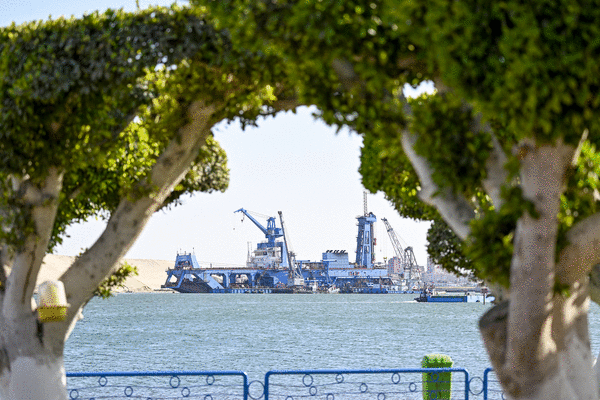
The business of shipping goods around the world has suffered shock after shock since 2000, culminating in the effective closure of the Red Sea and Suez Canal two years ago. Don’t say it too loud, but there’s a good chance the waterway can reopen in 2026, reducing transportation costs and easing the strain on global supply chains.
It's hard to overstate the canal’s importance: It’s a choke point for about 15% of global trade in goods — and double that for container traffic. It’s been effectively closed since November 2023 when the Houthis, a rebel group controlling large swathes of Yemen, started attacking commercial vessels in the southern mouth of the Red Sea, sinking at least four ships, setting ablaze several others and killing several mariners.
The closure forced shipping companies to take the long route around the southern tip of Africa, adding 10 days of sailing time from Asia to Europe and millions of dollars in extra costs. ING Bank NV estimates the detour is currently absorbing around 6% of global fleet capacity due to the longer voyage.
It was the culmination of five chaotic years for the shipping industry, which included the impact of COVID-19, the U.S.-China trade war, the grounding of a huge container ship in the Suez Canal in 2021, and the disruption to Atlantic-Pacific traffic in 2023-2024 due to a drought affecting the Panama Canal.
The Houthi attacks have decreased after the U.S. brokered a ceasefire between Israel and Hamas in Gaza in late September. It’s a fragile respite, but if it holds — a big if — it would allow traffic to resume through the waterways. Officially, the world’s top shipping companies and the largest commodity traders say the canal route is still closed. Quietly, however, they are testing the waters, sending single ships, including some of the world’s largest container vessels, up and down the Red Sea to see what happens. So far, the vessels have crossed without problem. The number of vessels crossing the canal hit the highest in more than a year and a half in November, according to data compiled by Bloomberg.
Crucially, some companies are now taking steps that go beyond single-vessel tests and are more akin to a partial reopening. Take CMA CGM SA, the French company that’s the world’s third-biggest shipping operation. For the first time in two years, it’s committing to a regular service from India to the U.S. eastern coast via the Suez route starting in early 2026. Others are keeping mum about their schedules, but are signaling their wait-and-see stance could change soon. “If the ceasefire holds, then I think we've crossed a gate and made a big step towards returning through the Red Sea,” Vincent Clerc, head of shipping giant AP Moller - Maersk A/S, said last month.
The industry has three good reasons to remain cautious, however.
The first is Yemen – and Gaza. The two ongoing conflicts are linked, and the calm in the Red Sea depends on sustaining the peace between Israel and Hamas. If the deal collapses, the Houthis could restart their attacks against vessels.
The second is that shipping companies are eager to avoid so-called double disruption: the risk of returning to the Red Sea too early only to have to switch back again to the long route around Africa if the Houthis renew their terrorism. That uncertainty calls for testing the Suez route with limited sailings, perhaps for as long as six months, before contemplating a full resumption, industry executives say. The more likely scenario is that container ships will initially take the long route around Africa when sailing from Asia to Europe fully loaded and keeping to schedules is crucial. On their backhaul sail to Asia, they may test the Suez route, as they carry fewer goods and timing isn’t as important.
The third is that insurance costs remain very high for the Red Sea, denting the economics of the route. On top, fuel oil prices have crashed to a five-year low of $350 a metric ton from a peak of more than $500 in 2003, reducing the extra costs of the trip around Africa. Put both together, and the financial incentive to switch back to the canal route is low.
“We think this will take a couple of quarters to gradually unwind the re-routing,” Constantin Baack, the head of MPC Container Ships ASA, recently told investors. “It's about balancing security, insurance, network adjustments, potential congestions, et cetera.”
There’s an unspoken fourth reason for caution: money. The moment the canal reopens, freight rates will nosedive as roughly 6% of global capacity suddenly isn’t needed to support the extra miles the route around Africa created. Already, container shipping costs are coming down in anticipation. The industry’s benchmark has fallen to about $2,000 per 40-foot (12-metre) box, down from almost $4,000 at the beginning of the year and more than $10,000 during the peak in 2021, according to Drewry World Container Index. Further declines are likely if the logistics picture improves.
Transportation costs aren’t the only price measure likely to affected by an easing of shipping friction. Oil prices could come under pressure too, as the boost voyaging around Africa gave to fuel-oil consumption fades. Other commodities could also come under pressure, as the potential disruption to supply chains that prompted companies to hold higher stockpiles as a precaution against shocks fades.
After five chaotic years, few shipping executives want to tempt fate by talking up the chances of the reopening of the Red Sea route. But finally there’s light at the end of the, ahem, canal.
____
This column reflects the personal views of the author and does not necessarily reflect the opinion of the editorial board or Bloomberg LP and its owners.
Javier Blas is a Bloomberg Opinion columnist covering energy and commodities. He is coauthor of “The World for Sale: Money, Power and the Traders Who Barter the Earth’s Resources.”
©2025 Bloomberg L.P. Visit bloomberg.com/opinion. Distributed by Tribune Content Agency, LLC.


















































Comments